How to Explain and Promote Tap-to-Give Plates to Your Congregation
Two jobs, not one. The first is explaining how the plates work in language your congregation actually uses. The second is promoting them across enough channels that nobody can say they didn't know. Here's the playbook for both, without turning every Sunday into an infomercial.
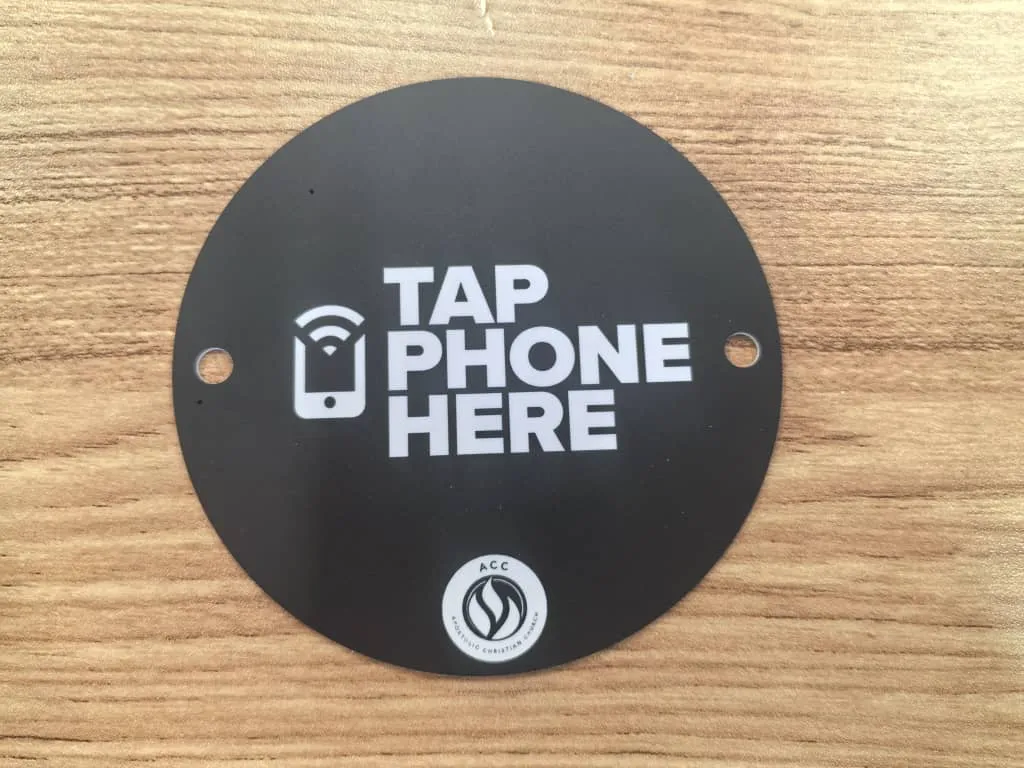
The two-job framing
Most churches collapse "explain" and "promote" into a single Sunday announcement and wonder why adoption stalls at 10%. They're separate jobs. Explain is a one-time understanding problem (people need to know how it works). Promote is an ongoing visibility problem (people need to be reminded every Sunday that it's there). Treat them as one and you'll either over-explain to people who already get it or under-promote to people who forgot.
See your church's plate and price in 30 seconds
Design it yourself on the next page. From $3.50 per plate, free shipping, no monthly fees.
Part 1, Explaining the plates
Your goal in the first three weeks is to get every regular attender past the “wait, how does this work?” threshold. After that, you can shift entirely to promotion. Here's what works.
Lead with the analogy, not the technology
The single best line we hear from pastors who nail the launch: “It works just like tapping your phone at the coffee shop.” That sentence does more work than any 90-second technical explanation, because tap-to-pay is the most common payment experience in the country now, even your most tech-averse members have seen someone do it.
Don't say NFC. Don't say RFID. Don't say contactless protocol. The acronyms create a wall. “Tap your phone to the plate” works. (We have a full breakdown in 8 Things to Say (and Not Say) When Introducing NFC Giving.)
Demo from stage in under 15 seconds
A live demo beats every other form of explanation. Hold your phone up. Tap the plate. The giving page opens on the projected screen behind you. People see it work. The whole thing takes ten to fifteen seconds. Then say one sentence: “That's it. No app, no QR code, no card to fish out.” Sit down.
Name what it isn't
The most common reason people don't engage with new giving tech is that they think it's replacing something they like. Older members worry the passing plate is going away. Cash-only givers worry they're being asked to switch. Online givers wonder if their recurring gift is moving.
Get ahead of all three in one sentence: “We're adding this for anyone who'd rather tap than fumble with cash or a card. Everything else stays exactly as it is.” This single line probably matters more than your entire technical explanation.
Frame the "why" before the "how"
If you only have one minute, spend the first thirty seconds on why and the last thirty on how. The why is: “Most of you don't carry cash anymore. We don't want generosity to depend on whether you remembered your checkbook.” The how is the demo. Pastor-led, mission-anchored intros land twice as well as “announcements” that feel like commercials.
Part 2, Promoting (the ongoing job)
Once your congregation understands what the plates are, the work shifts to keeping them top-of-mind during the offering moment. This is where churches drop the ball. They announce it for two Sundays, then go silent, and adoption flatlines. Here's the multi-channel cadence that compounds.
Stage moments
Every offering moment includes one sentence: “You can give in the offering as it passes, online, or tap your phone to the plate in front of you.” That's the whole script. Three options, no preference, no over-explaining. Once it's part of the routine it disappears into normal worship rhythm.
Bulletin / connect card
A single line on the giving section: “Give by passing plate, online at /give, or tap your phone to the disc on the pew.” List all three options together so the new one looks normal next to the old ones.
Pre-service slide loop
If you run a pre-service slide deck, add one slide: a phone tapping a plate, two words ("Just tap"), and the URL. People look at the screens before service starts, this is high-leverage real estate that costs you nothing.
Church app / push
If you use Subsplash, Nucleus, Planning Center, or Tithely's app, add a "Give" button that opens the same giving URL the plate opens. The tap and the app should land on the same page so there's no parallel system to maintain.
Monthly email
In your monthly member email, the giving line should read: “Ways to give: in the offering, online at [URL], or tap your phone to a plate at church.” Don't make tap-to-give its own announcement, embed it in the existing giving block.
Social / sermon clips
When you post a sermon clip or worship moment to Instagram or Facebook, your church-app or website link in bio can include a one-line “Give in 5 seconds” with the giving URL. New attenders find this before they find your bulletin.
The 3-phase rollout cadence
Phase 1 (Weeks 1-3): Active explanation
From-stage demo every Sunday. Bulletin and slide-loop mention. Greeters told to point at a plate when they hand out the bulletin. You are deliberately repetitive. The goal: every regular attender sees a demo at least once.
Phase 2 (Weeks 4-8): Casual mention
Drop the demo. Just mention it as one of the three giving options in every offering moment. “Give in the plate, online, or tap.” That's the whole script.
Phase 3 (Week 9+): Infrastructure
It's part of the room now. The plate is on every pew, the line is in every bulletin, the slide is in every pre-service loop. You stop talking about it specifically; it talks for itself. New visitors notice the plate on their seat the same way they notice the hymnal, just normal.
Part 3, Handling the inevitable pushback
You will get questions. Most of them come from a place of care, not opposition. Here are the three you'll get most often, and how to answer each in one or two sentences.
“What about people who don't have smartphones?”
The passing offering plate isn't going anywhere. Tap is one more option for the people who'd actually use it, not a replacement for anyone. (This is also where the “include, don't replace” framing earns its keep.)
“Is this safe? Where does my information go?”
The plate is just a piece of plastic that opens a webpage when tapped. It doesn't read anything from the phone. The webpage is your existing giving page, the same one you'd visit if you went to [your-church].org and clicked Give. Nothing changes about how donations are processed.
“Why are we doing this? Aren't we doing fine?”
A pastoral answer beats a logistics answer here. Something like: “Most of our visitors and a lot of our regulars don't carry cash. We don't want generosity to be limited by what someone happened to bring with them on Sunday.” That framing, generosity, not technology ”
Part 4, Recruit 5-10 visible champions
The fastest accelerator we see at churches that nail rollouts: identify five to ten members who are already comfortable with tap-to-pay, and ask them to be the first visible users. Greeters, worship-team members, deacons, ushers, anyone with public visibility.
Their job is simple. During the offering, they take out their phone, tap a plate, and put their phone back. They don't need to make a show of it. They just need to be the first ones to do the thing, so the rest of the congregation has permission and a model. Most people won't try something new until they've seen one or two trusted faces do it first.
This is how every successful behavior shift in a church spreads. Not from announcement, from imitation.
Part 5, Know whether it's working
Your giving platform's analytics will tell you within a month whether the rollout is working. The two numbers that matter:
- Number of mobile-source gifts in the first 4 Sundays vs. the 4 Sundays before launch. Healthy rollouts see 2-5x mobile gift volume by Sunday 4.
- Average gift size from mobile vs. cash/check. Tap-source gifts tend to run higher than cash because people give what feels right, not what happens to be in their wallet. Many churches see a 2-3x lift here.
If mobile gifts haven't moved by Sunday 4, the issue is almost always promotion (people forgot the plates exist) rather than explanation. Add the slide-loop image, double up the bulletin line, and recruit two more champions.
Ready to put plates in every pew?
One-time hardware. No monthly fees. Works with whatever giving platform you already use. From $3.50 per plate.