What Brady Shearer Says About NFC Tap-to-Give (And How to Use It at Your Church)
Brady Shearer reaches more pastors than almost anyone in church tech. He’s been hammering on one idea for years: friction kills engagement, and tap removes friction. Here’s what he’s saying about NFC giving and how to act on it without locking yourself into another monthly subscription.
Who is Brady Shearer?
Brady Shearer is the founder of Pro Church Tools, host of The Pro Church Tools Show podcast, and the maker of Nucleus (a church website builder used by 3,000+ churches) and Faith.Tools (a church-software directory). On TikTok alone he has 116K followers and nearly a million likes. His tagline: “helping churches navigate the biggest communication shift in 500 years.” When Brady talks, church communicators listen.
See your church's plate and price in 30 seconds
Design it yourself on the next page. From $3.50 per plate, free shipping, no monthly fees.
1. The “one tap away” thesis
If you read Brady’s work for any length of time, you keep running into the same idea: every step you ask someone to take is a chance for them to drop off. The pitch for his Nucleus product literally describes the headline feature as putting “every next step one tap away.” That’s not marketing fluff, it’s a worldview.
Applied to giving, the math is brutal. A visitor wants to give. You hand them a QR code, they squint at their phone, the camera opens, they tap the link, the giving page loads, they pinch and zoom to fill out the form, they fumble with their card. Every one of those steps loses a percentage. The traditional offering plate adds even more steps, cash, check, envelope, signature.
NFC compresses the entire interaction to: phone touches plate → giving page opens. One step. One tap. That’s the thesis Brady is selling, and the data backs it up, NFC engagement runs roughly fewer steps than a QR code across consumer benchmarks.
2. Where you see Brady talking about NFC
Brady doesn’t have one definitive “NFC for churches” manifesto. He’s done something more useful: he’s woven tap-to-give into the fabric of every product he ships and every directory he curates.
- Nucleus, the Launcher. The signature feature of his website product is called the Launcher: a sticky element that puts giving, connect cards, prayer requests, sermon notes, and event signups “one tap away” from the home page. Tap is the load-bearing word.
- Faith.Tools, NFC giving as a top-tier feature. Brady built Faith.Tools as a directory of best-in-class church software. Look at the top giving listings and you’ll see “NFC tap” called out as a headline capability on Tithely, Pushpay, Subsplash, Overflow, and SecureGive. If you treat his directory as a signal of where the category is heading, NFC giving is no longer an edge experiment, it’s table stakes for any modern giving platform.
- TikTok and Instagram. Brady has actively posted about NFC tags on church chairs. One January 2026 Instagram reel ended with: “Next-level church engagement is just a tap away. You ready to tap in?” His TikTok community has shared multiple videos under the “NFC tags on church chairs” theme.
- Brand alignment. Subsplash’s own marketing for Subsplash Tap uses Brady’s audio: “don’t let your tools outpace your mission… equip your church to give in the moment.” His voice is being borrowed by NFC giving providers because it carries weight in the audience.
In short: Brady is bullish on NFC. He hasn’t had to write a 5,000-word manifesto because he’s busy actually shipping the future he’s describing.
3. The implicit recommendation
Reading between the lines, here’s what Brady is telling church communicators:
- Remove every step you can. If you can get from “I want to give” to “my gift is in” in fewer than 30 seconds, you’ll outperform 90% of churches.
- Meet people on their phones. Nobody carries cash. Nobody wants another app. Tap to a URL is the lowest-friction bridge between a physical sanctuary and a digital wallet.
- Make giving a visible part of the room. Brady’s “perception design” framing applies here, a plate on every seat tells visitors that giving is normal, expected, and frictionless. A passing offering plate sends a different message.
- Treat it as infrastructure, not a campaign. The plates aren’t a one-off “digital push”, they’re part of the building, like signage.
Almost everything in Pro Church Tools content circles back to this idea: people are willing to engage, but the church has to remove the obstacles. NFC plates remove the biggest obstacle to in-service giving.
4. How to actually roll this out
If you’re convinced by Brady’s argument (and you should be), here’s a five-step path to live in 30 days.
Step 1. Pick one URL to tap to.
Use your existing giving page. Don’t change platforms, don’t build a new microsite. If you’re on Tithely, Pushpay, Subsplash, Givelify, Donorbox, Anedot, Planning Center Giving, Realm, Breeze, whatever, that URL becomes what every plate opens. NFC is platform-agnostic. (See our platform-specific setup guides if you want a walkthrough.)
Step 2. Order enough plates for every seat.
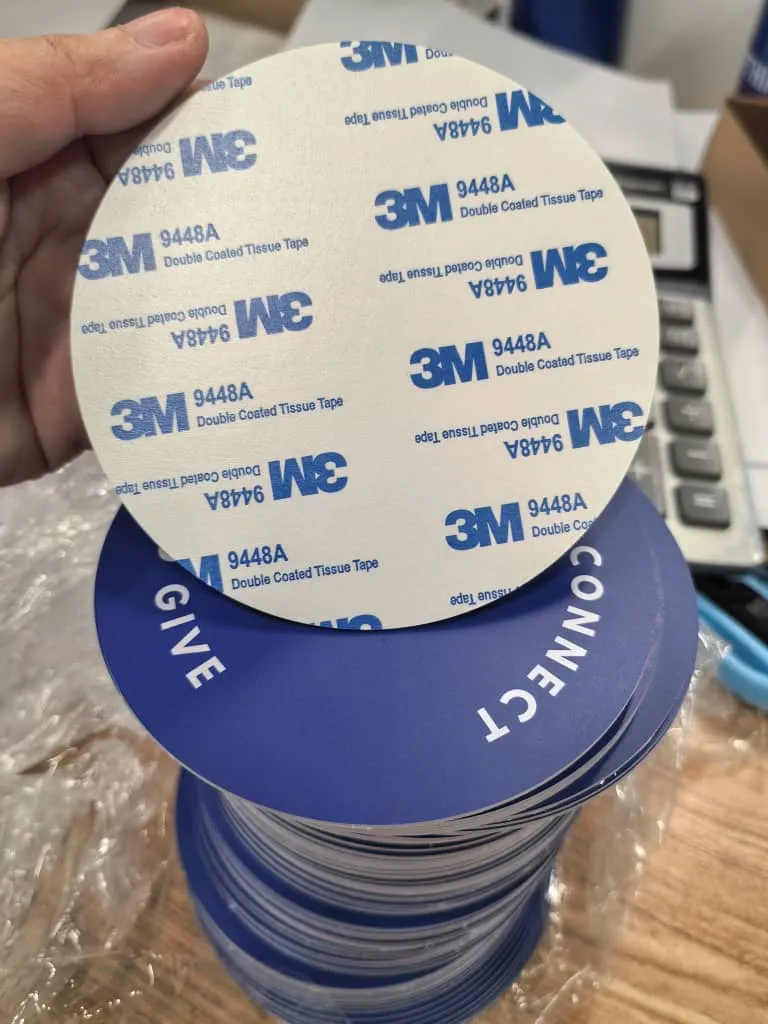
This is the part most churches get wrong. They buy 10 plates “to test” and put them at the welcome desk, where nobody notices them. Brady’s perception-design point applies: one plate per seat tells the congregation that this is the norm. Plates start at $3.50 each in volume, so a 300-seat sanctuary is about $1,050, less than one month of a typical Pushpay or Subsplash subscription.
Step 3. Mount them where people actually look.
Back of the pew in front of them. Back of the chair in front of them. Where the hymnal would be. Not the lobby, not the welcome center, not the bathrooms. The moment of decision for most givers is during worship or the offering, and the plate has to be at arm’s reach right then. Brady’s “one tap away” thesis only works if the tap target is right there.
Step 4. Announce it from stage, then stop announcing it.
Two Sundays of explanation from the platform (“tap your phone to the plate, give in 10 seconds, you’re done”), then it’s infrastructure. Don’t turn every offering moment into a 90-second NFC infomercial. Once people know it’s there, the plate sells itself every week.
Step 5. Reprogram plates for other “next steps.”
This is the Pro Church Tools playbook in action. Once your congregation is trained to tap, you can put plates near the welcome desk pointing to a connect card, near the kids’ check-in pointing to your volunteer form, near the prayer wall pointing to a prayer-request page. Tap.Giving plates are reprogrammable, so a single plate isn’t locked to giving forever. Brady’s Launcher does this digitally; NFC plates do it physically.
5. The honest difference between us and the platforms Brady features
Faith.Tools is great for shopping. It surfaces excellent platforms, Pushpay, Tithely, Subsplash, Overflow, SecureGive, that all now offer NFC tap-to-give as part of an all-in-one bundle. If you already pay one of them every month, ask whether they include NFC plates and how many. Many do.
The catch: those bundles charge ongoing fees. Pushpay runs roughly $1,475/mo. Tithely’s Elevate is ~$119/mo. Subsplash and Overflow have their own tiers. The plates themselves are often expensive (Pushpay’s VisitorTap was famously $59.95/mo per disc, with 500-unit minimums for branding).
Tap.Giving is the other path. We sell the hardware only. We don’t process your gifts, we don’t store your donor data, we don’t bill you next month. Buy plates once at $3.50 to $5.00 each, point them at whatever giving page you already use, and you’re done. If you already have a giving platform you like, you don’t need to switch, you just need the hardware to make the tap thesis real in your sanctuary.
Both paths get you to Brady’s “one tap away” future. Pick whichever one matches your budget and your existing stack.
FAQ
Has Brady Shearer reviewed Tap.Giving?
No. We’re not affiliated with Pro Church Tools, Faith.Tools, or Nucleus, and this article isn’t endorsed by Brady. It’s our read of the public arguments he makes about church engagement and how those arguments apply to NFC giving hardware specifically.
Do Tap.Giving plates work with Nucleus?
Yes. NFC plates store any URL you want. If your Nucleus site has a giving page, a Launcher item, a connect form, or a prayer page, the plate can be programmed to open any of those. You don’t need Nucleus to use our plates, but if you have it, they’re fully compatible.
What about Faith.Tools’s recommended giving platforms?
Every platform in the Faith.Tools giving directory will work with our plates: Pushpay, Tithely, Subsplash, Overflow, SecureGive, Givelify, Donorbox, Anedot, Planning Center Giving, Realm, Breeze. We program each plate to your giving page on whatever platform you use. We don’t compete with the platform, we just provide the physical tap target.
That number comes from consumer engagement benchmarks across NFC marketing campaigns (most often cited from GSMA / Identive industry data). It’s not a church-specific stat, but the underlying reason holds in church contexts: NFC removes the camera-app step QR codes require, and that single step kills a huge share of conversions. We unpack the comparison in QR Codes vs NFC for Church Giving.
Make Brady’s “one tap away” future real in your sanctuary
One-time hardware. No monthly fees. Works with whatever giving platform you already use. From $3.50 per plate.