See your church's plate and price in 30 seconds
Design it yourself on the next page. From $3.50 per plate, free shipping, no monthly fees.
The Contactless Church Collection Plate: A Modern Offering Plate for 2026
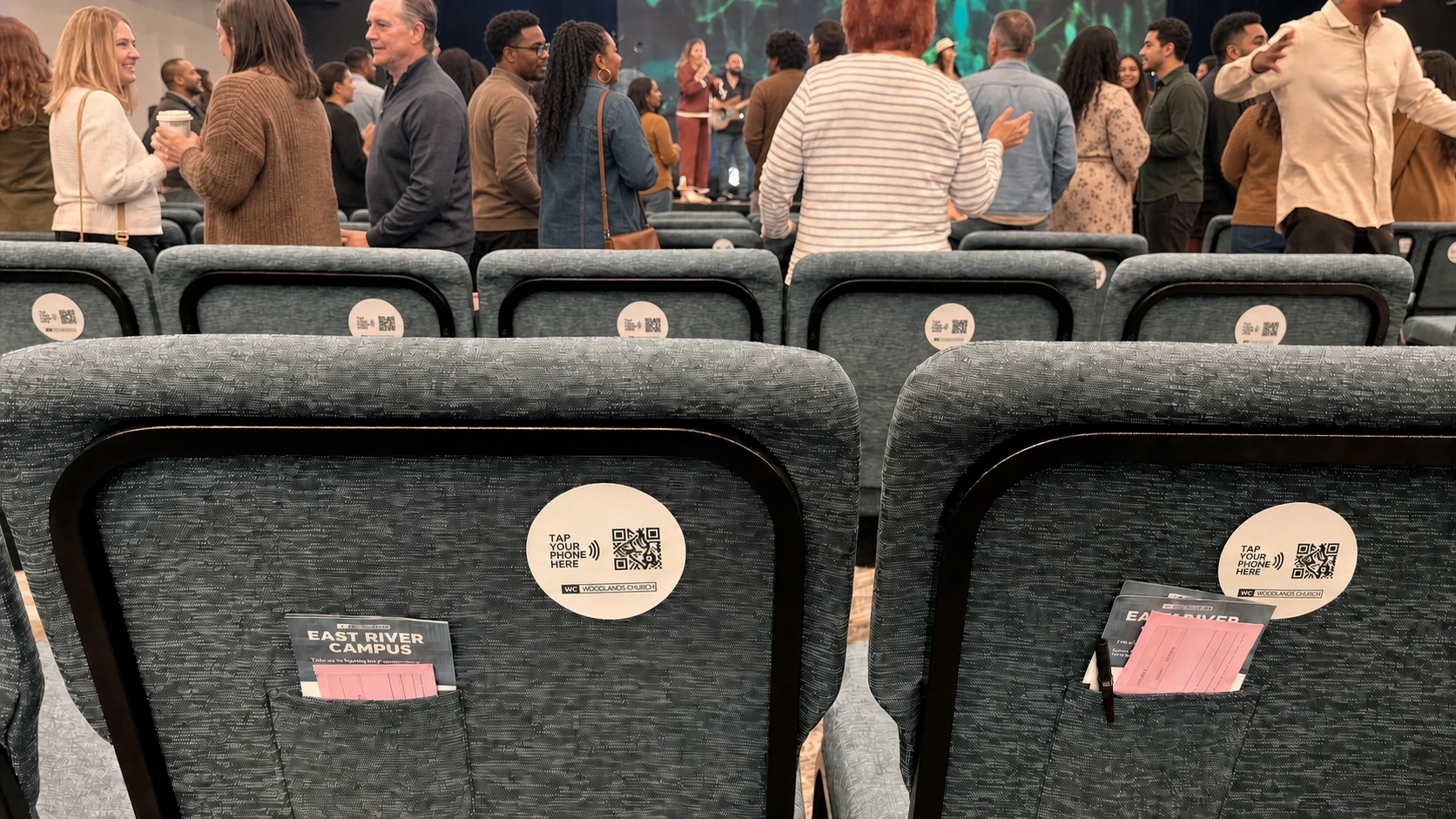
A contactless church collection plate is an NFC-enabled disc or plate that sits on the back of a pew or chair. When a congregant taps their phone on it, the church's giving page opens in their browser and they complete the donation with Apple Pay, Google Pay, or a card, typically in under 30 seconds. It replaces or supplements the traditional passed offering plate. Tap.Giving contactless collection plates cost $3.50 to $5.00 each with no monthly fees, work with any giving platform, and a 100-seat church can be fully equipped for $500 one-time.
Quick Answer: What Is a Contactless Church Collection Plate?
A contactless church collection plate is a small, rigid disc, usually about 4 inches across, mounted on the back of a pew, chair, or seat. Inside the plate is an NFC chip programmed with your church's giving page URL. There is no battery, no app, and no kiosk. A congregant simply holds their phone close to the plate, the giving page opens in their browser, and they finish the gift with the wallet they already use every day.
Most pastors find it easiest to think of the contactless collection plate as a modern offering plate: it sits in the same place a passed plate would land, it does the same job, and it works for the people in the room who simply do not carry cash anymore. It is a digital church collection plate that complements, not replaces, the practices your church already loves.
At Tap.Giving we sell the hardware: a one-time per-plate cost, free shipping, and no monthly fees. Your existing giving platform (Tithely, Pushpay, Subsplash, Givelify, Donorbox, Anedot, Planning Center, Breeze, or anything else) handles the actual transaction. We just put the giving page one tap away from every seat.
Why Churches Are Moving Beyond the Traditional Offering Plate
The plate still works. The wallets are different.
The traditional offering plate has done faithful work for centuries, and it still has a place. The challenge isn't the plate, it's that the wallets in the pews look very different than they used to. The Pew Research Center found that about 41% of Americans now make none of their weekly purchases with cash, up from 29% in 2018 (Pew Research Center). Among younger congregants that share is higher; many have never owned a checkbook and rarely carry physical bills. When the plate passes, they want to give. They have nothing to put in.
That's why a growing number of pastors are adding a contactless collection plate alongside the traditional one. It removes friction without changing your liturgy. It honors the moment of offering without forcing anyone to remember an app, a username, or a password.
of Americans make none of their weekly purchases with cash, up from 29% in 2018 (Pew Research Center).
nothing for a visitor to download
versus three steps for a QR code
to give from your seat, no app to install first
in fees from us, you keep the giving platform you already use
is almost fully digital, if you want them to give, the giving moment has to meet them on a phone.
How a Contactless Collection Plate Works
Three steps. No app. No kiosk. No friction.
Tap
A congregant holds their phone near the contactless plate on the pew or chair in front of them. iPhone and Android phones from the last several years are NFC-ready by default, nothing to enable.
Give
Your church's giving page opens in the phone's browser. The congregant chooses an amount, taps Apple Pay, Google Pay, or pays by card. Most gifts are completed in under 30 seconds.
Done
The gift lands in the same giving platform you already use, same reporting, same receipts, same donor records. The congregant returns to worship without ever opening an app store.
Want a deeper walkthrough? See how it works or read about the Tap.Giving plate itself.
Contactless Collection Plate vs Traditional Offering Plate
Two different jobs. Best when used together.
| Feature | Traditional Offering Plate | Contactless Collection Plate |
|---|---|---|
| Best For | Cash and checks | Phones, cards, digital wallets |
| Reaches Gen Z & cashless givers | Limited | Yes |
| Counting / deposit work | Manual count, bank deposit | Automatic in your platform |
| Donor record / receipt | Envelope required for record | Automatic email receipt |
| Available between services | Only when passed | 24/7 |
| Cost | One-time wood/metal plate | $3.50 to $5.00 per plate, one time |
| Honors tradition | Yes | Yes, sits quietly alongside |
Contactless Collection Plate vs Digital Giving Kiosk
Same goal, very different costs and footprints.
| Feature | Giving Kiosk | Contactless Collection Plate |
|---|---|---|
| Hardware Cost | $1,500 to $5,000+ per kiosk | $3.50 to $5.00 per plate |
| Where giving happens | Lobby / fixed location | Every seat in the room |
| During the offering moment | Awkward, have to leave the seat | Tap from your seat |
| Maintenance | Updates, screens, network | None |
| Monthly fees | Often $50 to $200+/mo | $0 |
Considering a kiosk? Read our deeper take on contactless plates as a giving kiosk alternative.
What to Look For in a Contactless Collection Plate
Not all NFC discs are built for weekly worship use.
Size & Shape
A 100mm (4-inch) rigid plate is the sweet spot. Big enough to find by feel during a service, small enough to mount on any pew or chair back.
Chip Type
Look for NTAG213/215/216 chips with reliable read range and broad iPhone/Android compatibility. The chip should be sealed inside the plate, not exposed.
Mounting
A strong adhesive back is standard. For chairs, look for pre-drilled screw holes. For permanent installs, pre-drilled screw holes are ideal.
Durability
Sealed, scratch-resistant plates last years of weekly tapping. There are no batteries to replace and no firmware to update.
Custom Branding
Your church logo, colors, and a clear "Tap to Give" instruction help first-time guests use the plate without any explanation.
Platform Freedom
A good contactless plate is platform-agnostic. The chip points to whatever giving page URL you choose, Tithely, Pushpay, Subsplash, or anything else.
How Much Does a Contactless Church Collection Plate Cost?
One-time hardware. No monthly fees. No transaction fees from us.
A 100-seat church can be fully equipped for $500 one-time.
Free shipping. No subscription. No setup fee.
A 250-seat sanctuary fully equipped for $1,000 one-time.
Most popular tier for mid-size churches.
A 500-seat campus fully equipped for $1,750 one-time.
Best value for large or multi-site churches.
The first-order discount takes 10% off and lasts 7 days from your quote, renewing if it lapses so you never lose it.
Compare full tiers and bundles on the pricing page.
Where to Mount Them in the Sanctuary
The goal: a contactless collection plate within arm's reach of every seat.
Pew Backs
The classic placement. Mount one plate centered on the back of each pew, just below the hymnal rack. Adhesive backing handles wood, laminate, and most fabrics.
Stackable Chairs
Screw-mount into the chair frame, or if you cannot modify the seating at all, put the plates on a welcome desk or entry table instead.
Theater-Style Seating
Mount on the seat back in front of the congregant, similar to airline tray-table placement. Pre-drilled holes for permanent installation are available.
Foyer / Welcome Center
A few extra plates on the welcome desk and near the exits cover guests who decide to give as they leave. Anyone who wants to give can find a plate.
Kids & Student Ministries
Parents often pick up children right after service. A plate in the kids' area lets caregivers give while they wait.
Events & Special Services
Carry a stack to weddings, conferences, missions banquets, and outdoor baptisms. Plates are mobile and platform-agnostic.
Do Traditional Offering Plates Still Have a Place?
Yes, absolutely. The hybrid model is what works best.
The moment of offering matters. Pastors have been right to protect it. The passing of the plate is a posture of worship, a moment where the whole body of Christ participates together. We are not asking churches to give that up.
What we have seen, again and again, is that the most generous churches are the ones that keep the traditional offering plate and add a contactless collection plate alongside it. The cash giver gives cash. The check writer writes a check. The 24-year-old who has not carried a wallet since college taps her phone. Every kind of giver is honored, and the offering moment stays whole.
Think of the contactless plate the way you think of online giving: a quiet, faithful option that meets people where they actually are. It is a modern church collection plate, an electronic church collection plate, that simply joins the practice you already love.
Frequently Asked Questions
Everything pastors ask before adding contactless plates.
Is a contactless collection plate the same as an NFC plate?
Yes. A contactless church collection plate is the consumer-facing name for an NFC-enabled disc or plate. The plate contains a small NFC chip programmed with the church's giving page URL. When a phone is tapped on the plate, the URL opens in the browser. "Contactless collection plate", "tap-to-give plate", "NFC giving plate", and "digital offering plate" all describe the same hardware. For a deeper comparison with paper alternatives, see our piece on NFC tap plates vs connect cards.
Do we have to stop passing the traditional offering plate?
No. Most churches we work with run a hybrid model. They keep passing the traditional offering plate during the service and add a contactless collection plate to every pew or chair. The two work together: members who carry cash or checks use the passed plate, and members who don't carry cash tap the contactless plate. Hybrid is what works best.
What do congregants who prefer cash do with a contactless collection plate?
Nothing changes for them. The contactless plate is an additional option, not a replacement. Congregants who give cash or check continue giving exactly as they always have. The contactless plate is there for the increasing number of people who simply do not carry cash anymore. The Pew Research Center found that about 41% of Americans make none of their weekly purchases with cash, up from 29% in 2018, and that share is even higher among younger congregants.
How durable are contactless collection plates for weekly use?
Tap.Giving plates are 100mm rigid plates with a sealed NFC chip and a strong adhesive back. They are designed for permanent installation on pew backs, chair frames, or seat-back hardware and are rated for years of weekly tapping. There are no batteries to replace, no software to update, and no moving parts. If a plate is ever damaged, replacing it costs only the per-plate price.
Can we use contactless plates with Tithely, Pushpay, or Subsplash?
Yes. Tap.Giving contactless collection plates are platform-agnostic. The NFC chip simply opens whatever URL you provide. If your church uses Tithely, Pushpay, Subsplash, Givelify, Donorbox, Anedot, Planning Center, Breeze, Realm, Nucleus, Clearstream, or any other giving platform, we encode each plate with your existing giving page URL. There is no integration work and no platform switching.
Can we use contactless plates for weddings, conferences, or fundraising events?
Yes, and a growing number of churches are doing exactly that. Because the plates are mobile and platform-agnostic, you can place them on registration tables at conferences, in foyers during special offerings, at fundraising events, missions banquets, or even at outdoor baptisms. Anywhere you would historically pass a basket or set out a donation jar, a contactless collection plate works.
Add a Contactless Option Alongside Your Traditional Plate
Keep what you love. Add what your congregation needs. A contactless church collection plate at every seat, one-time hardware, no monthly fees, works with the giving platform you already use.
No monthly fees · Works with any giving platform · 5-minute setup
Related Articles
The Modern Offering Plate
How the offering plate is evolving for cashless congregations.
ComparisonNFC Tap Plates vs Connect Cards
How a reusable tap plate compares with paper connect cards for giving.
ComparisonGiving Kiosk Alternative
Why contactless plates outperform expensive lobby kiosks.
Want to see what plates would cost for your church?
One-time hardware from $3.50/plate. No monthly fees, no transaction fees. Works with whatever giving platform you already use.
Free shipping, delivery 2-3 weeks from artwork approval. Built by a pastor, with a typical reply under 24 hours.