NFC Giving for Methodist Churches: Modernizing the Collection Without Losing Tradition
Methodist churches value order, liturgy, and faithful stewardship. NFC tap-to-give plates fit right into that tradition, letting every congregant give digitally during the offering, without an app, a subscription, or a single change to your worship flow.
See your church's plate and price in 30 seconds
Design it yourself on the next page. From $3.50 per plate, free shipping, no monthly fees.
1. Why NFC Giving Fits the Methodist Tradition
With roughly 30,000 United Methodist Church congregations in the United States, plus thousands of Free Methodist, African Methodist Episcopal, and other Wesleyan-tradition churches, Methodism is the third-largest Protestant denomination in the country. NFC giving for Methodist churches makes sense because of something deeply embedded in the Wesleyan DNA: order and intentionality.
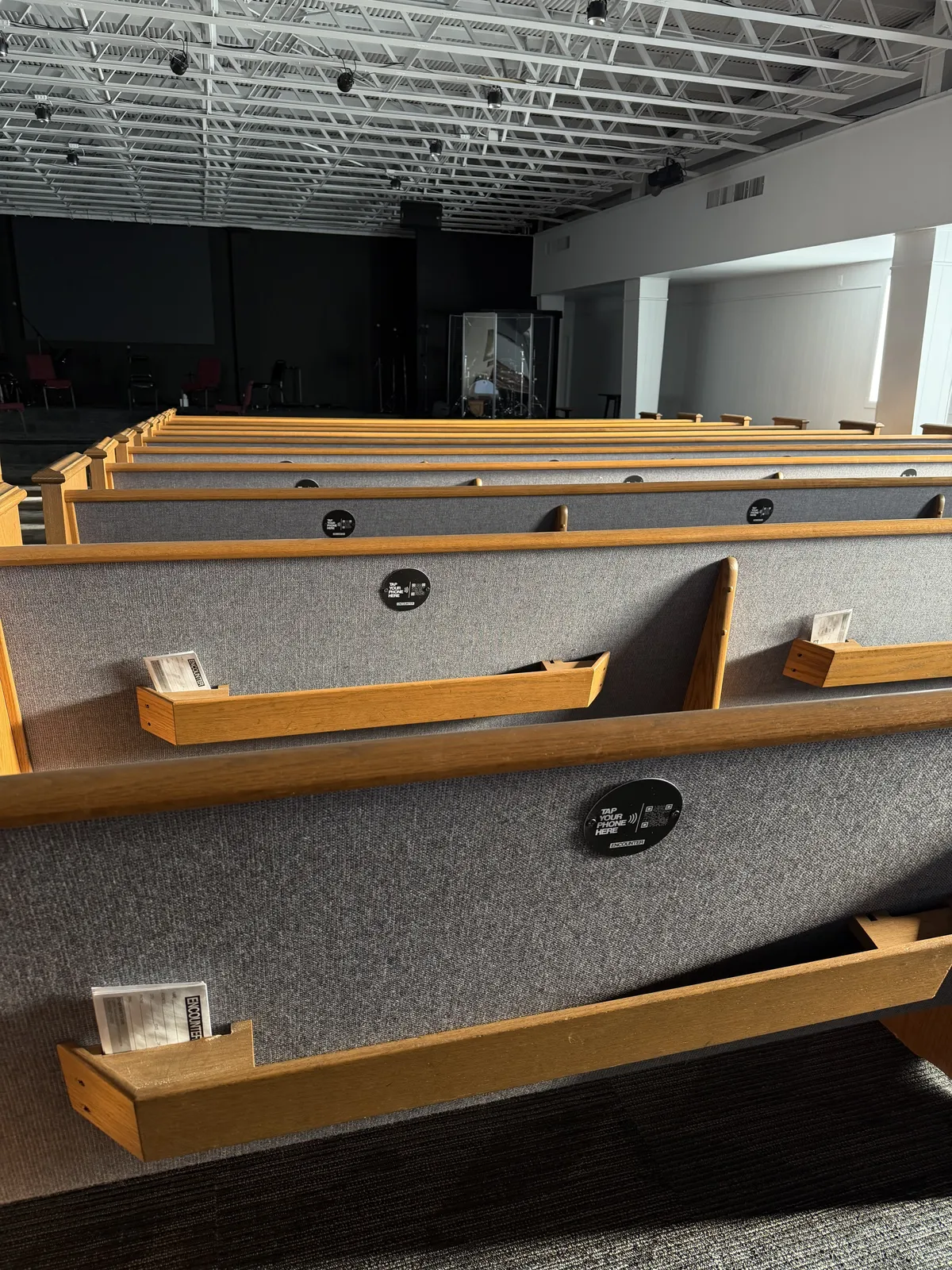
Methodists follow a structured liturgy. The offering isn’t a casual aside, it’s a moment of worship woven into the order of service. NFC tap-to-give plates honor that structure. They mount on pew backs or chairs, quietly available during the offering. No announcements about downloading an app. No QR codes taped to the bulletin. Just a plate that works when a congregant taps their phone. Other liturgical traditions land in the same place: our guide to NFC giving for Lutheran churches walks through the identical fit inside a Divine Service.
John Wesley himself was famously practical about money, “earn all you can, save all you can, give all you can.” NFC giving removes the barriers that keep willing givers on the sidelines. It’s stewardship technology that Wesley would have appreciated: simple, affordable, and effective.
Order and Structure, Not Disruption
Many Methodist congregations have resisted digital giving not because they oppose technology, but because most solutions require disrupting the worship flow, projecting QR codes, announcing app downloads, or replacing the offering moment entirely. NFC plates take the opposite approach. They fit into the existing liturgy. The offering still happens at the same time, in the same way. The plates are simply there for those who don’t carry cash.
2. How NFC Tap-to-Give Works in a Methodist Worship Service
NFC stands for Near Field Communication, the same technology behind tap-to-pay at a store. For a deeper technical overview, see our complete church giving technology guide. Here’s how it works during a typical Methodist worship service:
The Offering Begins
The service follows its normal liturgical order. During the offering, the pastor invites the congregation to give, and mentions they can tap the plate on their pew.
Congregant Taps Their Phone
They hold their phone near the plate for one second. The church’s giving page opens instantly in their browser. No app needed.
They Give
They enter their amount and complete the gift through your church’s existing giving platform. The whole process takes under 30 seconds.
The key for Methodist congregations is that the Doxology still gets sung, the ushers still bring the plates forward, and the prayer of dedication still happens. NFC plates don’t replace any of that. They add a quiet option for the growing number of people who haven’t written a check in years.
The data supports the shift. Churches using NFC tap-to-give report an higher in-service participation and 3x higher average donations compared to cash. NFC is also fewer steps than a QR code for engagement, because tapping is faster and more intuitive than scanning.
3. NFC Giving for Methodist Churches Navigating Budget Pressures
The United Methodist Church has experienced significant upheaval in recent years. Thousands of congregations have disaffiliated. Those that remain in the UMC, and those that have gone independent, are recalibrating budgets, renegotiating apportionments, and making hard choices about where every dollar goes.
When your church is already paying apportionments, funding a pastor’s salary, and maintaining a building that’s probably older than most of the congregation, adding a $1,400/year giving platform subscription is a tough ask. Adding a $20,000/year enterprise solution is out of the question.
This is why NFC giving plates resonate with Methodist church leaders. It’s not a subscription. It’s a one-time purchase.
A UMC Church Rebuilding After Disaffiliation
Picture a mid-size United Methodist church in the suburbs. After a painful disaffiliation vote, attendance dropped by a third. The budget is tight. The finance committee is reviewing every line item. Someone suggests upgrading the church’s digital giving. The committee chair winces, they just cut two subscriptions last month.
Then the church administrator pulls up Tap.Giving’s pricing. 200 plates at $4.00 each. $800 total. One time. No monthly fee. Works with the Vanco account they already have.
$800 once, versus $1,400+ every single year. The finance committee approves it in the same meeting. Three months later, digital giving during the service is up 40%, from people who were already in the pews but had stopped carrying cash years ago.
Typical Giving Platform
- $119-$1,475/month subscription
- 2.9% + $0.30 per transaction
- Annual contract or commitment
- 5-year cost: $7,000-$88,000+
Tap.Giving NFC Plates
- $3.50-$5.00 per plate, one time
- $0 transaction fees from us
- No contract, no commitment
- 5-year cost: $500-$1,400 total
For Methodist churches where apportionments already claim a significant portion of the budget, the math is simple. A one-time investment that pays for itself in weeks of increased giving is easier to justify than another recurring expense that compounds year after year.
4. Methodist Church Giving Platforms That Work with NFC Plates
Tap.Giving plates work with any giving platform that has a web-based giving page. That covers every platform Methodist churches commonly use. Here are the most popular ones and how they connect.
Vanco (formerly eServicePayments)
Vanco is one of the most widely used giving platforms in United Methodist congregations, especially those connected through conference-level agreements. Your NFC plates open your Vanco giving page directly. If your church uses Vanco’s GivePlus platform, the web giving URL works seamlessly with our plates.
Tithely
Popular among Methodist churches of all sizes, including many using the free tier. NFC plates open your Tithely giving page directly, no app download required for givers. See our guide on setting up NFC with Tithely for step-by-step instructions.
Realm (ACS Technologies)
Some Methodist churches use Realm for church management and giving. Realm has a web-based giving page that works with NFC plates. We encode your Realm giving URL into the plates, and congregants go straight to your familiar giving form.
Givelify, Donorbox, Planning Center & Others
If your platform has a web-based giving page (and virtually all of them do), our plates work with it. We handle the encoding, you just provide the URL. For a full overview of church giving technology options, see our comprehensive guide.
The important point: you don’t need to switch anything. If your annual conference has a preferred giving vendor, NFC plates work alongside it. We’re hardware, not software. We open a door, your giving platform handles everything behind it.
5. Why Your Ushers Will Love NFC Plates
In many Methodist churches, the usher ministry is one of the most established volunteer teams. These are faithful members, often longtime pillars of the congregation, who take pride in serving during the offering. Any change to giving technology raises a fair question: will this make the ushers feel unnecessary?
The answer is no. And here’s why ushers tend to become the biggest advocates for NFC plates once they see them in action.
The Ushers at Grace Methodist
Picture an older Methodist congregation, average age in the mid-60s, traditional worship, robed choir. The head usher, Harold, has been serving for 22 years. When the pastor mentioned NFC plates, Harold was skeptical. “Our people know how to write a check,” he said.
The first Sunday after the plates were installed, Harold watched from the back. He saw a young couple with a toddler, visitors, tap the plate and give without missing a beat. He saw a longtime member who always waved off the plate lean forward and tap her phone instead. He saw the offering proceed exactly as it always had, except more people participated.
After the service, Harold told the pastor: “Nothing changed for us. But something changed for them.” The ushers still pass the plate. They still bring the offering forward. The liturgy is identical. The only difference is fewer empty passes and more people giving.
Nothing Changes for Ushers
Ushers still pass the plate, collect cash and checks, and bring the offering forward. Their role stays exactly the same.
More People Participate
Instead of watching people wave off the plate, ushers see visitors and younger members tapping their phones to give.
The Liturgy Stays Intact
The Doxology, the prayer of dedication, the processional, every element of the Methodist offering tradition remains unchanged.
This is the part that matters most for Methodist churches: NFC plates are additive, not disruptive. They don’t replace the offering. They don’t replace the ushers. They don’t change the order of worship. They simply ensure that every person in the pew, cash or no cash, can participate in the act of giving during worship.
6. How to Launch NFC Giving at Your Methodist Church
Methodist churches typically have a well-defined decision-making process, church council, finance committee, or trustees depending on the congregation’s structure. Here’s a practical timeline that respects that process.
Week 1-2: Present to Church Council or Finance Committee
Bring the idea to your finance committee or church council. Share the cost ($500 for 100 plates, one-time), how it works (opens your existing giving page), and the data (less friction at point of collection). Emphasize: this is not a subscription. One purchase. Done. It works with Vanco, Tithely, or whatever platform you already use.
Week 2-3: Place Your Order
Once approved, place your order. Send us your church logo and giving URL. We handle the printing, NFC encoding, and shipping. Plates arrive in 2-3 weeks with free shipping.
Week 6-7: Mount the Plates
Plates come with adhesive backing. Peel and stick onto pew backs or chairs. If your Methodist church uses chairs in a fellowship hall or contemporary service, we can pre-drill screw holes as well. A couple of volunteers can install plates for the whole sanctuary in about an hour.
Week 7-8: Announce and Launch
Have your pastor mention it during worship: “You’ll notice new plates on the pews. If you’d like to give digitally during the offering, just tap your phone on the plate.” Put a note in the bulletin or newsletter. Most congregations reach full adoption within 2-3 Sundays.
Stewardship Campaign Tip
Many Methodist churches run annual stewardship campaigns in the fall. Launching NFC plates during this season gives the pastor a natural way to introduce the new giving option alongside stewardship teaching. It positions the plates as part of the church’s broader commitment to making generosity accessible, not just a tech upgrade.
Ready to bring tap-to-give to your Methodist church?
100 plates. $500. Free shipping. No monthly fees. Ever.
Start a quote to get 10% off for 7 days
7. FAQ: NFC Giving for Methodist Churches
Do NFC giving plates work with Vanco and other Methodist church giving platforms?
Yes. Tap.Giving plates work with any giving platform that has a web-based giving page, including Vanco, Tithely, Realm, Givelify, Donorbox, and Planning Center. The plates simply open your existing giving URL when someone taps their phone. No new software required.
How much do NFC giving plates cost for a Methodist church?
Tap.Giving plates cost $3.50 to $5.00 per plate depending on quantity. The minimum order is 100 plates at $5.00 each ($500 total). There are no monthly fees, no transaction fees from us, and free shipping. That $500 is a one-time cost, compare that to $1,400 or more per year for most giving platform subscriptions. See our full pricing for volume discounts.
Will NFC plates disrupt our Methodist worship liturgy?
Not at all. NFC plates mount on pew backs or chairs and fit seamlessly into the existing offering moment in your liturgy. The plates are there when congregants are ready to give, they simply tap their phone during the offering. Ushers can still pass the plate for cash and checks. The Doxology, prayer of dedication, and processional all stay exactly the same.
Can NFC giving help Methodist churches dealing with post-disaffiliation budget pressures?
Absolutely. Many Methodist churches navigating post-disaffiliation realities are looking for cost-effective ways to strengthen giving without adding recurring expenses. NFC plates are a one-time purchase, no monthly fees, no per-transaction fees from us. For $500, a church can equip 100 seats with tap-to-give. That’s a fraction of what most giving platform subscriptions cost annually. Read more about how smaller churches benefit from NFC giving.
NFC Giving and the Methodist Commitment to Faithful Stewardship
Methodists have always understood that stewardship is a discipline, not a donation. Tithes and offerings are part of the ordered life of faith that John Wesley envisioned. NFC giving for Methodist churches doesn’t change that theology. It removes the friction that keeps willing givers from participating.
NFC plates close that gap affordably and simply, without adding another recurring line item to a budget that’s already stretched thin by apportionments and building costs.
Whether your Methodist church has 50 members or 5,000, the math is the same: a one-time investment of $3.50-$5.00 per plate, zero recurring fees, and a giving experience that works for every person in every pew. See our pricing and find the right option for your church.
Related Articles
NFC Giving for Baptist Churches: A Practical Guide
See how Baptist churches are using NFC plates to keep the offering tradition alive while enabling digital giving.
GuideNFC Tap-to-Give for Catholic Parishes: A Practical Guide
Learn how Catholic parishes are modernizing the offertory collection with NFC tap-to-give plates.
InsightsNFC Giving for Small Churches: Big Results on a Tight Budget
100 plates for $500 covers your whole church. See why small churches actually benefit more from tap-to-give.