Church Giving Technology in 2026: Every Method, Compared
Most churches in 2026 need two or three giving methods, not one: an online giving page for recurring and remote gifts, NFC tap-to-give plates for the lowest-friction in-service giving, and a cash option for those who still prefer it. This guide compares all eight methods (cash, online, app, text, QR, NFC, kiosk, and digital wallets) by cost, friction, and fit, so you can choose the right mix and skip the ones that will not move giving at your church.
See your church's plate and price in 30 seconds
Design it yourself on the next page. From $3.50 per plate, free shipping, no monthly fees.
What Is Mobile Giving (Mobile Tithing) for Churches?
Mobile giving, sometimes called mobile tithing, is any way a member gives from their phone: an online giving page in the browser, a giving app, a text-to-give link, a QR code, an NFC tap plate, or a digital wallet like Apple Pay. Every one of them ends at the same place, your church’s giving page, so the real decision is not “which app” but how fast you get a phone from “I want to give” to a finished gift.
That framing matters because most churches already have the destination. If you run giving on Tithely, Pushpay, Givelify, Donorbox, or Planning Center, you already have a mobile giving page. What is usually missing is a fast on-ramp to it during the service, when the impulse to give is strongest and the window is shortest.
Ranked by how much a giver has to do, the on-ramps line up like this: a tap plate is one step (hold the phone near it), a digital wallet is one tap once you are on the page, text-to-give is about five steps and 15-30 seconds, a QR code needs a camera in decent light, and an app needs a download almost no visitor will do. Each method has its own section below, with real costs and where it fits.
The lowest-friction mobile giving for in-service moments
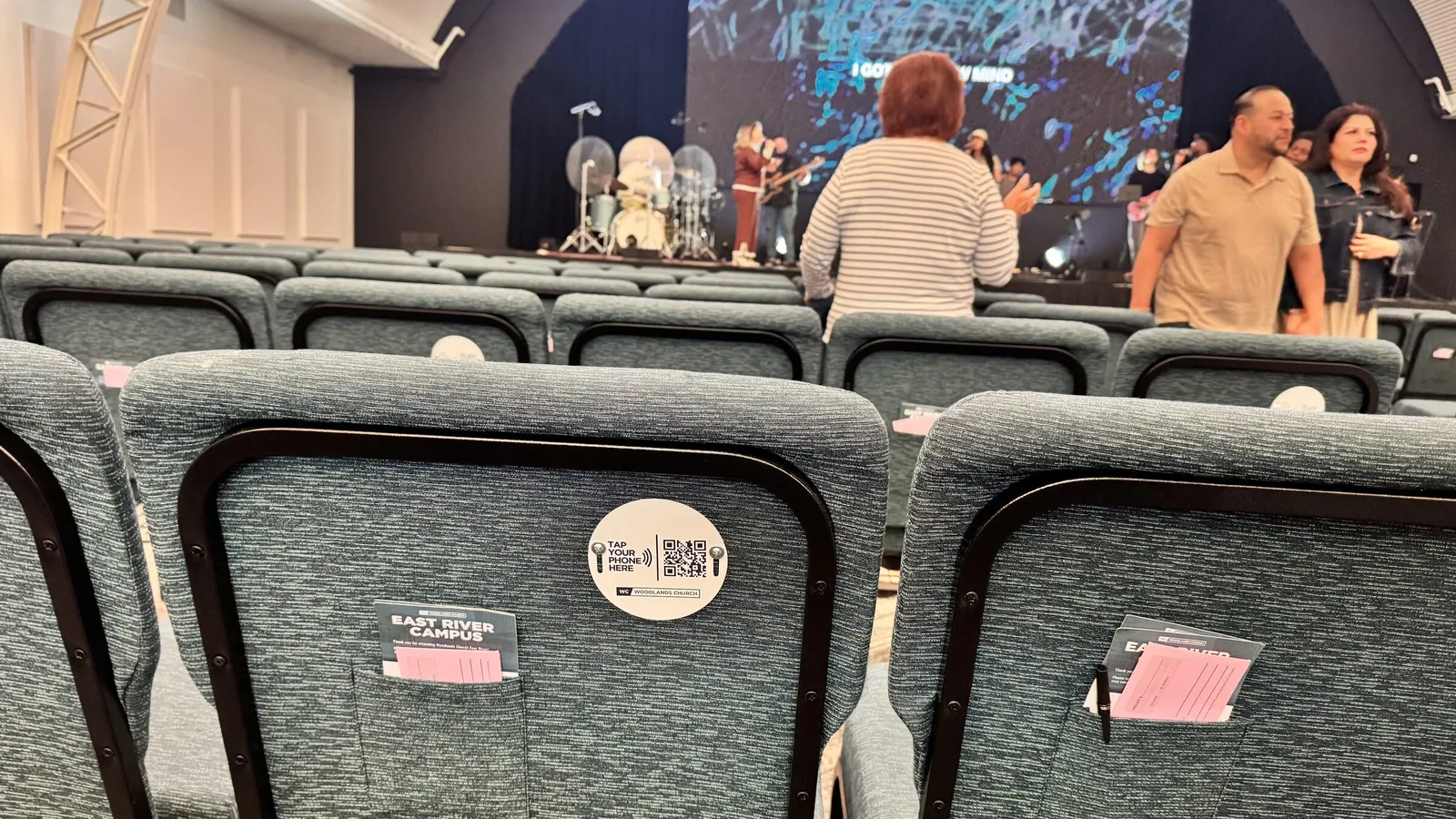
For giving during worship, NFC tap-to-give plates are the shortest path: the giver holds their phone near a pew-mounted plate and lands on your existing giving page in 2-3 seconds, with no app and no typing. Tap.Giving plates are $3.50-$5.00 each, one-time, with free shipping and no monthly fees, and they work with the giving platform you already chose. For a deeper walkthrough see our complete guide to mobile giving for churches, or design a plate and see your price in about 30 seconds.
1. The Church Giving Technology Landscape in 2026
Church giving has gone digital fast: roughly half of all donations are now made with a card or other digital method, and churches offering multiple digital options are 2x more likely to report increased giving. The shift from cash to contactless is accelerating across every denomination and church size, making a multi-method giving strategy essential for 2026.
Church giving technology has changed more in the past five years than in the previous fifty. Cash and checks once accounted for virtually all church donations. Today, roughly half of churchgoers give by card or other digital means and about 40% give directly from their phones (Subsplash church giving research), and among Protestant churches, 57% reported an increase in digital giving in the latest data.
The shift isn’t slowing down. Ministry Brands’ 2026 Annual Church Giving Report found that churches offering multiple digital giving options (digital wallets, recurring, livestream) were nearly 2x as likely to report increased giving compared to churches that rely on a single method. The message is clear: the more ways people can give, the more people give.
But “digital giving” is not one thing. It’s a spectrum that ranges from a basic web page to NFC-enabled plates on every pew. Each technology has different costs, different friction levels, and different strengths. This guide walks through every option available to churches today so you can make an informed decision about what belongs in your giving strategy.
A Note on Our Perspective
Tap.Giving sells NFC tap-to-give plates. We’re hardware, not a giving platform, which means we’re not competing with most of the technologies in this guide. We work alongside Tithely, Pushpay, Givelify, and every other platform. That lets us be honest about what each technology does well and where it falls short. We’ll call out our own limitations too.
Short on time? Route by your goal
This guide is the map. Each row points to the deeper answer for your specific job.
- Give during the service with the least friction is NFC tap-to-give, and here is what plates cost.
- Set up recurring and remote giving starts with an online giving page.
- Connect plates to the platform you already use is covered on our integrations page (Tithely, Pushpay, Givelify, Donorbox, Planning Center, and more).
- Compare tap-to-give hardware vendors head to head is our tap-to-give platform comparison.
- Design a plate and see your price right now takes about 30 seconds on the order page.
2. Cash and Checks: The Traditional Baseline
Cash and checks still represent about 40% of church donations, but that share is declining steadily as fewer people carry physical currency. They cost nothing to accept and preserve the communal offering moment, but they exclude the growing majority of congregants who no longer use cash for daily transactions.
Cash and checks still account for about 40% of all church donations. For many congregations, especially smaller and older ones, the physical offering plate remains central to the worship experience. There’s a tangible, communal aspect to passing the plate that digital methods can’t fully replicate.
But the trend line is unmistakable. Cash and check giving has been declining steadily for a decade, while digital giving is where the growth is: the churches reporting increased giving are overwhelmingly the ones leaning into digital channels, not cash. Fewer people carry cash. Fewer people own checkbooks. And younger generations have never built the habit.
Cash and Checks at a Glance
Setup cost: $0 (you already have an offering plate)
Monthly cost: $0
Donor friction: Low for those who carry cash; impossible for everyone else
Visitor friendly: Only if they have cash
Recurring giving: No (requires manual effort each week)
Best for: Older congregations, supplementing digital methods
Cash and checks aren’t going away overnight. But any church that relies on them as the primary giving method is watching its revenue slowly erode as generational habits shift.
3. Online Giving Pages: The Digital Foundation
An online giving page is the backbone of modern church giving, roughly 80% of digital donations come through web forms rather than apps. Platforms like Tithely, Pushpay, and Donorbox provide these pages, which handle recurring gifts, tax receipts, and serve as the destination for every other giving method on this list.
An online giving page is a web form where donors enter their payment information and make a gift through their browser. It’s the backbone of modern church giving technology, roughly 80% of people who give digitally use a web form rather than a mobile app (Tithely giving trends). Platforms like Tithely, Pushpay, Givelify, Donorbox, and Planning Center all provide these pages.
The online giving page is also the destination for most other technologies on this list. When someone taps an NFC plate, scans a QR code, or clicks a text-to-give link, they land on your online giving page. Think of it as the hub that every other giving method points to.
Why the online page matters most: recurring gifts
The online giving page is where recurring gifts get set up, and recurring gifts are the steadiest money a church has. A member enters their card once, picks weekly or monthly, and the gift keeps arriving whether or not they are in the building that Sunday. It is also the best defense against the summer giving slump, when attendance dips but the bills do not. That predictability is what lets a treasurer budget with confidence. Every other method in this guide, including tap plates, is really a fast on-ramp to this page.
Online Giving Pages at a Glance
Setup cost: $0-$500 (most platforms are free to set up)
Monthly cost: $0-$150/month + 2.9% + $0.30 per transaction
Donor friction: Moderate (type URL, navigate to page, enter info)
Visitor friendly: Only if they know the URL
Recurring giving: Yes, this is where recurring gifts are set up
Best for: Remote giving, recurring gifts, the foundation of your digital strategy
If you are still choosing a giving page, it helps to compare specific platforms on fees and features side by side. Two that churches often weigh are Qgiv and Sharefaith Giving, and both comparisons also show how tap plates fit alongside them.
Every church needs an online giving page. The question is how you get people to that page, especially during a service, when the impulse to give is strongest. That’s where the rest of this guide comes in.
4. Mobile Giving Apps
Mobile giving apps handle about 20% of digital church donations, but adoption is the core challenge, 51% of smartphone users download zero apps per month. Apps work well for committed weekly givers who use them regularly, but they create a high barrier for the remaining 70-80% of your congregation and are essentially invisible to visitors.
Mobile giving apps, from platforms like Pushpay, Tithely, Givelify, and Subsplash, let congregants give through a dedicated app on their phone. About 20% of digital church donations come through apps, with the remaining 80% using web forms. Apps offer a polished experience for committed members who use them regularly. If you are choosing between two of the popular ones, our Tithely vs Givelify comparison lays out their fees side by side.
The challenge is adoption. According to comScore, 51% of smartphone users download zero apps in a typical month. An app a visitor has to download before they can give is a barrier most people never cross. We wrote an entire guide on church giving without an app because the gap between app availability and actual adoption is so wide.
Mobile Giving Apps at a Glance
Setup cost: $0-$500
Monthly cost: $0-$1,475/month + 2.9% + $0.30 per transaction
Donor friction: High (download, create account, enter payment info)
Visitor friendly: No, visitors won’t download an app
Recurring giving: Yes
Best for: Committed, regular members who give weekly
Apps work well for the 20-30% of your congregation who download and use them. The question is what you offer the other 70-80%.
5. Text-to-Give
Text-to-give lets congregants text a keyword to a phone number and receive a giving link, no app download required, but it takes 15-30 seconds and five distinct steps. It costs $19-$200/month and requires cell service inside the building, which can be unreliable in older sanctuaries with thick walls.
Text-to-give lets congregants send a keyword (like “GIVE”) to a phone number. They receive a link via text message that opens a giving page in their browser. It’s a step up from typing a URL, and most people know how to text.
The friction is moderate. The giver needs to see the number (usually on a slide or bulletin), open their messaging app, type the keyword, send it, wait for the reply, and then tap the link. That’s roughly 15-30 seconds and five distinct steps. It also requires cell service inside the building, which can be spotty in older sanctuaries with thick walls.
Text-to-Give at a Glance
Setup cost: $0-$200
Monthly cost: $19-$200/month + transaction fees
Donor friction: Moderate (see number, text keyword, wait, tap link)
Visitor friendly: Somewhat, no app needed, but requires knowing the number
Recurring giving: Depends on platform
Best for: Churches that project the number during services, mid-size budgets
6. QR Codes for Church Giving
They work best on printed materials in well-lit spaces like lobbies and bulletins, but post-pandemic “QR fatigue” has reduced their effectiveness during services.
QR codes surged during the pandemic, and many churches adopted them for bulletins, projection screens, and pew inserts. The giver opens their camera, points it at the code, and taps the link that appears. It takes about 10-20 seconds and avoids the need for an app download.
The problem: people are tired of QR codes. After three years of scanning them for restaurant menus and COVID check-ins, many congregants simply ignore them. And in a dimly lit sanctuary, common during worship, QR codes don’t scan reliably. The data backs this up: NFC generates fewer steps than a QR code in head-to-head comparisons. Our full QR codes vs. NFC analysis breaks down exactly why.
QR Codes at a Glance
Setup cost: $0-$50 (free to generate, minor printing cost)
Monthly cost: $0
Donor friction: Moderate (open camera, aim, scan, tap link)
Visitor friendly: Somewhat, if they notice it and know to scan
Recurring giving: No (each scan is a one-time action)
Best for: Printed materials, lobbies, low-budget supplement
7. NFC Tap-to-Give: The Lowest-Friction Church Giving Technology
NFC tap-to-give plates let congregants tap their phone on a pew-mounted plate to open the church’s giving page in 2-3 seconds, no app, no camera, no typing. At $3.50-$5.00 per plate with zero monthly fees, NFC delivers the lowest friction of any giving method and generates fewer steps than a QR code.
Near-Field Communication (NFC) tap-to-give uses the same technology behind Apple Pay and Google Pay. An NFC plate is mounted on the pew or chair in front of each seat. When a congregant holds their phone near the plate, their browser opens directly to the church’s giving page. No app. No camera. No typing. Two to three seconds from tap to giving page.
The technology isn’t new, every iPhone since iPhone 7 (2016) and most Android phones since 2015 support NFC. That covers over 95% of smartphones in use today. What’s new is that churches can now afford to put NFC plates on every seat. For a deeper dive into the technology, see our NFC giving tech guide.
The same NFC chip ships in very different form factors, and they are not equal for a pew. Some vendors sell bare industrial tags or stickers meant for warehouses and access badges rather than a branded 4-inch plate a giver reaches for. If you are weighing raw tags against a purpose-built giving plate, our HID NFC tags vs. Tap.Giving breakdown shows where each one fits.
A common question about a plate on a public pew is whether someone could tamper with it. Tap.Giving plates ship locked by default, so the giving link a plate opens cannot be quietly rewritten by a passerby with a phone. Our overview of NFC giving plate security walks through how the locking works and what to ask any vendor before you buy.
With Tap.Giving, NFC plates cost $3.50-$5.00 per plate as a one-time purchase. No monthly fees. No transaction fees from us. Works with any giving platform that has a web-based giving page.
What this looks like for a small church plant
Picture a church plant of about 100 seats that runs its giving on a platform like Nucleus. They encode 100 plates with their existing giving-page link and mount them on the chairs with adhesive backs in under an hour on a Saturday. Because tapping a phone is a habit people already have from paying at stores, most attenders try the plate on their own without being told how. That is the whole appeal of NFC: there is nothing to teach and nothing to install. This is a composite illustration, not a specific church, but it matches how the setup goes for a small congregation.
NFC Tap-to-Give at a Glance
Setup cost: $350-$1,400+ (one-time, depends on quantity)
Monthly cost: $0
Donor friction: Very low (tap phone on plate, give)
Visitor friendly: Yes, no download, no account, no typing
Recurring giving: Via the giving platform the plate links to
Best for: In-service giving, visitors, churches that want zero ongoing costs
NFC is strongest at the point of collection, during the service, when the giving impulse peaks. It doesn’t replace your online giving page or your recurring giving setup. It gets people to those tools with the least possible friction. That’s why the ROI data is so compelling for churches of every size.
8. Church Giving Kiosks: Cost and Alternatives
A church giving kiosk (sometimes called a tithing kiosk) runs from about $1,199 for an entry iPad-based unit to $5,799 for a purpose-built model, plus $149-$299 per month in software, and each one is a single lobby giving point that only works before or after the service, not during worship when the giving impulse peaks. A kiosk serves one person at a time, creates a public queue, and needs ongoing power, WiFi, and maintenance that NFC plates on every seat eliminate.
Giving kiosks for churches are tablets or dedicated touchscreen stations placed in the lobby or foyer. Congregants walk up, tap or swipe a card, and make a gift. They were popular in the early 2010s as churches’ first foray into digital giving, and some larger churches still use them. A vendor like SecureGive sells four tiers, from a $1,199 iPad series up to a $5,799 signature cabinet, and layers $149-$299 per month of software on top of the hardware, so a single kiosk lands near $4,600 in its first year.
The fundamental problem with kiosks is timing. They only work before or after the service, not during worship, when the motivation to give is highest. They also create a public, physical bottleneck. Many people feel self-conscious walking up to a kiosk to make a donation in front of others. And with everyone carrying a smartphone, the concept of a shared public device for payments feels increasingly outdated.
Is an iPad giving kiosk the cheap option?
The iPad-based kiosk is the entry tier, roughly $1,199 for the hardware and stand, which is why churches shopping kiosks often start there. But the iPad is only the screen. It still rides the same $149-$299 per month giving software, still sits in the lobby, and still serves one giver at a time, so the recurring cost and the timing limits are identical to a purpose-built cabinet. A church that buys a used iPad and a locking stand can shave the hardware, but not the monthly software or the lobby-only reality. For the full hardware-plus-software math across every tier, and where a tablet kiosk actually makes sense, see our church giving kiosk cost and alternatives guide.
Giving Kiosks at a Glance
Setup cost: $1,199-$5,799 per kiosk (iPad tier to signature cabinet)
Monthly cost: $149-$299/month for software + transaction fees
Donor friction: High (walk to kiosk, wait in line, enter info on shared device)
Visitor friendly: Somewhat, no app needed, but requires initiative
Recurring giving: Some kiosk software supports it
Best for: Large churches with lobby traffic, supplementing other methods
Kiosks aren’t obsolete, but they’re no longer essential. The math makes the point: one kiosk near $4,600 in year one buys a single giving point in the lobby, while the same money in NFC plates equips more than a thousand seats one time, with nothing to pay again. Most of what a kiosk does, a congregant’s own phone does better, privately, at their seat, during the service.
9. Digital Wallets: Apple Pay and Google Pay for Church Giving
Digital wallets like Apple Pay and Google Pay let donors complete a gift with one tap and biometric confirmation, eliminating the need to type credit card numbers. Wallet giving is still a small share of church donations, but it is one of the fastest-growing: Ministry Brands found Protestant churches offering digital wallets were nearly twice as likely to report increased generosity among donors ages 18 to 29. Platforms like Tithely and Donorbox now add native wallet support.
Digital wallets let donors complete a gift using saved payment information on their phone, confirmed with Face ID, fingerprint, or a passcode. Instead of typing a credit card number into a form, they tap “Apple Pay” or “Google Pay” and the transaction processes in seconds.
About 4% of all church donations currently come through digital wallets, but that number is growing fast. Platforms like Tithely, Donorbox, and Planning Center now support Apple Pay and Google Pay natively. When a giver lands on the giving page (from an NFC tap, QR scan, or direct visit), their phone detects the saved wallet and offers it as a one-tap payment option.
Digital Wallets at a Glance
Setup cost: $0 (enabled through your giving platform)
Monthly cost: $0 (included in platform fees)
Donor friction: Very low (one tap with biometric confirmation)
Visitor friendly: Yes, if they have a wallet set up (most do)
Recurring giving: Depends on platform integration
Best for: Reducing friction at the final payment step, tech-savvy congregations
NFC + Digital Wallets: The Fastest Path to a Gift
The combination of NFC tap-to-give and digital wallets creates the lowest-friction giving experience possible. A congregant taps the NFC plate, lands on the giving page, and completes the gift with Apple Pay or Google Pay, all in under 15 seconds, without typing a single character. This is where church giving technology is headed.
10. The Complete Church Giving Technology Comparison
Here’s every giving method, side by side. Use this table to evaluate which combination of technologies makes sense for your church.
| Method | Setup Cost | Monthly Cost | Donor Friction | Visitor Friendly | Recurring Giving | Best For |
|---|---|---|---|---|---|---|
| Cash / Checks | $0 | $0 | Medium | If they carry cash | No | Older congregations |
| Online Giving Page | $0-$500 | $0-$150 + fees | Medium | Need URL | Yes | Remote giving, recurring |
| Mobile App | $0-$500 | $0-$1,475 + fees | High | No | Yes | Committed members |
| Text-to-Give | $0-$200 | $19-$200 + fees | Medium | Somewhat | Varies | Mid-size budgets |
| QR Codes | $0-$50 | $0 | Medium | Somewhat | No | Print, low budget |
| NFC Tap-to-Give | $350-$1,400+ | $0 | Very Low | Yes | Via platform | In-service, visitors |
| Giving Kiosk | $1,199-$5,799 | $149-$299 | High | Somewhat | Some | Large lobbies |
| Digital Wallets | $0 | $0 | Very Low | Yes | Varies | Payment step only |
Note: Transaction fees (typically 2.9% + $0.30) are charged by your giving platform or payment processor, not by the giving method itself. NFC plates and QR codes don’t add any additional transaction fees.
11. Building Your Church Giving Technology Strategy
The best church giving strategy layers 2-3 complementary methods: an online giving page for recurring and remote gifts, NFC plates for in-service giving, and cash for those who prefer it. No single technology covers every donor. The right combination depends on your church size, budget, and worship style.
No single technology solves church giving. The best strategy layers complementary methods. Here’s a practical framework based on church size and budget.
Small Churches (Under 200 Attendance)
Budget is tight and staff is limited. Focus on high-impact, low-maintenance methods.
- 1. Online giving page, Free or low-cost platform (Tithely free tier, Donorbox). This handles remote and recurring giving.
- 2. NFC tap-to-give plates, 100 plates for $500, mounted once, zero maintenance. Handles in-service giving for regulars and visitors alike.
- 3. Cash option, Keep a traditional plate or box for those who prefer it.
Total investment: ~$500 one-time + platform fees. See our small church NFC guide for a detailed walkthrough.
Mid-Size Churches (200-500 Attendance)
You have some budget and can support multiple channels.
- 1. Online giving page with digital wallets, Ensure your platform supports Apple Pay and Google Pay to minimize checkout friction.
- 2. NFC tap-to-give plates, 200-400 plates at $3.50-$4.00 each. Covers every seat.
- 3. Text-to-give or mobile app, For the portion of your congregation that already uses it. Don’t push adoption hard; let NFC handle in-service.
- 4. QR code on bulletin, A free fallback for anyone who prefers it.
Total investment: ~$700-$1,400 one-time + platform fees.
Large Churches (500+ Attendance)
You can afford comprehensive coverage. The goal is zero missed opportunities.
- 1. Full-featured giving platform, Tithely, Pushpay, or similar with app, web, recurring, and wallet support.
- 2. NFC tap-to-give plates, 400+ plates at $3.50 each across all venues. For the full platform comparison, see our guide.
- 3. Text-to-give, Projected on screens during services.
- 4. Kiosk in lobby, For congregants who prefer it, especially card-only givers.
- 5. QR codes, On bulletins, signage, and event materials.
Total NFC investment: ~$1,400+ one-time for 400 plates.
The most common starting point we see
The layered strategy above sounds involved, but the usual first step is small. A congregation of about 100 that wants to modernize giving without adding an expensive platform subscription orders 100 custom plates, points them at the online giving page it already has, and mounts them on the chairs in under an hour. No staff training and no new monthly bill. Tap plates are the cheapest, lowest-maintenance layer to add first, which is why most churches start there and expand later.
12. FAQ: Church Giving Technology
What is the most cost-effective giving technology for churches?
NFC tap-to-give plates are the most cost-effective option for in-service giving. Tap.Giving plates cost $3.50-$5.00 each as a one-time purchase with no monthly fees or transaction fees from us. A church with 200 seats can be fully equipped for $800 total. Compare that to giving apps ($119-$1,475/month) or kiosks ($1,199-$5,799 per unit plus $149-$299/month software). See our pricing.
How much does a church giving kiosk cost?
A church giving kiosk costs $1,199 to $5,799 for the hardware, from an iPad-based unit up to a purpose-built cabinet, plus $149 to $299 per month for the giving software, so a single kiosk runs close to $4,600 in its first year. That buys one giving point in the lobby that only works before and after the service. For in-service giving on every seat, NFC tap plates cost $3.50 to $5.00 each as a one-time purchase with no monthly fee. See the full breakdown in our church giving kiosk cost and alternatives guide.
What percentage of church giving is digital in 2026?
Roughly half of all church donations are now made with a card or other digital method, and 40% of donors give from their phones. Among Protestant churches, 57% reported an increase in digital giving in the latest Ministry Brands data.
Do churches need multiple giving technologies?
Yes. Research shows that churches offering multiple ways to give are nearly 2x as likely to report increased giving. Different congregants prefer different methods, older members may prefer cash or checks, while younger attenders expect digital options. The key is covering both in-service giving (NFC plates, cash) and remote giving (online giving page, recurring gifts).
How does NFC tap-to-give compare to QR codes for church giving?
NFC generates fewer steps than a QR code in head-to-head tests. NFC requires one step (tap your phone) vs. QR codes which require opening a camera, scanning, and tapping a link. NFC also works in dim sanctuaries where QR codes struggle. For the full breakdown, see our QR codes vs. NFC analysis.
What church giving technology works best for first-time visitors?
NFC tap-to-give is the most visitor-friendly technology because it requires zero setup, no app download, no account creation, no typing. Data shows visitors can give with no app to install. Visitors will not download an app or create an account for a church they’ve visited once. For more, read our guide on first-time visitors and NFC giving.
Can NFC plates work with our existing giving platform?
Yes. NFC plates are platform-agnostic, they open a URL in the phone’s browser. If your giving platform has a web-based giving page (virtually all of them do), NFC plates work with it. Tap.Giving plates work with Tithely, Pushpay, Givelify, Donorbox, Planning Center, and many more.
The Right Church Giving Technology Is the One People Actually Use
Every technology in this guide has a place. Cash still matters. Online giving pages are essential. Apps serve committed members. Text-to-give and QR codes fill gaps. Kiosks work in lobbies. Digital wallets speed up the payment step.
But the data consistently shows that lower friction equals higher participation. The church giving technologies that win aren’t the ones with the most features, they’re the ones that make it easiest for someone to go from “I want to give” to “I just gave.”
For in-service giving, the moment when the impulse is strongest and the window is shortest, NFC tap-to-give offers the lowest friction available. One-time cost. No monthly fees. Works with your existing platform. And it starts working the moment the plates are mounted.
Ready to add NFC tap-to-give to your church?
100 plates. $500. Free shipping. No monthly fees. Ever.
Start a quote to get 10% off for 7 days
Related Articles
Church Giving Without an App: Why Simpler Wins
51% of people download zero apps per month. Here’s every app-free giving method, ranked by friction.
GuideQR Codes vs NFC Tap-to-Give: Why Churches Are Making the Switch
Why NFC beats a QR code at the point of collection. See the full head-to-head comparison for church giving.
DataNFC Giving ROI: The Numbers Behind Tap-to-Give
The five-year cost comparison and first-time-giver data every church leader needs before buying.