NFC Giving for Small Churches: Big Results on a Tight Budget
You don’t need a megachurch budget to modernize your offering moment. For a one-time investment of $500, NFC tap plates can equip your entire church, no subscriptions, no IT staff, no complicated setup. That’s less than one month of a typical giving app.
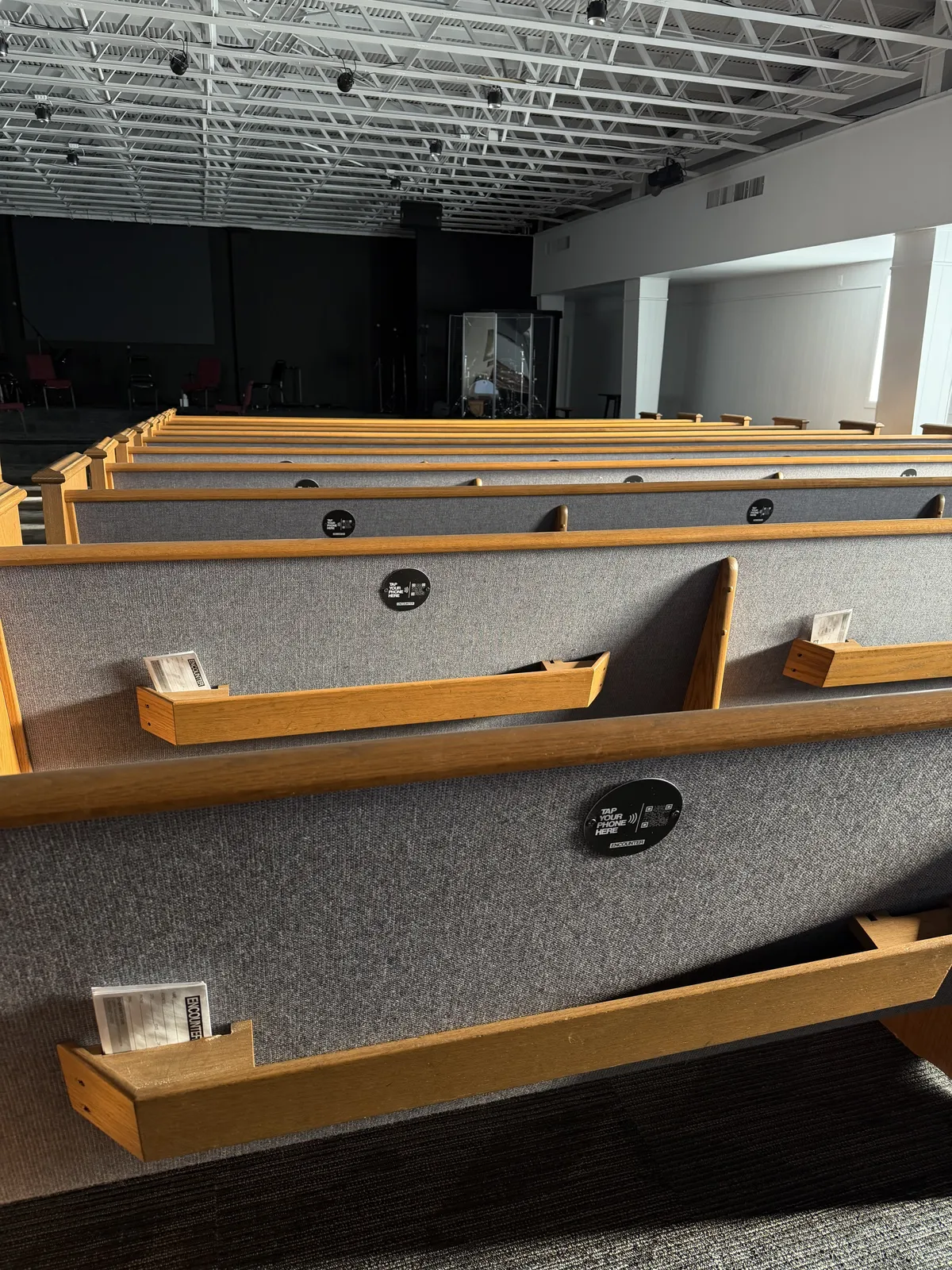
See your church's plate and price in 30 seconds
Design it yourself on the next page. From $3.50 per plate, free shipping, no monthly fees.
1. The Small Church Budget Reality
Small churches with 50-200 members can spend $2,400 to $4,800 per year on software subscriptions alone, and most giving technology was priced for megachurch budgets. Monthly fees of $50 to $200+ may be a rounding error for a church of 3,000, but for a church of 75, that is money taken directly from ministry.
If you lead a small church, you already know the feeling. Every line item on the budget gets scrutinized. Every new tool has to justify itself not just once, but every single month. And somewhere between the worship software subscription, the church management system, and the email platform, the idea of adding one more thing feels impossible.
Small churches, those with 50 to 200 members, operate in a different financial reality than their larger counterparts. There’s no dedicated technology budget. There’s no full-time administrator running cost-benefit analyses. Most decisions come down to a simple question: “Can we afford this without cutting something else?”
That’s exactly why so many small churches have been left behind by the digital giving revolution. The solutions on the market weren’t built for them, they were built for megachurches with five-figure tech budgets. Monthly subscriptions of $50 to $200+ might be a rounding error for a church of 3,000. For a church of 75, that’s the difference between keeping a ministry running or cutting it.
The Subscription Trap
A typical small church might spend $2,400 to $4,800 per year on software subscriptions alone, church management, streaming, email, website hosting, and giving platforms. Each one seemed affordable at $50 to $100/month, but they add up fast. That’s money that could fund outreach, building maintenance, or pastoral care.
2. Why Small Churches Actually Benefit More From NFC
Small churches often see a bigger proportional impact from NFC plates than large ones, because they have higher visitor-to-member ratios, faster word-of-mouth adoption, and every new giver makes a larger difference on the budget. With no IT department needed and zero maintenance, NFC is uniquely suited to lean church teams.
Here’s something most giving technology companies won’t tell you: small churches often see a bigger impact from NFC tap plates than large ones. It sounds counterintuitive, but the reasons are straightforward once you think about them. (And if you’re weighing NFC against QR codes or other options, our QR codes vs. NFC comparison lays out the full picture.)
Higher Visitor-to-Member Ratio
Small churches typically have a higher percentage of first-time visitors per service. Each visitor who gives through a tap plate is a proportionally larger impact on your total giving.
Tighter Community = Faster Adoption
In a church of 75, word spreads fast. When a few members start tapping, the rest follow within weeks. There’s no need for a six-month rollout plan.
Fewer Staff, Simpler Tech
No IT department means you need solutions that just work. NFC plates have zero software, zero logins, and zero troubleshooting, perfect for lean teams.
Large churches can absorb inefficiencies. If 10% of their congregation doesn’t adopt a new giving method, they barely notice. But in a small church, every single giver matters. When you make it frictionless for even a handful of people to give who weren’t giving before, the impact on your budget is immediate and meaningful.
The Small Church Multiplier
Churches using NFC tap plates report an average less friction in contactless giving and an higher in-service participation. In a small church where every dollar is felt, that kind of lift doesn’t just help, it transforms what’s possible.
3. The 100-Plate Advantage, What $500 Actually Gets You
For $500 total, a small church gets 100 NFC plates, enough for every chair plus extras for the lobby, welcome center, youth room, and outreach events. Every plate arrives pre-programmed with your giving page link and works forever with no monthly fees, making it the most affordable way to equip an entire church for digital giving.
Let’s make this concrete. Say you lead a church of 75 people. At $5.00 per plate, the minimum order of 100 plates costs $500 total. That might sound like a lot of plates for a small church, until you think about where they all go.
The 100-Plate Investment
With 100 plates, a church of 75 can put a plate on every single chair and still have 25 extras for the lobby, the welcome center, the coffee bar, the youth room, and community outreach events. You’re not just covering Sunday morning, you’re equipping your entire ministry with giving touchpoints everywhere people gather.
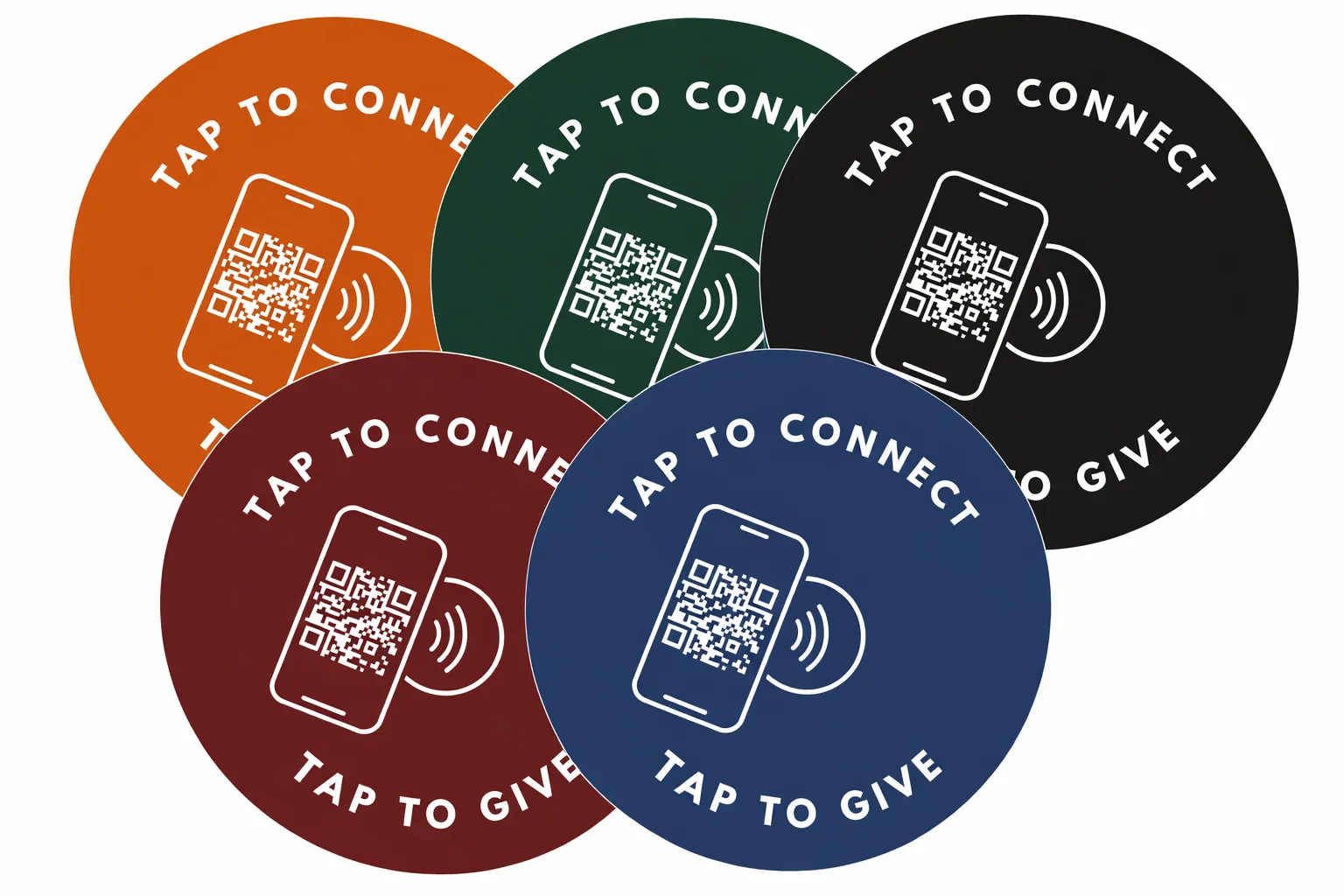
Every plate arrives pre-programmed with your giving page link. Members and visitors tap their phones just like they would at a coffee shop. Your giving page opens instantly. No app download. No account creation. No friction. And because plates are everywhere, not just passed during offering, people can give whenever the Spirit moves them.
Think about that for a moment. For less than one month of a typical giving app subscription, you’ve equipped your entire church, every seat, every room, every event, with a frictionless way to give. No ongoing cost. No contract. No cancellation fees. And the plates are yours forever.
4. $500 vs. $1,200/Year for an App
A typical giving app costs $1,200/year ($100/month), totaling $6,000 over five years, compared to a one-time $500 investment in NFC plates that last forever. That $5,550 in savings over five years goes directly back to ministry, and the plates serve 100% of your congregation without requiring a single app download.
This is the comparison that changes the conversation for small church leaders. Let’s put the two options side by side and let the numbers speak for themselves.
- Monthly subscription required
- Setup fees often $200 to $500
- Requires app download by members
- Training needed for staff and volunteers
- Visitors won’t download an app
- $6,000 spent over 5 years
- No monthly fees, ever
- No setup fees, free shipping
- No app download needed
- Zero training, pass the plate
- Visitors tap and give instantly
- $500 spent over 5 years, plates last forever
The 5-Year Savings
And here’s the part that really matters: Tap.Giving works with whatever giving platform you already use. If you’re already on Tithely, Subsplash, Planning Center, Pushpay, Donorbox, or any other platform with a web giving page, the NFC plates simply link to your existing page. You’re not replacing anything, you’re adding a frictionless entry point for the people sitting in your pews.
5. The Small Church Visitor Advantage
Small churches often have 7-13% of their seats filled by first-time visitors on any given Sunday, making each visitor’s gift a proportionally larger impact on total giving. Those visitors will not download an app or know your text-to-give number, but NFC plates let them tap and give instantly with no prior relationship required.
There’s a hidden superpower that small churches rarely recognize: per capita, you often have more first-time visitors than megachurches. It’s the community church effect. People visiting a new town, a friend’s recommendation, a neighbor’s invitation, small churches are often the first stop for someone exploring faith or looking for a new church home.
In a church of 75, having 5-10 visitors on a given Sunday means 7-13% of your seats are newcomers. In a megachurch of 5,000, that same number of visitors barely registers as a percentage. Your visitors matter more to your overall giving picture.
But here’s the problem: those visitors almost never give through traditional methods. They don’t have your app. They don’t know your text-to-give number. They didn’t bring cash or a checkbook. With a pass-the-plate model that only accepts physical donations, you’re leaving their generosity on the table.
The Visitor Giving Gap, Closed
Research shows 60% of churchgoers are willing to give digitally, and contactless donations are 3x higher than cash gifts. Yet most small churches have no way to capture that willingness in the moment.
NFC tap plates close that gap. When a visitor sees others tapping their phones to the plate, they do the same, instinctively, without instructions. It’s the same gesture they use at the grocery store. Three seconds, no learning curve, and your church just captured a gift you would have missed entirely.
6. Real Scenarios: Churches of 50, 100, and 200
Let’s walk through three real-world scenarios to show how NFC plates work at different small church sizes. These numbers are based on typical Sunday attendance, common seating layouts, and the giving increases churches report after adopting tap plates.
Church of 50
- Plates: 100 (minimum order)
- Total cost: $500
- Extras: 50 for lobbies, events, growth
- New gifts/week: 2-4
Church of 100
- Plates: 100 (one per seat + lobbies)
- Total cost: $500
- Avg. visitors/week: 5-10
- New gifts/week: 4-8
Church of 200
- Plates: 100-200 (full coverage)
- Total cost: $500 to $800
- Avg. visitors/week: 8-15
- New gifts/week: 6-12
How we estimated these numbers: Based on an average visitor gift of $25 (conservative for a first-time digital gift), 52 Sundays per year, and the lower end of reported participation rates. Your results will vary based on your community, but the pattern is consistent: even modest adoption drives meaningful revenue for small churches.
7. No IT Person Needed, Seriously
One of the biggest barriers to technology adoption in small churches isn’t cost, it’s complexity. Most small churches don’t have an IT volunteer, let alone an IT staff member. When something goes wrong with the projector, the pastor figures it out. When the Wi-Fi drops during the livestream, someone’s teenager gets recruited.
That’s why Tap.Giving was designed to be the simplest piece of technology your church will ever adopt. The entire setup process is three words: unbox and hand to usher. (Need a more detailed walkthrough? See our step-by-step launch guide.) Your plates arrive pre-programmed with your giving page link. There’s no software to install, no account to create, no pairing process, no firmware to update. Ever.
Open the box
Hand plates to ushers
Pass during offering
People tap and give
No Batteries or Charging
NFC chips are passive, they draw power from the phone that taps them. Your plates will work the same way in year five as they do on day one.
No Wi-Fi Required
The NFC tap works without internet. The phone uses its own cellular data to load your giving page. Your church Wi-Fi (or lack thereof) doesn’t matter.
What Small Church Pastors Tell Us
“I was worried my ushers, most of them in their 60s and 70s, wouldn’t understand it. But there’s nothing to understand. They pass the plate the same way they always have. The technology is invisible to them. It just works.”
8. The Compound Effect of a Few Extra Gifts
Small church leaders often underestimate the impact of “just a few extra gifts.” When you’re thinking about a single Sunday, two or three additional donations might not seem like much. But let’s zoom out and look at the year.
The Power of “Just 2-3 Extra Gifts”
For a small church operating on a $50,000 to $100,000 annual budget, an extra $3,000 to $6,000 per year is significant. (Want to see the full 5-year projections? Check out the ROI numbers every pastor needs to see.) That’s a new children’s ministry curriculum. That’s a building repair fund. That’s a contribution to a missionary your church has been wanting to support but couldn’t quite afford.
And remember: these numbers only account for visitor giving. They don’t include the existing members who switch from “I forgot my checkbook” to “I’ll just tap.” They don’t account for the impulse generosity that happens when giving is frictionless, the extra $10 or $20 someone adds because the process took three seconds instead of thirty. The real impact is almost always higher than the projections.
The Ripple You Don’t See
When a visitor gives on their first Sunday, something powerful happens: they form a connection to your church. They’re more likely to return, more likely to join a small group, more likely to become a regular giver. That first frictionless tap isn’t just a donation, it’s the beginning of a relationship.
9. Budget-Friendly Scaling: One Order Covers Your Church
Your first order of 100 plates covers your whole church, and then some. For a small church, that means plates on every seat, in every room, and extras on hand for events and outreach. You won’t need to reorder for a long time, if ever.
As you grow to multiple services or campuses, you can order more. Higher quantities bring the per-plate price down to $3.50 to $4.00, and shipping is always free. But for most small churches, that first order of 100 is all you’ll ever need.
Start
100 plates covers every seat, lobby, and youth room
Grow
Add 100 more for a second service or campus
Expand
500+ plates for multi-campus or large events
You’re not locked into a tier. You’re not paying for features you don’t use. And because every plate works with any giving platform, you’re never stuck, even if you switch from Tithely to Subsplash or from Pushpay to Planning Center, your plates keep working. Just update the redirect link and you’re done.
Free shipping to every destination we serve. Whether you order 100 plates or 500, delivery is typically 2-3 weeks from artwork approval. Rush service is available for a fee. There are no hidden handling fees.
Your Church Is Big Enough for This
The narrative that digital giving is only for big churches with big budgets was never true, it was just the reality of how giving technology was priced. Monthly subscriptions, setup fees, and per-user charges made it inaccessible for the churches that needed it most.
Tap.Giving changes that equation entirely. For a one-time investment of $500, a small church gets 100 plates, enough to equip every seat, every room, and every event with the same frictionless, modern giving experience as a megachurch. No monthly bill. No IT requirements. No learning curve for your volunteers. Just NFC plates that work with whatever giving platform you already have.
Your church doesn’t need a bigger budget to start capturing the generosity that’s already sitting in your pews. You just need a better way to receive it.
Ready to See Big Results on a Small Budget?
100 plates. $500 one-time. Your whole church covered. No subscription. No risk. Just a smarter way to receive generosity.
Related Articles
Why Churches Love Tap.Giving: 7 Reasons Pastors Are Making the Switch
From zero monthly fees to instant setup, discover why churches are choosing NFC plates to modernize their offering moment.
InsightsThe ROI of NFC Giving: What the Numbers Actually Say
A data-driven look at how NFC tap plates impact church giving, visitor retention, and long-term generosity.
Guide2026 Tap-to-Give Platform Comparison
Compare costs and features across Subsplash, Tithely, Tap Tag, and Tap.Giving.