Church NFC Tags: Costs, Setup & DIY vs Custom Plates
Everything churches need to know about NFC tags, costs, types, programming, where to buy, and how to choose between cheap DIY stickers and custom-branded plates.
Church NFC tags (also called tap-to-give plates, tap discs, or contactless collection plates) are small NFC-enabled stickers, cards, or branded discs that open a church's giving page when tapped with a smartphone. Basic unbranded NFC tags cost ~$0.50-$2 each in bulk but require DIY programming. Custom-branded church NFC tags from providers like Tap.Giving start at $3.50 per plate (minimum 100), include printing, programming, and adhesive backing, and work with any giving platform without monthly fees.
If your church has been searching for "NFC tags for churches," "church NFC," or "where to buy NFC tags for church giving," this guide walks through every option, from $0.50 Amazon stickers you program yourself to fully branded plates shipped ready-to-mount. We'll cover the technology, the price ranges, the trade-offs, and the mistakes to avoid.
This is an honest buyer's guide. DIY NFC tags are a legitimate option for budget-conscious churches and we'll show you exactly how to make them work. Custom-branded plates exist for churches that want a polished, ready-out-of-the-box solution. Both can succeed, the right answer depends on your size, design resources, and tolerance for setup work.
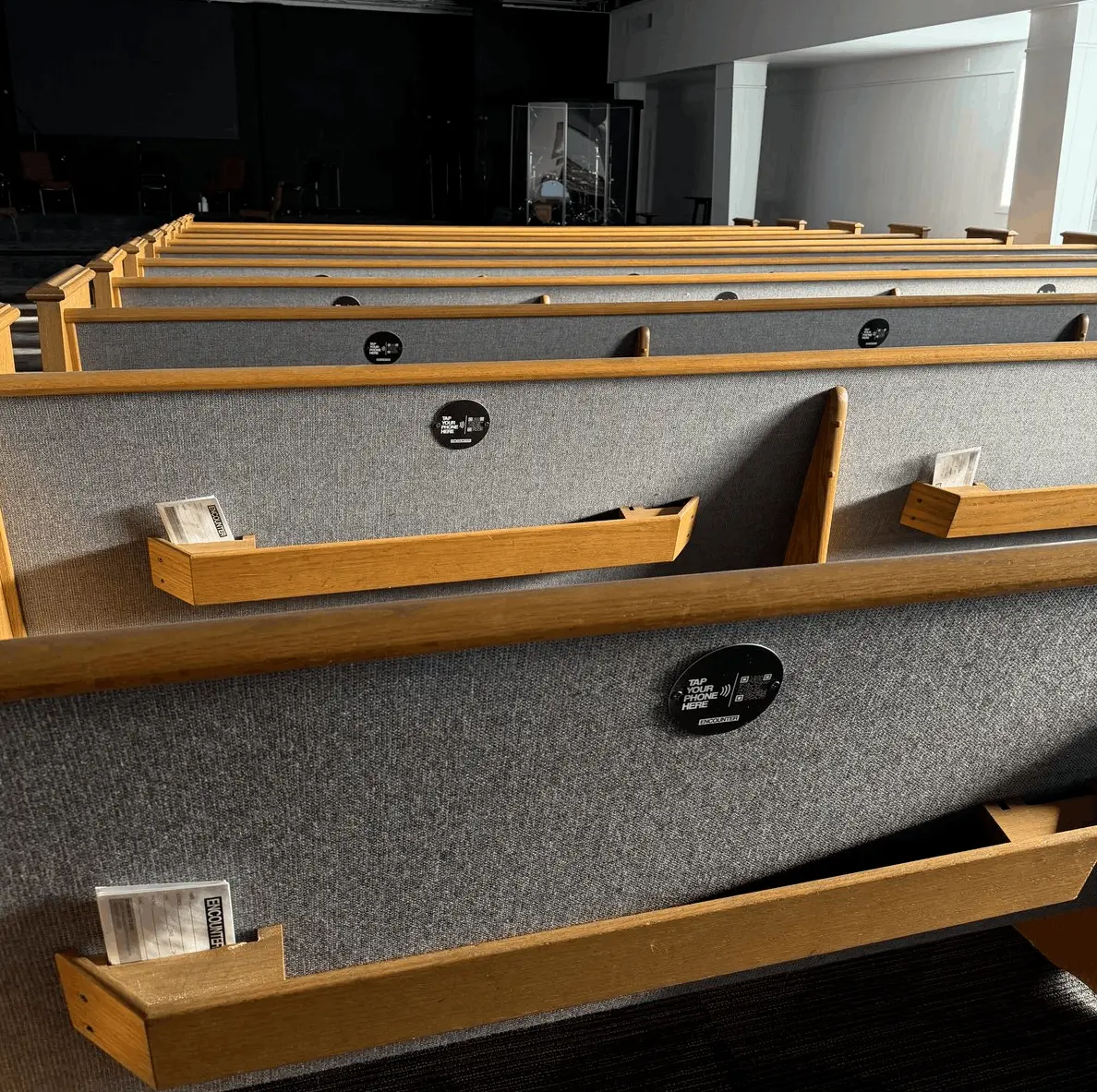
Quick Answer: What Are Church NFC Tags?
A church NFC tag is a small physical object, typically a sticker, card, or printed disc, that contains a tiny NFC chip and antenna. The chip is programmed with your church's giving page URL. When a member taps their smartphone against the tag, the phone reads the chip and opens the URL in their browser.
That's the entire technology. There's no Bluetooth pairing, no app to download, no power source in the tag (NFC chips are powered by the phone's own NFC reader), and no internet connection needed at the tag itself.
For churches, NFC tags solve one specific problem: making it as fast as possible for someone to reach the giving page during a service or event. A printed bulletin URL takes 8-15 seconds to type. A QR code requires opening the camera, framing the code, and tapping a notification. NFC takes about 1.5 seconds, phone within an inch of the tag, page opens automatically.
How NFC Tags for Churches Work
NFC stands for Near Field Communication, a short-range wireless protocol that operates at 13.56 MHz over a distance of about 4 centimeters (roughly 1.5 inches). Every NFC tag has two components:
- 1.An NFC chip, a tiny microchip with a small amount of memory (usually 144 to 868 bytes for tag-grade chips). The most common chip used in church NFC tags is the NTAG215, with 504 bytes of usable memory.
- 2.An antenna, a thin copper coil printed or etched around the chip. The antenna picks up energy from a nearby smartphone's NFC reader, which powers the chip just long enough to send back its stored data.
For church giving, the data stored on the chip is an NDEF (NFC Data Exchange Format) record containing your giving page URL. When a phone reads the tag, it recognizes the NDEF URL record and prompts the user to open the link, or on most modern iPhones (XS and newer) and all NFC-enabled Androids, it opens automatically.
Tags are passive: no battery, no maintenance, no expiration. A properly encapsulated NFC tag will last 10+ years and can be read effectively unlimited times. They also work indoors, outdoors, and through plastic, paper, fabric, and wood, but not through metal unless specifically built for it.
NFC Tag Types Churches Use
NFC tags come in many physical formats. Here are the five most common ones churches choose, with the trade-offs of each:
NFC Stickers
Round or square self-adhesive paper/PVC stickers, usually 25-30mm. Cheapest option ($0.30-$1.50 each in bulk).
Best for: Hidden placement (under bulletins, inside pew racks). Trade-off: No branding, looks unprofessional if visible.
NFC Cards
Credit-card-sized PVC cards. Can be printed full-color on both sides. ~$1-$3 each in bulk.
Best for: Connect cards, welcome kits, mobile placement. Trade-off: Can walk off; less ideal for permanent mounting.
NFC Discs / Plates
Round, rigid discs (typically 30mm to 100mm/4"). Custom-printed with church logo. Adhesive or screw-mount. ~$3.50-$8 each.
Best for: Permanent pew/chair installation. Trade-off: Higher cost than stickers but looks professional and lasts years.
NFC Keychains / Fobs
Small plastic or epoxy fobs. Can be given to guests or volunteers. ~$1-$3 each.
Best for: Welcome gifts, small group leaders, staff. Trade-off: Not seat-mountable; more of a giveaway than a giving station.
NFC Wristbands & Lanyards
Silicone wristbands or fabric lanyards with embedded NFC chips. ~$2-$5 each. Common at conferences and youth events.
Best for: Camps, retreats, youth ministry events, registration check-in. Trade-off: Event-specific; not a long-term in-service giving solution.
Where to Buy NFC Tags for Churches: Options Compared
There are three main paths for sourcing NFC tags. Each fits a different church size, budget, and design capability:
DIY: Bulk NTAG215 Stickers from Amazon
Cost: ~$0.50-$1.50 per tag (packs of 50-100)
Where: Amazon, AliExpress, GoToTags, NFC Tagify, Seritag
What you get: Blank, unprogrammed, unbranded NFC stickers. You program them yourself with a free phone app (NFC Tools or NXP TagWriter).
Best for: Small churches, side-projects, testing the concept before committing, churches with strong volunteer design teams who can print custom labels to stick over the tags.
Custom-Branded Church NFC Tags
Cost: ~$3.50-$8 per tag depending on quantity and provider
Where: Tap.Giving, ChurchTap, Seritag (custom orders), Tapitag
What you get: Full-color custom-printed plates with your church logo, NFC chips pre-programmed with your giving URL, adhesive or screw-mount backing, ready to install out of the box.
Tap.Giving specifics:
- NTAG215 chips (504 bytes, universal compatibility)
- 100mm (4") diameter rigid plates
- Custom printing included, send a logo, get a design proof
- $5.00/plate at 100-199, $4.00 at 200-399, $3.50 at 400+
- Minimum order 100 plates, no monthly fees, no transaction fees
- Tags can be left unlocked (URL changeable) or locked permanently
Best for: Churches that want a polished, professional installation without the design and programming work.
Platform-Bundled NFC Tags
Cost: Hardware cost plus ongoing monthly software fees
Examples: Tithely Tap, Subsplash Tap, Donorbox TapTag, Overflow Tap, Pushpay VisitorTap
What you get: NFC tags tied to a specific giving platform's account. The tag URL is owned/managed by the platform. You'll typically also pay the platform's monthly subscription and per-transaction fees.
Best for: Churches that already use that specific platform and want a single vendor for hardware + software. Trade-off: If you switch giving platforms, your tags stop working.
How to Program NFC Tags for a Church (DIY Walkthrough)
If you're going the DIY route, programming NFC tags is straightforward. The whole setup takes about 5 minutes for the first tag and 30 seconds per tag after that. Here's the process:
Step 1: Buy blank NTAG215 stickers
Search "NTAG215 NFC stickers" on Amazon. Look for packs of 50 or 100 from sellers with 4+ star ratings. Expect $20-$50 for a 50-pack. NTAG215 is the recommended chip, universal phone support and enough memory for any URL.
Step 2: Download a free NFC writing app
iOS: NFC Tools (free, by wakdev) is the standard. Available on the App Store.
Android: NFC Tools (same developer) or NXP TagWriter (free, by NXP, the chipmaker). Both are excellent.
Step 3: Write your giving URL
Open NFC Tools → "Write" → "Add a record" → "URL/URI". Type your full giving page URL (for example: https://yourchurch.com/give). Hit "OK," then "Write."
Hold the tag against your phone, typically the back-center for Android, the top-center for iPhone. The app confirms when the write is successful.
Step 4: Test on multiple phones before mass-deploying
Test on at least one iPhone (iOS 14+), one older iPhone (7/8/X), and two different Android phones. Tap each phone to the tag and confirm the giving page opens. This step prevents the most common mistake: discovering after deployment that a phone model can't read your tags.
Step 5: (Optional) Lock the tags
In NFC Tools, you can lock a tag so the URL becomes read-only. Only lock tags after extensive testing, once locked, the URL can never be changed. We generally recommend leaving tags unlocked unless you have a tampering concern, so you can update the URL later if your giving platform changes.
Want to skip all this? Custom-branded plates from Tap.Giving arrive pre-programmed with your URL, no app, no writing, no testing required. But the DIY path is real and works fine for budget-conscious churches.
How Much Do Church NFC Tags Cost in 2026?
Here's a clean comparison of what different sources actually charge per tag in 2026, based on a 100-tag order:
| Source | Per-Tag Cost | Branding | Pre-Programmed | Monthly Fee |
|---|---|---|---|---|
| Amazon NTAG215 stickers | $0.50-$1.50 | None | No | $0 |
| AliExpress bulk | $0.30-$1.00 | None | No | $0 |
| Seritag (custom) | $2-$6 | Custom | Optional | $0 |
| Tap.Giving plates | $3.50-$5.00 | Custom + included | Yes | $0 |
| ChurchTap | ~$5-$8 | Custom | Yes | Varies |
| Donorbox TapTag | ~$5 | Limited | Yes | $0-$150/mo |
| Subsplash Tap | Bundled | Branded | Yes | Platform fee |
| Overflow Tap | Bundled | Branded | Yes | $208-833/mo |
Pricing reflects publicly listed rates as of April 2026 and is subject to change. Platform-bundled options vary based on church size and chosen plan.
How Much Do 100, 200, or 400 Custom Plates Cost?
A custom-branded church NFC plate order is a one-time cost with no monthly or per-gift fees. At Tap.Giving that is $500 for 100 plates, $800 for 200 plates, and $1,400 for 400 plates, with free shipping included. The per-plate price falls as the quantity rises, so a larger church pays less per seat.
| Order size | Price per plate | One-time total | Shipping | Ongoing fees |
|---|---|---|---|---|
| 100 plates | $5.00 | $500 | Free | $0 |
| 200 plates | $4.00 | $800 | Free | $0 |
| 400 plates | $3.50 | $1,400 | Free | $0 |
The math is easy to reproduce: multiply your seat count by the per-plate price for that tier. A 150-seat church ordering one plate per seat pays 150 x $5.00, which is $750 one-time. A 250-seat church crosses into the $4.00 tier and pays 250 x $4.00, which is $1,000. Because the hardware carries no monthly platform fee, that number is the whole cost in year one and every year after.
Not sure how many plates you need? Our guide to how many NFC plates a church needs works through seat-count math for common room sizes, and how much tap-to-give plates cost breaks the pricing down further. You can also design your plate and see your exact price in about 30 seconds.
Do Church NFC Tags Work With Your Giving Platform?
Yes. An NFC tag simply opens a web link, so it works with whatever giving platform your church already uses. The chip holds your giving page URL, and tapping a phone opens that page in the browser. Your church keeps its current platform, processor, and donor records. The one thing worth checking before you buy branded plates is whether the tags are locked to a single vendor's account or point at a URL you control.
| Giving platform | Works with Tap.Giving plates | What the tag points at | Setup guide |
|---|---|---|---|
| Tithely | Yes | Your Tithely giving form URL | Tithely setup |
| Pushpay | Yes | Your Pushpay giving link | Pushpay setup |
| Givelify | Yes | Your Givelify giving profile URL | Givelify setup |
| Donorbox | Yes | Your Donorbox campaign URL | Donorbox setup |
| Planning Center Giving | Yes | Your Planning Center giving URL | Planning Center setup |
| Breeze ChMS | Yes | Your Breeze giving form URL | Breeze setup |
| Any other platform | Yes | Any public giving URL (for example yourchurch.com/give) | DIY steps above |
This is the difference between a platform-agnostic tag and a platform-bundled one. Tags sold inside a specific product, such as Subsplash Tap, Tithely Tap, or Pushpay VisitorTap, point at that vendor's giving flow, so if you ever change platforms the tags stop working. A Tap.Giving plate points at a URL you own. We ship plates locked by default (tamper-proof, and the one we recommend); if your church wants to repoint the destination later without reprinting, you can request the chip unlocked, or add the Smart Redirect Dashboard, which repoints a locked plate without touching the chip at all. If you are weighing a bundled option, our Subsplash Tap comparison shows how the ongoing platform cost adds up over time.
Where to Place NFC Tags in a Church
Placement matters more than people expect. The same tag can convert at very different rates depending on where it lives. Highest-converting placements churches we've worked with use:
- Pew backs, spaced so every seat has a plate within arm's reach. The most natural moment to give is during the offering portion of service.
- Chair backs, for chairs without a back rail, screw-mount into the frame. For solid backs, adhesive plates work directly on plastic, wood, or fabric.
- Bulletin holders / hymnal racks, natural location people already look at.
- Lobby welcome counter, for guests who want to give on the way in or out.
- Connect card kiosks, pair NFC tags with new visitor cards.
- Exit doors, often missed but high-intent placement; a "thank you" + tap-to-give tag at the door catches people on the way out.
Avoid: placing tags directly on metal surfaces (metal blocks the NFC field unless you use specifically labeled "on-metal" tags), and never place a tag without a clear printed call-to-action like "Tap here to give." A bare tag with no instructions converts at near zero. For a deeper installation walkthrough, see our guide to mounting NFC plates on church chairs.
NFC Tag Mistakes Churches Make
After working with churches deploying tap-to-give programs, the same handful of mistakes show up over and over. Most are easy to avoid:
Mistake 1: Not testing on multiple phones
Older iPhones (7, 8, X) require opening Control Center → NFC Reader before they'll scan tags, they don't auto-scan like newer models. Test on at least one older iPhone, one new iPhone, and two Android phones before deploying.
Mistake 2: Locking tags too early
Some churches lock NFC tags during initial setup "for security", then realize months later they need to update the giving URL because they switched platforms. Locked NTAG215 tags can never be re-written. Leave tags unlocked unless tampering is a real concern. Worth knowing: the tag never holds a card number, so the real safety question is about your giving page, not the chip. We cover the whole picture in is tap-to-give safe for churches?
Mistake 3: Cheap, fragile materials
$0.20 paper-backed stickers from the cheapest AliExpress listing tend to peel, fade, and fail in 3-6 months. Spend at least $0.75-$1 per tag for PVC- or epoxy-encapsulated NFC tags rated for outdoor/long-term use, or buy properly built plates.
Mistake 4: No visible call-to-action
A bare NFC tag is invisible to anyone who doesn't already know what NFC is. Always include "Tap here to give" or similar text directly on or beside the tag. Custom-branded plates have this baked into the design; DIY stickers usually need a printed label added on top.
Mistake 5: Pointing the tag at the wrong URL
Tags should open the final giving page, not your church homepage with a "Give" link. Every extra click costs conversions. Use a clean URL like yourchurch.com/give or your platform's direct giving URL.
Why Isn't My Church NFC Tag Working?
Almost every church NFC tag that seems dead is one of six things: the phone's NFC is switched off, the phone is tapping the wrong spot, the tag is sitting on metal, the tag was never programmed (or was locked to the wrong URL), a cheap sticker has physically failed, or a thick case is blocking the signal. None of them mean the technology is broken. Work down this list in order and the tag almost always comes back.
| What you see | Most likely cause | What to do |
|---|---|---|
| Nothing happens on tap | NFC is turned off, or an older iPhone needs its reader opened | On Android, switch NFC on in Settings. On iPhone 7, 8, and X, open Control Center and tap the NFC reader button first. iPhone XS (2018) and newer read automatically when the screen is on. |
| Works on one phone, not another | The phone is tapping the wrong spot, or moving too fast | The NFC antenna is near the top on iPhones and the center back on most Androids. Rest that part of the phone flat on the tag and hold still for a full second. |
| Reads slowly or drops out | The tag is on or near metal, or two tags are too close together | Metal detunes an ordinary tag. Move it onto wood, plastic, or fabric, or use an on-metal tag built for it. Keep tags at least a few inches apart so a phone reads only one. |
| Opens the wrong page, or an old link | The tag holds the wrong URL, or was locked before it was tested | If the tag is unlocked, rewrite the correct giving URL with NFC Tools and re-test. If it was locked, the URL can never be changed and the tag has to be replaced. Test before you lock. |
| Stopped working after a few weeks | A cheap paper sticker has cracked, peeled, or faded | Bargain-bin stickers fail fast. Replace with a PVC or epoxy encapsulated tag rated for long-term use, or a rigid plate built to stay mounted for years. |
| Only works with the case off | A thick case, a metal popsocket, or a card wallet sits between phone and tag | NFC reads through about 4mm. A heavy case or a metal accessory over the antenna blocks it. Tap the bare part of the phone, or thin the stack between the reader and the tag. |
One more check that catches people out: if the page opens but loads slowly or asks the giver to log in, that is the giving platform, not the tag. The tag only opens a web link. Point it at the direct giving page (for example yourchurch.com/give), not a homepage the giver then has to navigate.
This is the quiet advantage of ordering plates pre-programmed. Every Tap.Giving plate is written with your giving URL and read-tested before it ships, so the "nothing happens" and "wrong page" rows never reach your pews. Plates ship locked by default for tamper-proofing; if you expect the URL to change, ask for the chip unlocked on request, or add the Smart Redirect Dashboard so the destination can move without ever touching the physical plate. If a DIY tag is fighting you, most of it is placement: our guide to mounting plates on church chairs covers the metal and spacing fixes seat by seat.
Should You DIY or Buy Custom-Branded NFC Tags?
Both paths work. The honest answer depends on three factors: budget, design capability, and how visible the tags will be in your space.
DIY Makes Sense When...
- Total budget is under $200
- You have a volunteer who's comfortable with phone apps
- You're testing the concept before scaling
- You can hide tags under bulletins or behind seat cards
- Your church has 50-100 seats or fewer
- You have someone who can design and print custom labels to layer over plain stickers
Custom-Branded Makes Sense When...
- You're deploying 100+ tags
- Tags will be visible at every seat
- You want a polished, brand-consistent look
- You don't have time for design + programming
- You want one-time cost with no ongoing fees
- You want plates rated for permanent installation (multi-year durability)
Considering custom plates? See how your church's name looks on one before you decide. No email needed to try the preview.
Preview a plate with your church's nameThe honest math: 100 DIY stickers + a few hours of programming + custom-printed labels typically lands between $80-$200 all-in. 100 Tap.Giving plates land at $500 ($5.00 each), arriving printed and pre-programmed. At smaller volumes, DIY saves real money. At 200+ tags, the gap narrows because Tap.Giving's per-plate price drops to $4.00 and the time savings become significant.
Frequently Asked Questions
Are NFC tags the same as tap-to-give plates?
Yes, they're the same underlying technology. "NFC tag" is the generic term for any sticker, card, or disc with an embedded NFC chip. "Tap-to-give plate" is what churches typically call a branded, custom-printed NFC disc designed to be mounted on pews, chair backs, or kiosks. A tap-to-give plate is simply a church-branded NFC tag.
How much do NFC tags for churches cost?
Basic unbranded NFC stickers cost about $0.50 to $2.00 each in bulk on Amazon or AliExpress, but require DIY programming and don't include church branding. Custom-branded church NFC plates start around $3.50 per plate at Tap.Giving (400+ plates) up to $5.00 per plate (100-199), with printing, programming, and adhesive backing included. Platform-bundled options like Subsplash Tap or Overflow Tap typically cost more because they include monthly software fees.
Can I program my own NFC tags for church giving?
Yes. Buy blank NTAG215 stickers from Amazon, download a free app like NFC Tools (iOS/Android) or NXP TagWriter (Android), choose "Write URL," enter your giving page link (for example yourchurch.com/give), and tap each tag to your phone. The whole process takes about 30 seconds per tag. You can leave tags unlocked so the URL can be changed later, or lock them with the app once you're sure the URL is final.
What's the best NFC chip for church use?
NTAG215 is the best balance of compatibility, memory, and price for church giving. It has 504 bytes of usable memory (more than enough for a long URL), works with every modern iPhone and Android, and is the same chip used in Amiibo and most commercial branded NFC tags. NTAG213 is cheaper but has less memory; NTAG216 has more memory than you need. Avoid older NTAG203 chips, they have iPhone compatibility issues.
Do NFC tags work on iPhone and Android?
Yes. Every iPhone from iPhone 7 (2016) and newer, and virtually every Android phone made in the last decade, can read NFC tags out of the box. iPhones from XS (2018) and newer read NFC tags automatically when the screen is on, no app required. Older iPhone 7/8/X models require opening the Control Center NFC reader. All Android phones with NFC enabled in settings read tags automatically.
Where should I place NFC tags in my church?
The highest-converting placement keeps a plate within arm's reach of every seat, usually one plate per seat, using pew backs or chair backs. Add plates at bulletin holders, lobby welcome counters, connect-card kiosks, and exit doors. Avoid placing NFC tags directly on metal unless they are labeled for metal, and use a clear call to action such as "Tap here to give."
Why won't my NFC tag open the giving page?
A church NFC tag that seems dead is almost always one of six fixable things: the phone's NFC is switched off (turn it on in Android settings, or open Control Center on an iPhone 7, 8, or X), the phone is tapping the wrong spot (the antenna is near the top on iPhones, center-back on most Androids), the tag is on metal (move it off, or use an on-metal tag), the tag holds the wrong URL or was locked too early, a cheap sticker has physically failed, or a thick case is blocking the signal. If the page opens but loads slowly or asks for a login, that is the giving platform, not the tag. Pre-programmed plates arrive written and read-tested, so most of these never come up.
Skip the DIY Work, Get Custom Plates Ready to Mount
DIY NFC tags are a real option and we encourage churches with the budget constraint and design capability to go that route. If you'd rather skip the design, printing, and programming work, Tap.Giving handles all three.
100mm custom-printed NFC plates with NTAG213 chips, pre-programmed with your giving URL, $3.50-$5.00 per plate, no monthly fees, no transaction fees, free shipping in 2-3 weeks.
No monthly fees · Works with any giving platform · Custom design included
Keep Learning
For more on the technology and how it fits a church context, read our NFC giving explained guide. If you're interested in the no-monthly-fee approach, see DIY NFC giving with no monthly fees. For installation specifics, our guide to mounting plates on church chairs walks through every common seat type. Comparing NFC against QR codes? Read QR codes vs NFC for church giving. If you lead a non-denominational church, our guide to NFC giving for non-denominational churches speaks to that setting directly. And if you're ready to look at branded options, our tap-to-give plate page shows the full product, with current pricing and the order page when you're ready.
Related Articles
NFC Giving Explained: A Church Tech Guide
How NFC giving works and why churches are adopting it in 2026.
DIYDIY NFC Giving With No Monthly Fees
Build a tap-to-give system on a tight budget without subscription costs.
SetupHow to Mount NFC Plates on Church Chairs
Step-by-step guide to mounting tap-to-give plates on every common seat type.