9 Questions Your Church Board Will Ask About NFC Giving (And the Answers)
You’re sold on NFC tap-to-give. Now you have to sell your board. Here are the exact questions they’ll ask, and the data-backed answers that get a “yes.”
How to Use This Article
Print this page or email the link to your board members before the meeting. Each question includes the concern behind it, the answer, and the supporting data. The goal: let the facts do the convincing so you can focus on the vision.
See your church's plate and price in 30 seconds
Design it yourself on the next page. From $3.50 per plate, free shipping, no monthly fees.
“How much does it cost?”
What they really mean: Is this going to blow the budget?
Answer: Tap.Giving plates cost $3.50 to $5.00 each, purchased once. A 100-seat church is fully equipped for $500 total. There are no monthly fees, no transaction fees from us, no subscription. Compare that to giving kiosks ($1,500 to $5,000/unit) or Overflow Tap ($2,500+/year). This is one line item, one time. See full pricing →
“Will it actually pay for itself?”
What they really mean: Show me the ROI.
Answer: Conservative estimates show a $5,375 return in the first 90 days from a $500 investment, through 7 channels: first-time visitor gifts, recaptured drop-off givers, cash-to-digital conversions, recurring giving sign-ups, volunteer time savings, special offering surges, and social proof effects. Even cutting that in half, it’s a 500%+ ROI. See the full 90-day math →
“Does it work with our current giving platform?”
What they really mean: Do we have to switch platforms?
Answer: Yes, Tap.Giving works with any giving platform that has a web-based giving page. It simply opens a URL when tapped. You don’t change, replace, or add any software.
“Is it secure? Can someone steal financial data?”
What they really mean: Are we putting our members at risk?
Answer: NFC tap plates contain zero financial data. They store one thing: a URL. When someone taps, their phone opens that URL in the browser. All payment processing happens on your existing giving platform (Tithely, Pushpay, etc.) using their PCI-compliant security. The plate is no different from typing a URL, it just does it in 3 seconds instead of 20. Full security guide →
“Will older members be able to use it?”
What they really mean: Will this alienate our senior members?
Answer: Two things. First, NFC works on any phone made after 2015, iPhone 7 and up, virtually all Android phones. Second, NFC adds an option, it doesn’t remove anything. Cash, checks, and envelopes stay. Members who prefer those methods are completely unaffected. The data shows older members adopt NFC at about 50% the rate of younger members within the first month, and the gap closes by month three as they see others using it. How to introduce it →
“Why not just use QR codes? They’re free.”
What they really mean: Why spend money when a free option exists?
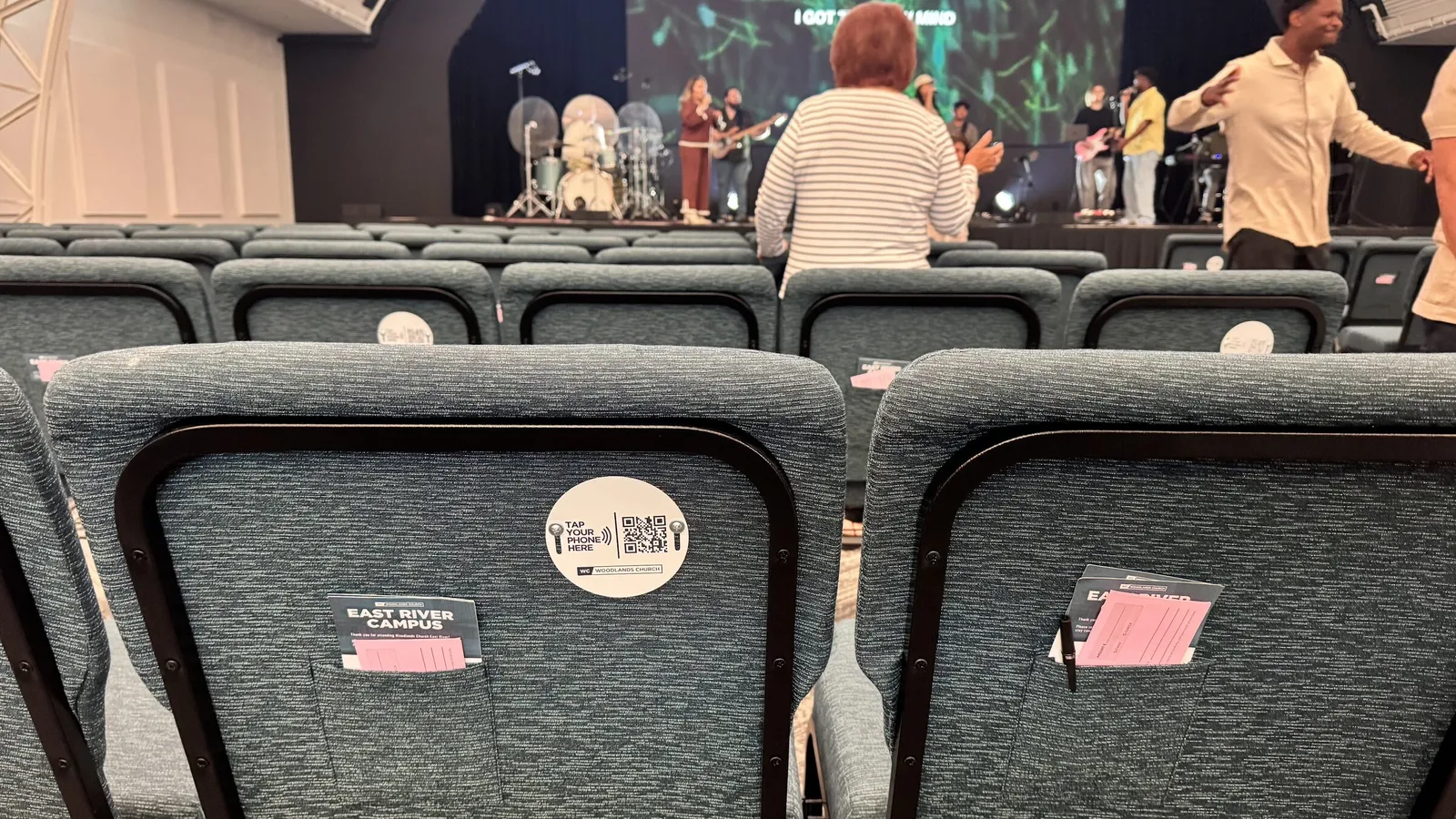
Answer: QR codes are a great free option for printed materials and well-lit lobbies. But in head-to-head testing, NFC generates fewer steps than a QR code. QR codes require a camera, line-of-sight, and adequate lighting, three things that don’t reliably exist in a dimly lit sanctuary during worship. NFC works in the dark, takes 2-3 seconds vs. 10-20, and doesn’t suffer from “QR fatigue.” Use QR on bulletins as a backup. Use NFC on pews as the primary. Full QR vs. NFC comparison →
“How hard is installation?”
What they really mean: Who’s doing the work and how long does it take?
Answer: Tap.Giving plates come with industrial-grade 3M adhesive backing. You peel and stick. One person can install 100 plates in under an hour. No tools, no screws, no electrician needed. The plates also have pre-drilled screw holes if you prefer permanent mounting. Mounting guide →
“What if we switch giving platforms later?”
What they really mean: Will we be locked in?
Answer: No lock-in. Tap.Giving plates are reprogrammable, you can change the URL they open at any time using the free NFC Tools app on your phone. If you switch from Tithely to Pushpay next year, spend 10 minutes updating your plates. Compare that to competitors like Subsplash Tap, which only works with Subsplash, or Overflow Tap, which requires an Overflow subscription.
“What are other churches seeing?”
What they really mean: Is this proven or are we guinea pigs?
Answer: Churches using NFC tap-to-give report:
Your Board Meeting Cheat Sheet
Key Talking Points
- $500 one-time for 100 seats. Zero monthly fees.
- Works with our existing platform. No switching.
- Pays for itself in 30-90 days conservatively.
- No financial data on the plates. Fully secure.
- Adds an option. Doesn’t replace cash or checks.
- Install in under 1 hour. Peel and stick.
Objection Responses
- “Too expensive” → Less than one kiosk. No monthly fees. Ever.
- “Older members won’t use it” → It adds an option. Nothing is removed.
- “QR codes are free”
- “Security concerns” → Plates store a URL, not financial data.
- “We’re not tech-savvy” → If your phone can tap to pay at a store, it works.
Ready to present to your board?
Send them this article. Then order your plates.
Start a quote to get 10% off for 7 days