How to Increase Online Giving at Your Church: 7 Proven Strategies
The fastest way to increase online giving at your church is to remove the friction between the moment someone decides to give and the moment their gift goes through. These seven strategies do that: a giving page that loads fast on a phone, giving that is visible during worship, an NFC plate on every seat that opens your giving page in one tap, and a follow-up that turns a first-time giver into a recurring one. None of them require a bigger budget or a new giving platform.
See your church's plate and price in 30 seconds
Design it yourself on the next page. From $3.50 per plate, free shipping, no monthly fees.
Why Online Giving Stalls at Most Churches
If your giving process requires an app download, account creation, or URL typing during worship, you are losing potential donors at every step.
Here is the reality most pastors miss: a church with a giving problem usually does not have a generosity problem, it has a friction problem. When someone is moved to give during worship, the gift either happens in the next few seconds or it does not happen at all. If you want to increase online giving at your church, the answer is not asking people to give more, it is making it easier for them to give at all.
Count the steps a giver actually takes on each path. The differences are not small.
Every step you remove is a place you stop losing people who already wanted to give. Most people bail after the second step, so the giver who faces five steps rarely finishes. Every strategy in this guide targets that gap between intent and action. Some are free. Some cost a few hundred dollars. All of them shorten the path.
Whether your church runs 50 people or 5,000, these seven strategies will help you increase church donations without guilt-driven appeals or expensive software subscriptions.
Remove Friction From the Giving Process
Reducing friction is the single most impactful strategy to increase church giving, every extra step between the impulse to give and the completed gift loses donors. Time yourself giving as a first-time visitor during your next service. If it takes more than 10 seconds, you have room to improve.
This is the single most impactful thing you can do to boost church giving. Every extra step between the moment someone decides to give and the moment their gift goes through is a place where you lose them. Open the app. Log in. Find the give button. Enter the amount. Confirm. That’s five steps, and most people bail after two.
The principle is simple: the fewer steps between impulse and action, the more people act. This applies to every giving method your church offers. If your current process requires downloading an app, creating an account, or typing in a URL during worship, you’re bleeding donors at every step.
Quick Friction Audit for Your Church
Try this exercise: sit in a pew during your next service and time yourself giving a donation using only what a first-time visitor would have. No app pre-installed. No bookmarked URL. Just what’s visible in the room.
- Under 10 seconds? You’re in great shape.
- 30-60 seconds? Room for improvement.
- Over a minute? You’re losing most potential givers.
For a deep dive on every app-free giving method ranked by friction, we put together a full comparison. The takeaway: the simpler the path, the higher the participation.
Add NFC Tap-to-Give to Every Seat
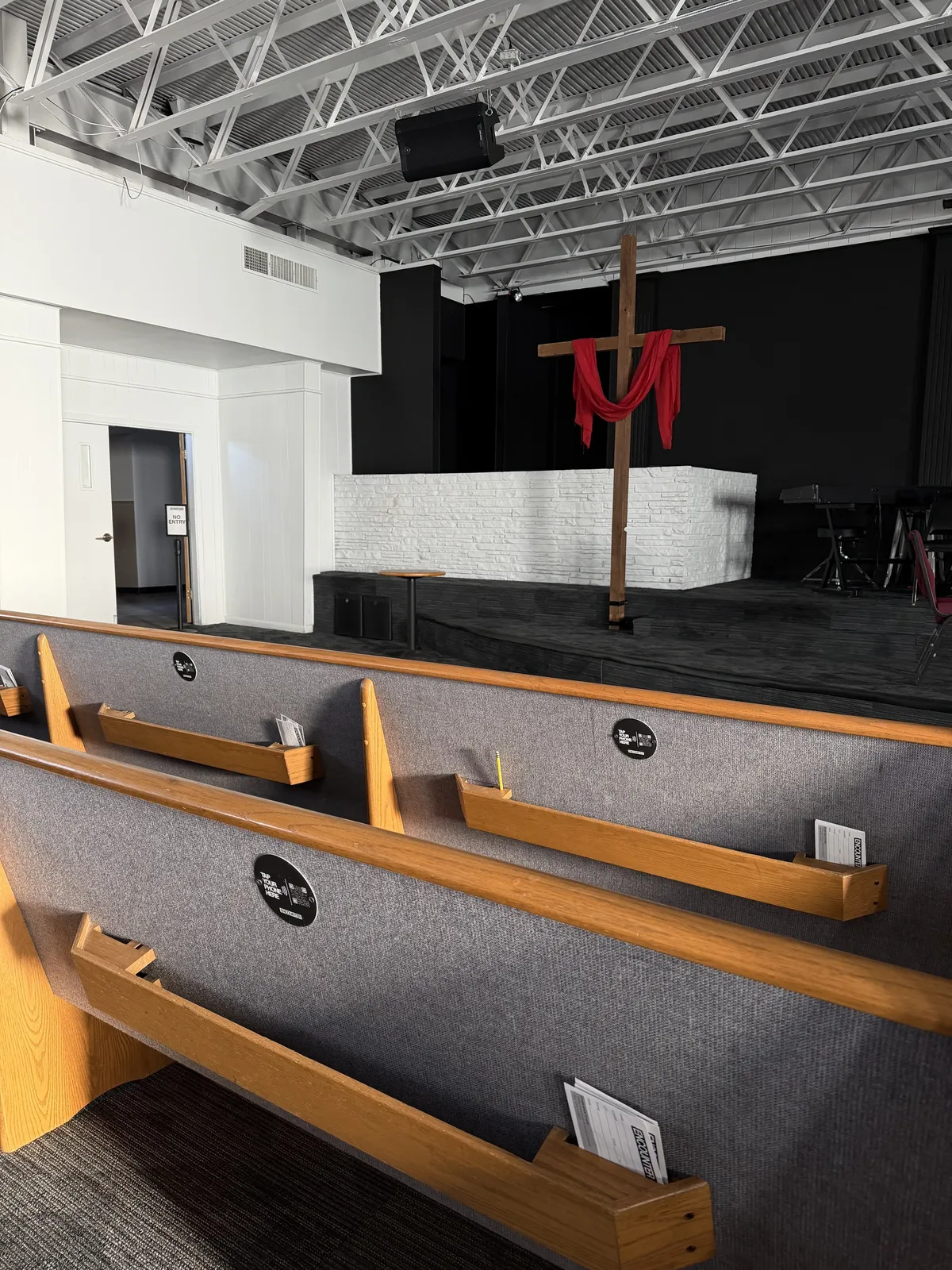
NFC tap-to-give plates mounted on every pew or chair let congregants reach the giving page in 2-3 seconds, no app, no camera, no URL required. Churches report less friction in contactless giving, higher in-service participation, and visitors can give with no app to install who would never have downloaded an app.
If removing friction is the principle, NFC tap-to-give is the execution. An NFC plate mounted on a pew or chair lets someone tap their phone and land on your church’s giving page in 2-3 seconds. No app. No camera. No URL. No account. Just tap and give.
The reason NFC works so well is that it meets people where they are, literally. The plate is on the seat in front of them. They don’t have to remember a website, scan something, or pull up an app. The giving moment during worship is short. NFC captures it before it passes.
What makes this approach even more powerful is that NFC plates are platform-agnostic. They work with Tithely, Pushpay, Givelify, Donorbox, any platform with a web-based giving page. You don’t switch systems. You just add a faster on-ramp to the one you already have.
What About Visitors?
This is where NFC really shines. visitors can give with no app to install, people who would never download an app for a church they’ve visited once. A visitor notices the plate, taps out of curiosity, and gives. That interaction is impossible with app-based giving.
With Tap.Giving, NFC plates cost $3.50 to $5.00 per plate depending on quantity. No monthly fees. No transaction fees from us. A church with 100 seats is fully equipped for $500, a one-time investment. See the full ROI breakdown.
Make Giving Visible During Worship
Here’s a mistake churches make constantly: they set up online giving and then hide it. The giving page exists on the website somewhere. Maybe there’s a button in the app. But during the actual worship service, the moment when people are most moved to give, nobody can see how.
Increasing church giving isn’t just about having the right tools. It’s about making those tools visible at the right moment. That means being intentional about when and how you surface giving options during the service.
Three Ways to Make Giving Visible
Slides during the offering
Display a simple slide that shows how to give: “Tap the plate on your seat” or “Visit ourchu.rch/give on your phone.” Keep it to one clear action.
A brief verbal cue
A 10-second mention: “If you’d like to give today, you can tap the plate on the seat in front of you or visit our website.” Natural, non-pushy, effective.
Physical presence in the space
NFC plates on every seat, a giving station in the lobby, or a tasteful insert in the bulletin. The best giving tools are the ones people can see without looking for them.
Tip: The “See One, Do One” Effect
When one person taps their phone on an NFC plate, the person sitting next to them notices. Social cues are powerful. Visible giving tools create a ripple effect that invisible apps never can. This is one reason physical giving methods outperform purely digital ones during worship.
Optimize Your Giving Page for Mobile
When someone finally lands on your giving page, whether from an NFC tap, a text link, or typing in a URL, that page needs to work flawlessly on a phone. Not “kind of work.” Not “work if you pinch and zoom.” It needs to load fast, look clean, and make completing a gift effortless.
Most online church giving now happens on a phone, not a desktop. If your giving page wasn’t built mobile-first, you’re losing people at the finish line, after they’ve already decided to give.
Mobile Giving Page Checklist
Test It Yourself
Pull out your phone right now and open your church’s giving page. Is the “Give” button above the fold? Can you complete a gift in under 30 seconds? If not, talk to your giving platform provider. Most platforms (Tithely, Givelify, Donorbox) let you customize your giving page, use that. Your church giving technology is only as good as the page it sends people to.
Enable and Promote Recurring Giving
Recurring givers keep giving through the weeks one-time givers miss: summer travel, holiday absences, the Sundays someone stays home sick. A single $50-a-week commitment adds up to $2,600 over a year, with no second decision from the giver. The key is making recurring setup easy: a simple toggle on the giving page after a first tap can convert a one-time gift into years of steady support.
If you want to increase online giving at your church in a way that compounds over time, recurring giving is the strategy. One-time givers are great. Recurring givers are the backbone of a healthy church budget.
The compounding effect is real. A $50/week recurring giver contributes $2,600 per year, rain or shine, vacation or not. They give through the summer giving slump, the year-end holiday season, and the Sundays they stay home sick. One-time givers skip all of those weeks.
How to Promote Recurring Giving Effectively
- Make it the default suggestion. When someone gives for the first time, your giving page should ask “Would you like to make this a recurring gift?” with a simple toggle.
- Offer flexible schedules. Weekly, bi-weekly, and monthly options cover different pay cycles. Don’t force everyone into the same cadence.
- Share the impact. “47 families set up recurring giving this month, funding our children’s ministry for the entire summer.” Specific stories motivate better than general asks.
- Use NFC as the entry point. Someone taps a plate, gives $50, and sees the recurring option on your giving page. That first frictionless experience opens the door to long-term commitment.
The Sunday-to-Schedule Pipeline
Think of in-service giving (NFC, offering plate, text-to-give) as the top of the funnel. The goal isn’t just to capture that one gift, it’s to convert one-time givers into recurring givers. Every giving method should lead to a giving page that makes setting up a recurring gift easy and obvious.
Talk About Giving From the Pulpit Without Guilt
This is the strategy most pastors avoid, and it’s one of the most effective. Churches where pastors talk about generosity regularly, without making it weird, see higher giving participation. Not because people feel pressured, but because they understand why giving matters.
The key word is regularly. One stewardship sermon in October isn’t enough. Brief, consistent mentions throughout the year normalize giving as part of worship, not as an interruption to it.
What Works From the Pulpit
“Giving is one of the ways we respond to God’s generosity toward us. If you’d like to give today, you can tap the plate on your seat.”
“Because of your generosity last month, we fed 200 families through our food pantry.” Specifics build the trust that giving depends on.
“If you’re visiting today, we’re glad you’re here. There’s no expectation to give. But if you’d like to, the plate on your seat makes it easy.”
“We’re $15,000 behind budget this month” creates anxiety, not generosity. People give toward vision, not toward deficits.
When you pair a healthy theology of giving with frictionless giving tools, the combination is powerful. The pastor provides the “why.” The NFC plate provides the “how.” Both matter.
Follow Up With First-Time Givers
A first-time giver who receives a personal thank-you within 48 hours is significantly more likely to give again, yet most churches send no follow-up at all. Retaining just 30% of first-time givers as recurring donors could add $93,600 in annual giving from follow-up alone, based on 10 new givers per month at $50/week.
Getting someone to give once is the hardest part. Getting them to give again is about follow-up. Yet most churches do nothing after a first-time gift, no thank you, no acknowledgment, no next step. That’s a missed opportunity to grow church giving over time.
Research consistently shows that donor retention increases significantly with timely, personal acknowledgment. A first-time giver who receives a thank-you within 48 hours is far more likely to give again than one who hears nothing.
Within 24 Hours
Send an automated thank-you email. Keep it warm: “Thank you for your generous gift. Here’s how it makes a difference.”
Within 1 Week
A personal note from the pastor or a staff member. Handwritten is ideal. A personal email works too. The key is that it feels human.
Within 30 Days
Share a specific impact story tied to their giving fund. Then gently invite them to set up recurring giving if they haven’t already.
The Retention Math
If your church gets 10 new first-time givers per month but retains none of them, you’re running on a treadmill. If you retain even 30% of them as recurring givers, that’s 36 new recurring donors per year. At $50/week each, that’s $93,600 in annual giving, from follow-up alone.
Most giving platforms (Tithely, Pushpay, Givelify) can identify first-time givers in their reporting. Set up a simple workflow: when someone gives for the first time, trigger a thank-you sequence. It doesn’t need to be complicated. It just needs to happen.
Putting It All Together: Your Church Giving Action Plan
You don’t need to implement all seven strategies at once. Start where the impact is highest and the effort is lowest.
Priority Order for Most Churches
Audit your friction. Time yourself giving as a visitor. Fix anything over 30 seconds.
Check your mobile giving page. Load it on three different phones. Fix what’s broken.
Add a giving slide and verbal cue to next Sunday’s service. Zero cost, immediate impact.
Set up a first-time giver thank-you email in your giving platform. Takes 15 minutes.
Order NFC plates for every seat. See my plate design & pricing, 2-3 week delivery.
Launch a recurring giving campaign. Give it a name, share the vision, and track signups.
Talk about generosity consistently from the pulpit. Not once a year. Every few weeks.
The churches that grow their online giving aren’t the ones with the biggest budgets or the fanciest technology. They’re the ones that make it easy to give, make it visible to give, and make people feel good about giving. These seven strategies do all three. For small churches on a tight budget, even implementing two or three of these can start to build a lasting culture of generosity.
Ready to increase online giving at your church?
Start with the strategy that has the highest ROI: NFC tap-to-give on every seat. 100 plates. $500. No monthly fees.
Start a quote to get 10% off for 7 days
FAQ: Increasing Online Giving at Church
What is the fastest way to increase online giving at a church?
The fastest way is to reduce friction. Most churches lose potential givers because the process takes too many steps. Adding NFC tap-to-give plates to every seat eliminates the biggest barriers, no app download, no URL to type, no QR code to scan. Churches using NFC report less friction in donations at the point of collection.
How much does it cost to add NFC tap-to-give to a church?
With Tap.Giving, NFC plates cost $3.50 to $5.00 per plate depending on quantity, with no monthly fees, no setup fees, and no transaction fees from us. A church with 100 seats can get fully equipped for $500. The plates work with whatever giving platform the church already uses, Tithely, Pushpay, Givelify, and more.
Does recurring giving really increase church donations?
Yes. A recurring giver keeps giving through summer slumps, vacations, and the holidays when attendance drops, so the same person contributes on the weeks a one-time giver would skip. A single $50-a-week commitment adds up to $2,600 over a year without another decision. Churches that make recurring setup the default on their giving page tend to grow steady, predictable giving over the following year.
Should pastors talk about money from the pulpit?
Yes, but the approach matters. Churches where pastors talk about generosity regularly, not just during budget season, see higher giving participation. The key is framing giving as a spiritual practice and an act of worship, not as paying the bills. Brief, consistent mentions are more effective than one annual stewardship sermon. Pair the message with a frictionless giving tool so people can act in the moment.
Related Articles
Church Giving Without an App: Why the Simplest Option Wins
Every app-free giving method ranked by friction. See why NFC tap-to-give outperforms QR codes, text-to-give, and kiosks.
DataNFC Giving ROI: The Numbers Behind Tap-to-Give
Less friction, higher in-service participation, and how the math works out. See the real numbers behind NFC giving for churches.
InsightsNFC Giving for Small Churches: Big Results on a Tight Budget
100 plates for $500 covers your whole church. See why small churches actually benefit more from tap-to-give.