Church Giving for Millennials and Gen Z: Meeting the Next Generation Where They Are
Young adults want to give. They just won’t carry cash, download a niche app, or fill out a form during worship. The churches that make giving feel like tapping at the coffee shop are the ones winning the next generation.
See your church's plate and price in 30 seconds
Design it yourself on the next page. From $3.50 per plate, free shipping, no monthly fees.
1. The Myth That Young People Don’t Give
Millennials and Gen Z are generous, 73% of practicing Christian millennials gave to a church last year, and 84% of Gen Z want to financially support causes they believe in. The issue is not willingness but method: younger generations do not carry cash, own checkbooks, or download single-purpose church apps.
Every pastor has heard it: “Young people just don’t give like older generations did.” It shows up in board meetings, budget discussions, and late-night worries about the future of church giving. And on the surface, the numbers seem to confirm it, millennials and Gen Z do give smaller average amounts than Boomers.
But that headline stat hides a more important story. Barna Group research shows that 73% of practicing Christian millennials gave to a church in the past year. The Giving USA Foundation reports that millennials are the fastest-growing segment of charitable donors, with total millennial giving increasing year over year even as older cohorts plateau. And Gen Z? They’re already the most socially conscious generation in history, 84% say they want to support causes they believe in financially.
The problem isn’t generosity. Millennials and Gen Z are generous. The problem is that most churches still collect giving in ways that assume people carry cash, own checkbooks, or are willing to download a dedicated app for a single church. Younger generations do none of those things.
The Real Generational Shift
The shift isn’t from generous to stingy. It’s from cash to digital. From planned to spontaneous. From obligated to inspired. Young adults give when the moment moves them, and they need a giving method that works in that moment, not one that requires preparation they didn’t do.
2. It’s Not Willingness, It’s Friction
Young adults compare every transaction to the 2-second tap-to-pay at a coffee shop. If giving at church requires more effort than buying a latte, the moment passes.
Here’s the data point that should change how every church leader thinks about millennial and Gen Z church giving: Pushpay reports that 60% of churchgoers say they’re willing to give digitally, but far fewer actually made a digital donation in the past year (Subsplash). That 36-point gap isn’t apathy. It’s friction.
Friction is every step between “I want to give” and “I just gave.” For a 28-year-old sitting in your service, here’s what friction looks like:
The Friction Stack (What You’re Asking Young Adults to Do)
Hear the announcement about your church’s giving app
Open the App Store or Google Play
Search for the right app (there are multiple with similar names)
Download and install it (hope the church Wi-Fi works)
Create an account with email, password, and phone number
Find your specific church inside the app
Enter payment information
Finally make the gift
Estimated time: 3-10 minutes. Percentage who actually complete all 8 steps during a service: very low.
Now compare that to how a millennial pays for coffee: they tap their phone. Done. One step. Two seconds. That’s the standard younger generations measure every transaction against. If giving at church requires more effort than buying a latte, you’ve already lost the moment.
This is why churches that rely exclusively on app-based giving are leaving money on the table with younger demographics. The willingness is there. The method is the barrier.
3. How Millennials and Gen Z Already Pay for Everything
75% of millennials have used contactless payments, and over 90% of Apple users pay in-store with Apple Pay where accepted, making tap-to-pay the default behavior for anyone under 40. Church giving methods need to match this expectation: instant, contactless, and requiring zero setup or preparation.
To understand what millennial and Gen Z church giving should look like, look at how they already pay for things outside of church.
A 2025 Mastercard study found that 75% of millennials have used contactless payments, with Gen Z adoption even higher. Apple reports that over 90% of in-store transactions among its users in the U.S. now use Apple Pay where it’s accepted. Visa’s data shows contactless payments grew 30% year-over-year globally through 2025, driven almost entirely by consumers under 40.
How Younger Generations Pay vs. How Most Churches Collect
| Behavior | Millennials / Gen Z | Most Church Giving |
|---|---|---|
| Primary payment | Tap phone / digital wallet | Cash, check, or app |
| Time to pay | 2-3 seconds | 3-10 minutes (first-time app setup) |
| Account required | Already set up (Apple Pay, Google Pay) | New account per church |
| Download required | No | Yes (church-specific app) |
| Cash on hand | Rarely or never | Expected during offering |
| Decision style | Spontaneous, in the moment | Planned, pre-configured |
The pattern is clear. Younger generations have been trained by every retailer, coffee shop, and transit system on the planet to tap their phone and go. They don’t think about it. They don’t fumble. They tap. That’s the muscle memory churches need to leverage, not fight against.
For a deeper look at the full landscape of church giving technology, including how each method stacks up on cost and adoption, see our comprehensive guide.
4. Giving Methods Ranked by Generational Fit
Not all giving methods connect equally with millennials and Gen Z. Here’s how each one scores on the factors that matter most to younger donors: speed, familiarity, zero friction, and no prerequisites.
NFC Tap-to-Give
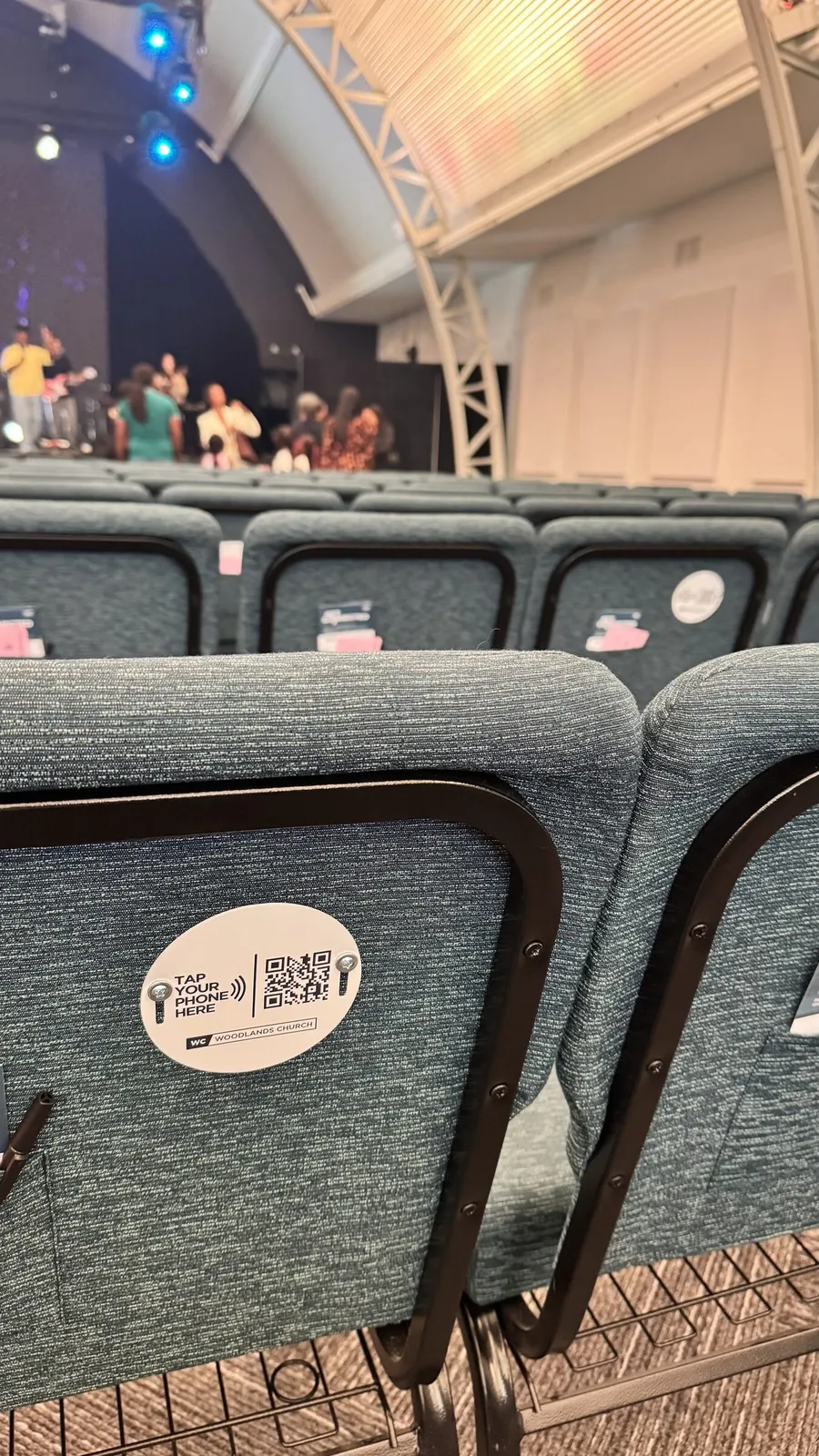
Best FitA plate mounted on the pew or chair. The giver taps their phone. The church’s giving page opens instantly. Identical gesture to Apple Pay or Google Pay. No app, no account, no typing. This is the only giving method that matches how younger generations already interact with the physical world.
Why it wins with younger donors: Zero learning curve. The “tap to pay” gesture is already second nature. Works for visitors and first-timers without any setup.
Text-to-Give
Moderate FitTexting is familiar to every generation, and younger adults are fast texters. But text-to-give still requires knowing a phone number and keyword, and the first-time setup process typically involves creating an account via text link.
Generational friction: Younger adults actually text less than older millennials, Gen Z prefers visual platforms. Still requires a subscription ($50 to $200/month for the church).
QR Codes
Mixed FitMillennials and Gen Z know how to scan QR codes. But knowing how and wanting to are different things. Post-pandemic QR fatigue is real, and NFC generates fewer steps than a QR code in head-to-head comparisons. QR also struggles in dim sanctuaries and requires line-of-sight.
Generational friction: Requires opening camera, aligning, waiting for scan. Feels transactional and impersonal, the opposite of what younger adults want from a worship experience.
Dedicated Giving App
Poor FitThis is where most churches invest their digital giving budget, and where the generational mismatch is starkest. Millennials download an average of 1-2 apps per month. Gen Z downloads even fewer. Neither generation will dedicate precious phone space to a single-purpose giving app they use once a week at most.
Generational friction: 51% of smartphone users download zero apps per month. Of those who do download, 46% uninstall within 30 days. App-based giving is optimized for the most committed givers, not the ones you’re trying to reach.
Cash and Check
Generational Dead EndOnly 16% of Americans under 35 carry cash regularly, according to Pew Research. Among Gen Z, check usage is almost nonexistent, many have never written one. Passing the plate with only cash and check as options is, for younger congregants, the same as not passing it at all.
5. NFC Tap-to-Give: The Bridge Between Tradition and Modern Behavior
NFC tap-to-give is the only digital giving method that works within the traditional worship flow rather than competing with it, a 2-second tap that does not pull attention away from the service. The plate sits on the pew as part of the physical environment, and the gesture feels identical to how younger generations already interact with the world.
Here’s what makes NFC tap-to-give unique among all digital giving methods: it works within the traditional worship flow instead of competing with it.
An app requires someone to disengage from worship, pick up their phone, and navigate software. A QR code requires them to open their camera and scan. A text-to-give number requires them to compose a message. Each method pulls attention away from the service.
An NFC plate sits on the pew, part of the physical environment. When the offering moment comes, a young adult taps their phone on the plate in front of them, a gesture so quick it doesn’t break the flow of worship. The giving page opens. They give. They’re back in the moment in seconds.
Feels Familiar
Same tap gesture they use at the grocery store, coffee shop, and transit system every day
Works for Visitors
No account, no app, no prior relationship with the church. visitors can give with no app
Preserves Worship
Two-second interaction. Doesn’t pull people out of the service to navigate an app
Why This Matters for Church Growth
Millennials now represent the largest adult generation in the U.S. Gen Z is right behind them. Together, they’ll make up the majority of your congregation within the next decade, if they’re not already. Churches that build giving infrastructure around how these generations naturally behave aren’t just solving a giving problem. They’re building for the next 30 years.
6. What It Looks Like in Practice
Statistics tell part of the story. But the real impact shows up in individual moments during Sunday services.
Jenna, 28, First-Time Visitor
Jenna came to a Sunday service because a friend from work invited her. She hasn’t been to church since college. During the offering, she watches a few people pull out checkbooks and feels awkward, she doesn’t carry cash, doesn’t have this church’s app, and isn’t about to start downloading one.
Then she notices a small plate on the chair in front of her. A simple prompt says “Tap to Give.” She holds her phone near it out of curiosity. Her browser opens to the church’s giving page. She gives $25. The whole thing took less time than unlocking her phone.
Jenna didn’t plan to give that morning. She gave because the method matched how she already interacts with the world. That $25 would never have happened with an app-only system.
Marcus, 34, Youth Pastor Who Championed NFC
Marcus leads the young adults ministry at his church. For years, he watched his age group sit through the offering with their hands in their laps, not because they didn’t want to give, but because they didn’t carry cash and had never gotten around to downloading the church’s giving app.
He brought the idea of NFC plates to the church’s leadership team. His pitch was simple: “Our young adults tap their phones 50 times a day to pay for things. Let’s let them tap to give, too.”
Within the first month, his young adults group saw giving participation jump significantly. The fastest-growing donor segment? Adults under 35 who had never given digitally before. “They didn’t need a sermon on generosity,” Marcus says. “They needed a method that didn’t feel like homework.”
7. How to Reach Younger Donors at Your Church
If you’re ready to close the generational giving gap, here’s a practical roadmap. None of this requires replacing your existing giving platform, it works alongside whatever you already use.
Keep Your Platform
Tithely, Pushpay, Givelify, NFC plates work with all of them
Mount on Every Seat
Adhesive back or screws
Announce Simply
“Tap your phone on the plate to give”, that’s all you need to say
Pro Tip: Let Young Adults Introduce It
Have a millennial or Gen Z volunteer demonstrate the tap during the first Sunday announcement. When younger congregants see someone their age using it naturally, adoption follows fast. Churches report that young adults are often the most enthusiastic early adopters, because the gesture already feels familiar to them.
For a step-by-step rollout plan, including announcement scripts and timeline, see our NFC launch guide for churches.
Ready to meet the next generation where they are?
100 plates. $500. Free shipping. No monthly fees. Works with your existing giving platform.
Start a quote to get 10% off for 7 days
8. FAQ: Church Giving for Millennials and Gen Z
Do millennials and Gen Z actually give to churches?
Yes. Barna Group research shows 73% of practicing Christian millennials gave to a church in the past year. Gen Z gives at lower average dollar amounts but at comparable participation rates when digital options are available. The gap between older and younger donors shrinks dramatically when churches remove friction from the giving process.
What is the best way to accept donations from younger churchgoers?
The best method mirrors how younger generations already pay for things, contactless and instant. NFC tap-to-give plates let someone give by tapping their phone, the same gesture they use at the grocery store with Apple Pay or Google Pay. No app download, no account creation, no friction. For a full comparison of methods, see our church giving technology guide.
Will NFC tap-to-give work with phones millennials and Gen Z use?
Every iPhone since iPhone 7 (2016) and nearly all Android phones since 2015 have NFC built in. That covers over 95% of smartphones in use today. Since millennials and Gen Z overwhelmingly use newer phones, compatibility is essentially 100% for these age groups. For full device details, see our NFC giving tech guide.
How much does it cost to add NFC giving to our church?
Tap.Giving plates cost $3.50 to $5.00 per plate depending on quantity, with a minimum order of 100 plates ($500). That’s a one-time cost with no monthly fees, no transaction fees from us, and free shipping. A church with 200 seats can be fully equipped for $800, less than one month of what many giving platform subscriptions cost.
The Next Generation Is Ready. Is Your Giving Method?
The narrative that millennials and Gen Z don’t give is wrong. They give generously, when the method matches how they live. They tap to pay for coffee. They tap to ride the subway. They tap to get into buildings. Church giving for millennials and Gen Z should feel exactly that natural.
NFC tap-to-give plates bridge the gap between the traditional offering moment and modern digital behavior. One-time cost. No monthly fees. Works with whatever giving platform your church already uses. And it reaches the people who’ll be filling your pews for the next three decades, if you give them a reason to stay.
Related Articles
Church Giving Without an App: Why the Simplest Option Wins
51% of people download zero apps per month. Here’s every app-free giving method, ranked by friction.
InsightsFirst-Time Visitors and NFC Giving: Capturing the Moment
Learn how tap-to-give turns visitors into givers without any barriers.
GuideQR Codes vs NFC Tap-to-Give: Why Churches Are Making the Switch
NFC generates fewer steps than a QR code. See the full head-to-head comparison for church giving.