Best Church Donation Technology in 2026: The Buyer’s Shortlist
Short answer: For most churches in 2026, the best church donation technology is a combination: NFC tap-to-give plates for in-service giving ($3.50-$5.00 each, one-time, no monthly fees) paired with a free-tier online platform like Tithely or Donorbox for recurring and remote gifts. Below we compare six categories honestly on cost, friction, and who each one fits, and show why the one-time versus every-year math is where the choice is really made.

Key Takeaways
- NFC tap-to-give plates win on total cost for in-service giving. A one-time $3.50-$5.00 per plate with no monthly fee beats every recurring option on this list. A 100-seat church spends $500 once and never pays again for the hardware.
- Every church still needs an online giving platform. Tithely, Pushpay, Givelify, and Donorbox actually process the payment and issue the tax receipt. NFC plates, QR codes, and text-to-give are different ways of getting a giver to that platform, not replacements for it.
- QR codes are free but struggle in a dim sanctuary. A phone camera needs enough light and a clean angle to focus. An NFC plate opens the giving page from a simple tap, with no camera or line of sight required.
- Giving kiosks cost the most per giver reached. At $1,500-$5,000+ per unit, a kiosk only serves the lobby, one person at a time, and never catches the moment during worship when giving impulse is highest.
- There is no single best technology, only a best combination. The strongest 2026 stack pairs an online giving platform for recurring and remote gifts with NFC plates on every seat for the sixty seconds during the offering.
What This Technology Actually Is (and What It Is Not)
Contactless giving technology covers any tool that lets a congregant give without handling cash, a check, or a physical card: NFC tap plates, QR codes, text-to-give, giving kiosks, and the online giving platforms that process the payment behind all of them. It does not include a donate button buried on a church website with no promotion in the room, or a single QR sticker on a bulletin board that nobody points people to from the stage. A technology only counts if a congregant can reasonably find and use it in the moment they decide to give.
It is also not a payment processor by itself. NFC plates, QR codes, and text-to-give are delivery mechanisms, not banks. A plate opens a browser to a giving page. A QR code does the same from a printed source. A text reply does the same from a phone number. All three still hand off to an online giving platform like Tithely, Pushpay, Givelify, or Donorbox to move the money, generate a receipt, and record the gift. That hand-off is the fact this whole guide keeps coming back to, because it is where boards get confused: adding tap-to-give or a kiosk is not a decision to leave your current giving platform. It is a decision about how fast a congregant reaches the platform you already have.
This guide also treats “contactless” and “digital giving” as overlapping, not identical. Text-to-give and a recurring online gift are digital but not contactless in the strict sense. The distinction matters less in practice than the cost and friction differences below, so we compare all of them together as the real choices a church actually faces.
See your church's plate and price in 30 seconds
Design it yourself on the next page. From $3.50 per plate, free shipping, no monthly fees.
1. The Church Giving Technology Landscape in 2026
The best church donation technology in 2026 is not one tool but a combination of 2-3 methods that cover both in-service and remote giving. Most churches rely on a single method, usually an app or web page, that reaches less than a quarter of the congregation. This guide compares every major category, with honest pricing and our top pick in each. If your church is just moving beyond cash and checks, start with our primer on how electronic giving for churches works and what it costs. For where the wider shift is heading, see our roundup of church giving trends for 2026.
How We Ranked These Options
We scored each technology on five objective criteria that matter most to a church board making this decision:
- Cost: the total one-time and recurring dollar cost to equip 100 seats, from each vendor’s own published pricing, or the most recent verifiable third-party reporting where a vendor quotes privately.
- Friction: how many seconds and steps stand between a person deciding to give and the gift actually processing.
- Visitor-friendliness: whether a first-time guest with no account and no app can use it on the spot.
- Worship integration: whether it works during the service itself, not only in the lobby or online afterward.
- Platform flexibility: whether the technology locks a church into one vendor’s giving platform or works with whatever platform the church already uses.
No technology wins on every criterion, which is why the side-by-side table further down shows all five at once instead of collapsing them into a single score. Pricing was last reverified September 2026 against each vendor’s own site; the source for each figure is named in its section.
2. NFC Tap-to-Give, Best for Physical Worship
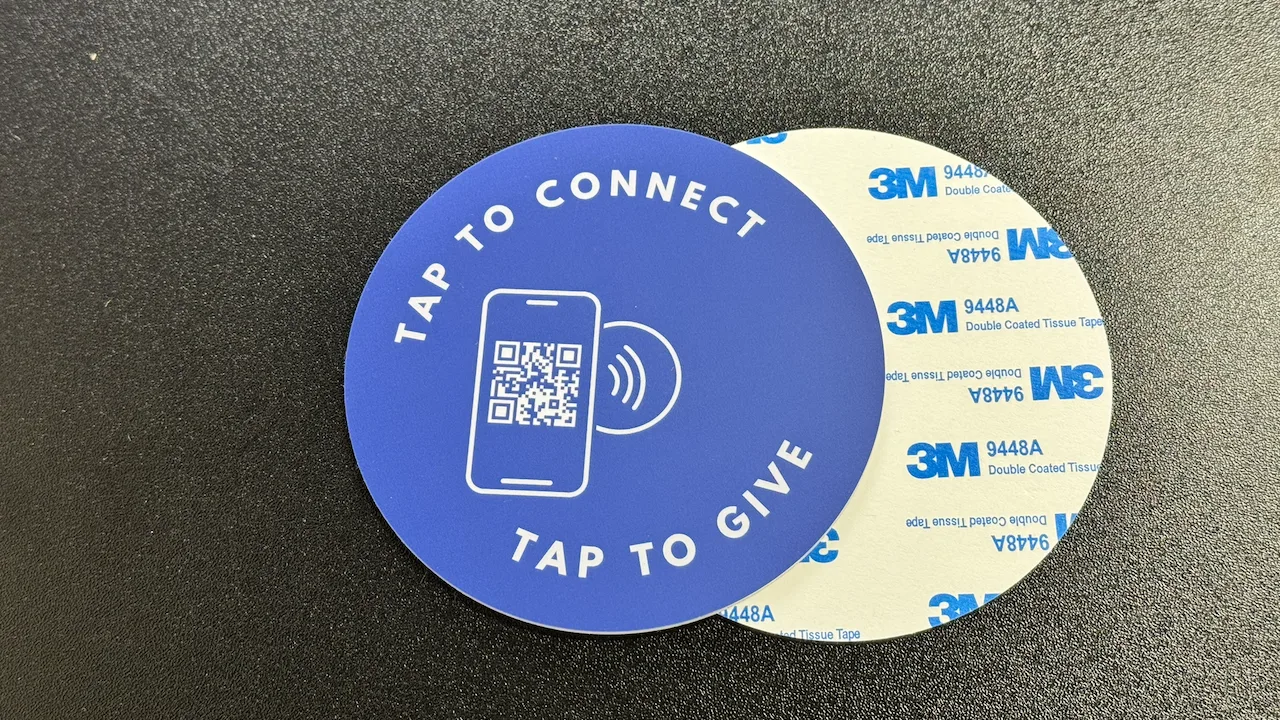
NFC tap-to-give is the best church donation technology for in-service giving: a pew-mounted plate opens the giving page in 2-3 seconds with no app or camera required. A congregant taps their smartphone on the plate, their browser opens to the church's giving page, and they're done. Tap.Giving plates cost $3.50-$5.00 each as a one-time purchase with no monthly fees. (You will see the same technology called both tap to donate and tap to give; they mean the same thing.)
NFC Tap-to-Give
Our Pick for In-Service GivingPros
- Lowest friction of any giving method (2-3 seconds)
- Works during worship without disrupting the service
- No app download, no account creation for givers
- Works in a dim sanctuary with no camera or line of sight
- One-time cost, no monthly fees or per-gift cut from us
Cons
- Doesn’t process payments (needs a giving platform)
- Physical product requires mounting/installation
- Only works for in-person giving (not online/remote)
Key Players
Our pick: Tap.Giving. Full disclosure, we sell these plates. But the reason is straightforward: $500 equips 100 seats one time with no monthly fees, no transaction fees from us, and it works with whatever giving platform you already use. Overflow Tap’s custom plates run about $4.35 each plus a required monthly plan (around $49/month at 100 units), which is roughly $1,000 in year one and about $588 every year after. ChurchTap’s TapDot starts around $3.85 per unit, and real link management costs $19.99/month on top. Tag-based options like Clearstream carry a required monthly plan too (see our Clearstream NFC tags vs Tap.Giving breakdown). For the full field, see our platform comparison.
The three-year math is where tap-to-give plates separate
Every tap-to-give product looks similar on the shelf. The gap shows up over time, because most competitors pair the hardware with a required monthly plan. Here is the same 100 custom units priced across three years, using each provider’s own published per-unit price plus its required plan.
| Tap product (100 units) | Year one | Every year after | 3-year total |
|---|---|---|---|
| Tap.Giving plates | $500 | $0 | $500 |
| Clearstream tap tags | ~$440 | $240 | ~$920 |
| ChurchTap TapDot (with TapPro) | ~$434 | $240 | ~$1,105 |
| Overflow Tap (annual contract) | ~$1,023 | ~$588 | ~$2,199 |
Figures use each competitor’s published per-unit price plus its required plan (Overflow and Clearstream require a subscription; ChurchTap’s figure assumes the $19.99/mo TapPro plan for real link management). Tap.Giving plates are a one-time purchase with no required subscription: the optional Never-Reprint redirect is free on 400+ orders and $50/yr below that.
NFC tap-to-give is the best church donation technology for capturing the moment of generosity during worship. It is the only method that meets a giver in the seconds the offering is actually happening, when a phone is already in hand. For the cost math behind equipping a full room and what a church can reasonably expect, read our NFC giving cost and ROI breakdown. For an outside voice on the same technology, see what church-tech commentator Brady Shearer says about NFC tap-to-give. You can also design your church’s plate and see your exact price in about a minute.
I am a pastor, and the reason I built Tap.Giving is what I watched happen at our own offering. As fewer people carried cash or checks, the plate passing down the row met a lot of empty hands, and the folks who wanted to give were left hunting for an app after the moment had passed. A plate on the seat back gave them a two-second way to give right then, without a download or an account. That is the gap NFC fills, and no other method on this list fills it during the service.
Best for: Any church that wants to increase in-service giving, especially among visitors and first-timers. Works for any size, from a 50-seat chapel to a 5,000-seat auditorium. See our guide for small churches using NFC.
3. Online Giving Platforms, Best for Digital Infrastructure
Every church needs an online giving platform to process payments, manage recurring gifts, and generate tax receipts. It's the digital backbone every other giving method points to. If NFC plates are the front door, your online platform is the plumbing. Options range from free tiers (Tithely, Givelify) to enterprise platforms like Pushpay, which quotes each church privately and is reported at roughly $1,475/month for its full giving, app, and church-management bundle, with most platforms charging 2.9% + $0.30 per transaction.
Online Giving Platforms
Best for Digital InfrastructurePros
- Full payment processing and tax receipts
- Recurring/scheduled giving support
- Donor management and reporting
- Works for both in-person and remote giving
Cons
- Monthly subscription fees (some platforms)
- Transaction fees on every gift (2.9% + $0.30 typical)
- App-dependent platforms have low adoption
- Vendor lock-in makes switching expensive
Key Players
Our pick: Tithely for most churches. Their free giving tier is genuinely usable, and the $119/mo All-Access bundle adds church management, apps, and websites if you need them later. For larger churches that need enterprise donor management and dedicated support, Pushpay is the industry standard, but it quotes each church privately and its full bundle is reported around $17,700/year, so ask for a written quote before you commit. Givelify is the easiest entry point if you want giving with zero monthly cost. For details on pairing any of these with NFC, see our setup guides for Tithely, Pushpay, and Givelify.
Best for: Every church needs an online giving platform. The question is which one matches your budget and feature needs. Small churches do well on Tithely’s free tier or Givelify. Mid-size churches benefit from Tithely Plus or Donorbox (if you are weighing Donorbox, our GivingFuel vs Donorbox comparison runs the small-church math). Large churches with complex needs may justify Pushpay’s cost.
Important: Platforms and NFC Are Not Either/Or
You need a giving platform regardless, it processes the actual donations. NFC plates are a delivery mechanism that opens your platform’s giving page faster. Think of NFC as the front door and your giving platform as the house. The best church giving solution in 2026 uses both. See how Tap.Giving works with your existing platform.
4. Text-to-Give, Best for Simplicity
Text-to-give lets congregants send a text message (like “GIVE”) to a dedicated phone number. They receive a reply with a link to the church’s giving page. It’s familiar technology, everyone knows how to text, and requires no app download.
Text-to-Give
Best for SimplicityPros
- Everyone knows how to send a text
- No app download needed
- Works on any phone (including older models)
- Easy to announce from the stage
Cons
- Monthly cost: $50-$200/month typically
- Requires seeing and remembering a phone number
- Poor cell reception in some church buildings
- 15-30 seconds to complete (pulls attention from worship)
Cost range: $50-$200/month on top of your giving platform. Many platforms (Tithely, Pushpay, Subsplash) include text-to-give as part of their subscription. Standalone text-to-give services also exist.
Best for: Churches that want a backup giving method that’s easy to promote from the pulpit. Especially useful for churches with older demographics who are comfortable texting but less comfortable with NFC or QR codes.
5. QR Code Solutions, Best for Free/DIY
QR codes are the zero-cost entry point for church giving technology. Generate a QR code that links to your giving page, print it on bulletins or display it on screen, and congregants scan with their phone camera. The price is right, free, but the data on engagement tells a different story.
QR Codes
Best for Free/DIYPros
- Completely free to create and print
- No hardware or subscription required
- Easy to put on bulletins, screens, posters
- Good for printed materials and take-home items
Cons
- Needs a camera, good light, and line of sight to the code
- Doesn’t work well in dim sanctuaries
- Requires line-of-sight to the code
- “QR fatigue” from overuse during the pandemic
Cost: Free. You can generate a QR code with any free online tool and print it yourself. The only cost is paper and ink.
Best for: Churches with zero budget for giving technology, or as a supplemental method on printed materials. QR codes work fine in well-lit lobbies and on take-home cards. They struggle during worship in dimly lit rooms. For a detailed comparison, read our QR codes vs. NFC analysis.
6. Giving Kiosks, Best for Lobbies
Giving kiosks cost $1,500-$5,000+ per unit, only work in the lobby, and miss the worship moment when giving impulse is highest. They serve one person at a time, require power and WiFi, and create public queues that many congregants avoid. In 2026, NFC plates do the same job at a fraction of the cost from every seat.
Giving kiosks are dedicated tablet or touchscreen stations placed in a church lobby. Givers walk up, select their gift amount, swipe a card or tap to pay, and they’re done. Kiosks made sense when they were the only cashless option. In 2026, the math has changed.
Giving Kiosks
Highest Cost per GiverPros
- Accepts credit/debit cards directly
- Familiar for people who use self-checkout
- Visible in the lobby as a giving reminder
Cons
- $1,500-$5,000+ per kiosk unit
- Only works in one location (lobby)
- Not available during worship when the giving impulse peaks
- Requires power, Wi-Fi, and ongoing maintenance
- Many people feel self-conscious giving publicly
Cost: $1,500-$5,000 per kiosk, plus monthly software fees and maintenance. A church needing 2-3 kiosks could spend $6,000-$15,000 to serve a fraction of the people that $500 of NFC plates would reach. Read our full kiosk vs. NFC comparison.
Best for: Large churches that want a visual giving station in the lobby as a supplement to other methods. Kiosks should not be your primary giving strategy, they miss the moment of worship and serve one person at a time.
7. All-in-One ChMS with Giving, Best for Integration
Church management systems (ChMS) like Planning Center, Subsplash, and Realm now include built-in giving modules. The appeal: one platform for member management, communication, scheduling, and giving. Everything talks to everything else.
All-in-One ChMS
Best for IntegrationPros
- Giving data syncs with member records
- One vendor for multiple church functions
- Unified reporting across attendance and giving
- Reduces number of tools to manage
Cons
- Giving module often isn’t best-in-class
- Switching costs are high (you’re all-in with one vendor)
- Pricing bundles can make the giving portion expensive
- Some lock NFC features into proprietary hardware
Key Players
Our pick: Planning Center for churches that want modular pricing and best-in-class tools that play well together. If you’re already on Subsplash for your church app, their giving module makes sense (here is what Subsplash actually costs), but know that Subsplash Tap locks you into their ecosystem. A platform-agnostic NFC option like Tap.Giving gives you more flexibility. We have setup guides for Planning Center and Realm.
Best for: Churches that value unified data and want to minimize the number of vendors they manage. The tradeoff is flexibility, if you outgrow the giving module, switching is painful. For a worked example of what a denominational ChMS costs against plates, see our FellowshipOne Giving vs Tap.Giving cost breakdown.
8. Side-by-Side: Best Church Donation Technology Compared
Here’s every category of church giving technology compared on the five factors that matter most.
| Technology | Cost | Friction | Visitors | During Worship | Platform Flexibility |
|---|---|---|---|---|---|
| NFC Tap-to-Give | $500-$1,400 one-time | Lowest | Instant | Yes | Any platform |
| Online Platform | $0-$1,475/mo + fees | Moderate | With link | Not ideal | Vendor-specific |
| Text-to-Give | $50-$200/mo | Low-Moderate | If announced | Yes | Platform-tied |
| QR Codes | Free | Moderate | If visible | Poor in low light | Any platform |
| Giving Kiosk | $1,500-$5,000+/unit | Highest | Lobby only | No | Vendor-specific |
| All-in-One ChMS | $50-$500+/mo | Moderate | With link | Varies | Locked in |
NFC plates win in-service giving on cost and friction.
Design your church’s plate in your browser and see the exact price. No signup, no charge.
Design your plate & see pricing →Which Option Fits Your Use Case
The right stack depends on your room, your budget, and your congregation, not your denomination. Here is the combination we would recommend for seven common situations.
| Your situation | Recommended combination | Why |
|---|---|---|
| Small church, under 200 seats, tight budget | NFC plates + a free Tithely or Givelify tier | Fully equipped for about $500 one-time, no monthly cost added |
| Mid-size church, 200-500 seats | NFC plates + Tithely Plus or Donorbox | Adds recurring-giving tools without a large subscription jump |
| Large church, 500+ seats, multiple services | NFC plates + Pushpay or Planning Center | Enterprise donor management and reporting the volume calls for |
| Rental venue, chairs move or stack weekly | NFC plates mounted per chair + QR code on a projected slide | Plates travel with the chairs; QR covers any week they are not set up yet |
| Older or less digitally fluent congregation | Text-to-give announced from the stage + NFC plates for smartphone users | Text-to-give needs no app, which matters most for this room |
| High-visitor seasons (Easter, Christmas) | NFC plates in guest seating + a lobby kiosk if budget allows | Visitors give without downloading anything; a kiosk adds capacity for overflow crowds |
| Already locked into a ChMS giving module (Planning Center, Subsplash, Realm) | Add platform-agnostic NFC plates on top | Keeps your existing system of record while removing the need to have an app open to give |
9. How to Build Your Church’s Giving Technology Stack
Build your church’s giving stack around two essentials: an online giving platform for recurring and remote gifts, plus NFC plates on every seat for in-service giving. Layer in text-to-give or QR codes as backup channels. This combination covers every giver type, members, visitors, cash donors, and digital-first attenders, at the lowest total cost.
No single technology does everything. The best church donation technology strategy in 2026 combines two or three methods that cover different situations. Here are our recommended stacks by church size and budget. Whichever you choose, the rollout is where adoption is won or lost, so it helps to know the digital giving launch mistakes churches make before you announce it from the stage.
Small Church (under 200)
- 1.NFC plates on every seat ($500 for 100)
- 2.Tithely free tier for online/recurring giving
- 3.QR code on bulletin as backup
Mid-Size Church (200-500)
- 1.NFC plates on every seat ($800 for 200)
- 2.Tithely Plus or Donorbox for online giving
- 3.Text-to-give (included with platform)
Large Church (500+)
- 1.NFC plates on every seat ($1,400 for 400)
- 2.Pushpay or Planning Center for enterprise giving
- 3.Text-to-give + kiosk in the lobby
The Common Thread
Notice that NFC plates appear in every stack. That’s because no other technology captures the moment of generosity during worship as effectively. The other tools handle what happens outside the service, online gifts, recurring setup, donor management (if you are weighing a dedicated donor database, our Bloomerang vs Tap.Giving comparison shows where each one fits). NFC handles the 60 seconds during the offering when people are most moved to give.
What Results Look Like
26 churches have ordered Tap.Giving plates so far, for more than 5,700 plates now mounted in sanctuaries, fellowship halls, and chairs across the country. We do not yet have a review-platform star rating (see the FAQ below), so the honest evidence is the order ledger and direct, unedited quotes from the churches that bought plates. A few, exactly as they were sent to us:
“They arrived and are installed, and I was already able to login and change the destination with ease, these are phenomenal!”
Lakewood Park Baptist Church
“People are adapting perfectly with them in our congregation this past Sunday!”
Endurance Church
“I combed the market for all the various types of tags and was so pleased with the way you all offer services.”
Center Point Church
“Looks good! Thanks for the extra work to create a custom one for us!”
Lincoln Heights Christian Church
These are set-dressing-free, unedited reactions from real orders, not a composite or a paid review. See more of them, and the full order ledger behind the 5,700-plate figure, on our homepage.
10. FAQ: Best Church Donation Technology
What is the best church donation technology for small churches on a budget?
For small churches, NFC tap-to-give plates offer the best value. Tap.Giving plates cost $3.50-$5.00 each with no monthly fees, so a 100-seat church can be fully equipped for $500 one time. Pair that with a free-tier online platform like Tithely or Donorbox for digital giving outside of services.
Do I need to replace my current giving platform to use NFC tap-to-give?
No. NFC tap-to-give plates like Tap.Giving work with whatever giving platform your church already uses, Tithely, Pushpay, Givelify, Donorbox, Planning Center, or any platform with a web-based giving page. The plates open your existing giving URL when tapped. See how it works.
How much does church giving technology cost per year?
Costs vary widely. QR codes are free. NFC plates are a one-time $500-$1,400 purchase. Text-to-give runs $50-$200/month ($600-$2,400/year). Online platforms range from free (with transaction fees) to a reported ~$1,475/month for Pushpay's full bundle (Pushpay quotes each church privately). Giving kiosks cost $1,500-$5,000 per unit. All-in-one ChMS platforms range from $50-$500+/month.
Is NFC tap-to-give better than QR codes for churches?
In most worship settings, yes. A tap opens the giving page in about two to three seconds with no camera, app, or account, and it works in a dim sanctuary where a phone camera struggles to focus on a QR code. QR codes are still a good free starting point and work well on printed bulletins and take-home cards. Read our full QR vs. NFC comparison.
Can our church use multiple giving technologies at the same time?
Absolutely, and most churches should. The best strategy combines 2-3 methods: NFC plates on pews for in-service giving, an online giving page for remote/recurring gifts, and optionally text-to-give or QR codes as backup. Different people prefer different methods, so offering options maximizes participation.
Do NFC giving plates charge transaction fees?
No. NFC tap-to-give plates like Tap.Giving are a one-time hardware purchase and never take a cut of a gift. The plate simply opens your church’s existing giving page. Any transaction fee comes from the giving platform that processes the gift (commonly 2.9% + $0.30 on a card, less on ACH), and that same fee applies no matter how the giver reaches the page, by tap, QR code, app, or by typing the URL. Plates add giving speed without adding a per-gift cost.
Which contactless giving option is actually right for my church?
It depends more on your seating and budget than your denomination. A small or mid-size church with fixed seating does best with NFC plates plus a free or low-cost online platform. A rental venue with chairs that move weekly does well with plates mounted on the chairs themselves plus a QR backup. A large church running multiple services usually layers in an enterprise platform like Pushpay for donor management. See the use-case table above for the specific combination we would recommend for your situation.
Does Tap.Giving have ratings on a review site like G2 or Capterra?
No, not yet. Tap.Giving is hardware, not software, and most church-tech review platforms are built for giving and ChMS platforms rather than a one-time physical product. Our evidence is the order ledger and the direct, unedited quotes from churches that have bought plates, several of which are in the results section above.
The Bottom Line on Church Donation Technology in 2026
There is no single best church donation technology, there is a best combination. Every church needs an online giving platform for payment processing and recurring gifts. But the real opportunity in 2026 is what happens during worship: the 60 seconds when people are moved to give and need the lowest-friction path to do it.
NFC tap-to-give fills that gap better than anything else on the market. It’s the lowest friction, the most visitor-friendly, and, with Tap.Giving, the most affordable. For $500, your entire church gets tap-to-give with no monthly fees, no transaction fees from us, and full compatibility with whatever platform you already use. That’s the best church giving solution in 2026.
Try Tap.Giving Free: See Your Plate and Price in 60 Seconds
You do not have to decide anything to find out what this would cost your church. Our live plate designer builds a proof with your church’s name and shows the exact price for your seat count in about a minute, with no signup and no charge. A 100-seat church sees $500 one time; a 400-seat church sees $1,400 one time, free shipping either way. If you start a quote today, the 10% first-order discount applies automatically. There is a 30-day money-back guarantee if the plates are not a fit once they arrive, and every order works with whatever giving platform your church already uses, so nothing about your current setup has to change.
Ready to add tap-to-give to your church?
100 plates. $500. Free shipping. No monthly fees. Works with your existing platform.
Start a quote to get 10% off for 7 days
Related Articles
Church Giving Technology Guide: Everything You Need to Know
The complete guide to church giving technology in 2026, from NFC to online platforms to kiosks.
ComparisonTap-to-Give Platform Comparison: Every Option Ranked
Head-to-head comparison of every NFC tap-to-give provider for churches. Pricing, features, and our honest picks.
DataNFC Giving ROI: The Numbers Behind Tap-to-Give
What NFC plates cost, how the year-one math works, and what a church can reasonably expect from tap-to-give.