Tap Discs and Tap Plates for Churches: A 2026 Buyer’s Guide
Pastors searching for tap discs and tap plates for churches usually find two different industry words describing the exact same device. This guide explains what they actually are, who calls them what, what you should pay, and how to pick the right quantity and mount for your space.
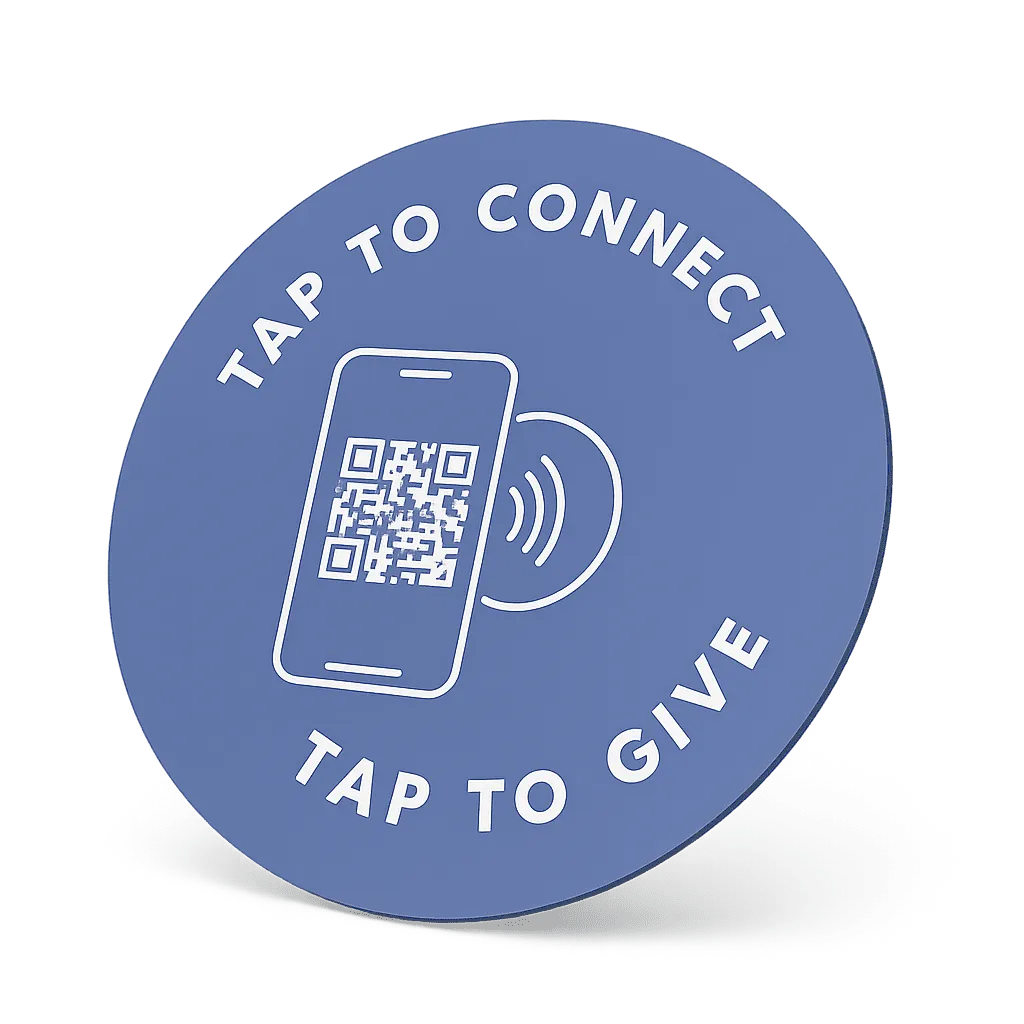
Tap discs and tap plates for churches are the same product: a printed NFC device, usually about 4 inches across, programmed with the church’s giving URL so a phone tap opens the giving page. Tap.Giving plates start at $3.50 each (one-time, 400+) and work with Tithely, Pushpay, Subsplash, Donorbox, and any other platform with a mobile-friendly giving page. The only meaningful difference between vendors is whether the hardware comes with a recurring software subscription or not.
See your church's plate and price in 30 seconds
Design it yourself on the next page. From $3.50 per plate, free shipping, no monthly fees.
What’s the Difference Between a Tap Disc and a Tap Plate?
Functionally, nothing. A tap disc and a tap plate are the same device, sold by different vendors using different words. Both are small printed circles, roughly 4 inches across, with an NFC chip and a copper antenna laminated inside. Both store a single web address. Both work with the phone in any churchgoer’s pocket without an app.
If a vendor uses the word “disc,” they’re usually emphasizing the shape and finish. If a vendor uses the word “plate,” they’re leaning on the offering-plate metaphor that congregations already understand. Tap.Giving falls in the plate camp because pastors and board members recognize what a plate is at a glance. Overflow uses disc. The underlying NFC giving hardware is the same.
Quick translation guide
- Tap disc / NFC disc / giving disc = the same hardware
- Tap plate / NFC tap plates / collection plate = the same hardware
- NFC tag / NFC sticker / NFC tap tag = often a thinner version of the same chip, no printed disc
- Tap-to-give / tap and give / contactless giving = the action, not the hardware
How a Tap Disc or Tap Plate Actually Works
The mechanism is simpler than the marketing makes it sound. A church member holds their phone within an inch or two of a plate mounted on the pew or chair in front of them. The phone’s NFC reader sends out a small magnetic field, that field powers the passive chip inside the plate for a fraction of a second, and the chip transmits a URL back to the phone. The phone shows a banner: Open giving page. One tap, the giving page opens in the existing browser, and the giver chooses an amount.
The whole interaction takes about eight seconds for a first-time giver. No app store, no signup, no login, no QR scan. Whether your team calls the action tap to give or tap to donate, the donation flows through your existing giving platform exactly as it would for any other online gift, including the receipt, the donor record, and the deposit to your bank.
NFC is the same chip standard that powers Apple Pay and Google Pay. Every iPhone since the iPhone XS (2018) reads NFC by default. Every mainstream Android phone since around 2014 reads NFC by default. If a phone can tap to pay at a coffee shop, it can tap a plate. That installed base is why NFC giving
For the full walkthrough of the giver experience, see How Tap to Give Works for Churches. For the case against the QR alternative, see QR Codes vs NFC for Church Giving.
Who Calls Them What: Discs, Plates, and Tags
The vocabulary churches encounter while shopping for a tap disc for churches comes down to a vendor preference. Here is how the main players describe their hardware in 2026.
| Vendor | What They Call It | Hardware Pricing Model |
|---|---|---|
| Tap.Giving | Tap plate / NFC tap plates | One-time $3.50 to $5.00, no monthly fee |
| Overflow | Tap disc / Overflow Tap disc | ~$13 per disc plus annual platform fee |
| Subsplash | Subsplash Tap plates | Hardware bundled with Subsplash subscription |
| Clearstream | NFC tags | $1 to $2 per tag (sticker form, no printed disc) |
| Donorbox | TapTag | Hardware add-on to Donorbox plans |
The shape, the chip standard, and the giver experience are nearly identical across the list. What differs is whether the price you see is one-time or recurring, and whether the church is locked into the vendor’s software stack. For a deeper look at one of the better-known disc vendors, read Overflow Tap vs Tap.Giving.
What You Actually Pay for Tap Discs and Tap Plates
The hardware itself is roughly the same product no matter who prints it. What differs is the business model wrapped around it. For a small church making a one-time hardware purchase, that distinction can mean thousands of dollars over a few years.
Tap.Giving (one-time)
- 100-199 plates: $5.00 each
- 200-399 plates: $4.00 each
- 400+ plates: $3.50 each
- Free shipping. No monthly fees.
- 7-day first-order discount: 10% off
Subscription-based vendors
- Hardware: often $10 to $15 per disc
- Plus annual platform fee (Overflow lists about $1,200/year)
- Plus payment processing (typically 2.9% + $0.30)
- Hardware sometimes “free” if you sign a software contract
A 200-seat church ordering 200 Tap.Giving plates pays $800 once. A comparable subscription-bundle quote can run $1,500 to $3,800 in year one and another $1,200+ each year after. Across five years, the gap commonly hits $7,000 or more on identical-looking hardware. For the full math, see our pricing page or the detailed breakdown in Overflow Tap vs Tap.Giving.
Worth saying plainly: we’re hardware only. Tap.Giving doesn’t replace your existing giving platform and doesn’t take a cut of donations. The 2.9% + $0.30 processing fee you already pay your platform stays where it is. Adding plates doesn’t change it, and you can order plates without switching anything else.
How to Decide Quantity and Mount Type
The two practical decisions for a church NFC disc rollout are how many to buy and how to mount them. Both are easier than they sound.
Quantity by church size
The standard target is one plate per seat in the worship space, plus a small spare pool for the foyer, kids check-in, guest tables, and the front desk. Our 100-plate minimum order covers most small congregations in a single purchase. Larger churches that drop into the volume tiers usually order in this rough range:
- Small church (under 100 seats): 100 plates @ $5.00 = $500 total, leaves a generous spare pool
- Mid-size church (200 seats): 200 plates @ $4.00 = $800 total
- Large church (400+ seats): 400 plates @ $3.50 = $1,400 total, drops you into the lowest per-plate price
- Multi-site or campus rollout: 600-1,000+ plates; we’ll quote directly if you need a single order across locations
Mount type by furniture
Tap.Giving plates ship with an adhesive backing as the default. For most pews and pulpit shelves, the adhesive holds for years. We also offer two alternatives:
- Pre-drilled screw holes for wooden pews and pulpits where adhesive isn’t welcome. Plates still ship with the adhesive layer; you can use either.
- Pre-drilled screw holes for stackable chairs without a solid back. Two holes, positioned so the plate sits flat at the top edge.
For a step-by-step mounting guide on different chair styles, see How to Boost Church Giving With NFC Donation Plates and the broader Church NFC Tags Complete Guide.
The Setup Workflow, Start to Finish
From the day a church places an order to the first Sunday a plate is tapped, the timeline runs about two to three weeks. There are five things the church does and one thing the manufacturer does.
- Send us your logo and giving URL. A vector logo (.ai or .svg) prints crispest. The URL is whatever giving page your platform already gives you.
- Approve the free mockup. The editable proof instantly shows the plate front (logo, “Tap to Give,” and QR fallback) before any plates are made.
- We manufacture and ship. Production runs about a week. Shipping adds another week or two. We pad the estimate to two to three weeks total so you’re not surprised.
- Mount the plates. A volunteer team can usually handle 200 plates in 60 to 90 minutes.
- Announce from the stage. A 30-second demo on a Sunday is the single most important moment of the rollout. Our launch kit includes a script and a slide.
Most churches see their first plate tap on the first Sunday after install and reach steady-state participation within three to four weeks. That cadence matches the four-week rollout plan we recommend.
Ready to add tap-to-give to your church?
One-time hardware cost. No monthly fees. Works with the giving platform you already use. Whether you call them tap discs or tap plates, the math is the same.
Start a quote to get 10% off for 7 days
FAQ: Common Buyer Questions
Is a tap disc the same thing as a tap plate?
Yes. Tap disc, tap plate, NFC giving disc, and NFC tap plate all describe the same device: a small printed disc with an NFC chip programmed with your church’s giving URL. The differences are cosmetic (size, mounting, branding) and pricing, not functional. Overflow calls them discs; Tap.Giving and Subsplash call them plates; Clearstream calls them NFC tags. All of them open the same giving page the same way.
How much does a tap disc or tap plate cost for a church?
Tap.Giving plates are one-time purchases at $5.00 each for 100 to 199, $4.00 for 200 to 399, and $3.50 for 400 or more, with free shipping and no monthly fees. Some subscription-based vendors charge significantly more (Overflow Tap, for example, lists discs at about $13 each plus an annual platform fee). The hardware cost is similar across brands; the recurring software cost is where the difference shows up.
Do tap plates work with Tithely, Pushpay, Donorbox, and other giving platforms?
Yes. Tap.Giving plates are programmed with whatever giving URL you already use, so they work with Tithely, Pushpay, Subsplash, Donorbox, Givelify, Anedot, Planning Center Giving, Nucleus Giving, and any other platform that has a mobile-friendly giving page. The plate is not a payment processor; it’s a sign-post pointing at the URL your platform already hosts.
How many tap plates does a church need?
A common rule of thumb is one plate per seat in your worship space, then a handful of spares for guest tables, the foyer, and kids check-in. A 150-seat church usually orders 150 to 175 plates; a 400-seat church orders 400 to 450. Our minimum order is 100 plates, which still covers most small and mid-size churches in a single purchase.
How do tap discs and tap plates mount to chairs or pews?
Tap.Giving plates ship with an adhesive backing that holds on wood, plastic, and most chair fabrics. For wooden pews and pulpits, pre-drilled holes are available for screws. For chairs without solid backs, pre-drilled screw holes are the better mount. A volunteer team can mount about 200 plates in 60 to 90 minutes.
Does a tap disc need a battery or internet connection?
No. NFC tap discs and tap plates are passive: no battery, no Wi-Fi, no internet of their own. The phone’s NFC reader powers the chip for the half-second it’s near the plate, and the chip transmits a URL back. The plate keeps working for years with no maintenance because there are no moving parts and nothing to recharge. NFC itself is a well-documented standard; if you want the technical background, the Wikipedia entry for near-field communication is a good starting point.
How long does it take to receive tap plates after ordering?
Plan on two to three weeks from artwork approval to delivery. The editable proof is available instantly, and production begins after you approve the final artwork. Most churches start three to four weeks ahead of a stewardship Sunday, Easter, or Christmas.
Related Articles
NFC Giving Explained: A Church Tech Team’s Complete Guide
The technical companion: chip standards, phone compatibility, locking, and troubleshooting.
ComparisonOverflow Tap vs Tap.Giving: Disc Pricing Compared
A direct dollar-by-dollar comparison of one of the better-known disc vendors versus our one-time plate pricing.
GuideHow Tap to Give Works for Churches
A plain-English walkthrough of the giver experience, the chip inside the plate, and the money path.