5 Church Giving Mistakes That Cost You Thousands
(And How to Fix Them)
Most churches leave thousands of dollars on the table every year, not because people don’t want to give, but because the church makes it too hard. Here are the five biggest culprits.
See your church's plate and price in 30 seconds
Design it yourself on the next page. From $3.50 per plate, free shipping, no monthly fees.
Relying on a Single Giving Channel
The Mistake
Your church offers one way to give, maybe an app, maybe a website link, maybe just the offering plate, and expects it to work for everyone.
Here’s the reality: no single giving method reaches more than 25% of your congregation. App-only giving misses the 68% of members who never download the app. Cash-only misses the 73% of Americans under 40 who rarely carry cash. A website link in the bulletin misses anyone who doesn’t read the bulletin.
The most effective church giving strategies in 2026 layer 2-3 channels: an online platform for recurring/remote gifts, NFC tap plates for in-service giving, and optionally text-to-give or QR codes as a backup. Different people respond to different methods.
The Fix
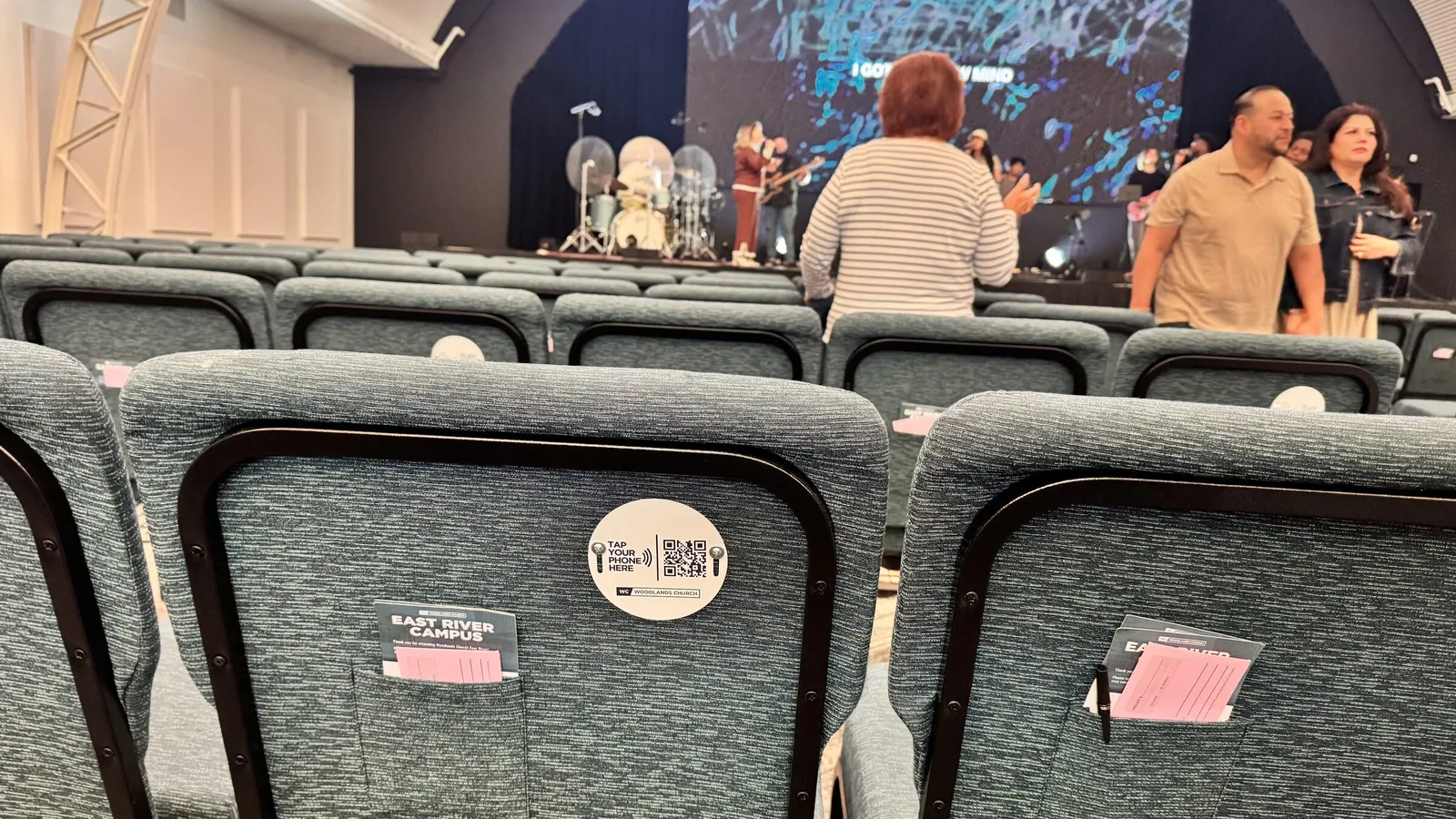
- Add NFC tap plates to every seat for in-service giving ($3.50 to $5.00/plate, one-time)
- Keep your online giving platform for recurring and remote gifts
- Add a QR code to the bulletin as a free third option
Read our complete technology guide for help choosing the right combination.
What It Costs You
Churches using only one giving channel collect 30-50% less than those using multiple channels. For a church averaging $5,000/week in giving, that’s $1,500 to $2,500/week left on the table, or $78,000 to $130,000 per year.
Making First-Time Giving Too Hard
The Mistake
Requiring an app download, account creation, or multi-step process before someone can give for the first time.
Every step you add between “I want to give” and “I just gave” eliminates 20-30% of potential givers. A typical app-based giving flow has 6-8 steps: download app → create account → verify email → enter payment info → select fund → enter amount → confirm. That’s a 6-step funnel with a ~15% completion rate for first-timers.
Now consider NFC: tap phone → giving page opens → enter amount → pay with Apple/Google Pay. That’s 3 taps and 10 seconds. The completion rate is dramatically higher because there’s no account to create, no app to download, no password to remember.
The Fix
- Use NFC plates that open your giving page directly, no app required
- Ensure your giving page supports Apple Pay and Google Pay for instant checkout
- Never require account creation to give (offer it after the gift)
- Test your giving flow yourself, time it from start to finish
See our guide on church giving without an app for a deeper dive.
What It Costs You
If your church gets 400 first-time visitors per year and only 5% give (with no app to install), you’re missing 192 first-time gifts per year at ~$45 each = $8,640 per year in lost first-time giving.
Ignoring the Offering Moment
The Mistake
Telling people “you can give online at our website” instead of providing a way to give right now, in this moment, from their seat.
The moment of highest generosity is during worship, not afterwards in the parking lot, not later at home, not next Tuesday when they remember. Studies show giving intention drops 60% within 60 seconds after the offering moment passes.
Many churches have accidentally de-emphasized the offering by going fully digital. They removed the physical offering plates, put a URL on the screen, and hoped people would give later. They don’t. The churches that thrive financially in 2026 are the ones that make the offering moment easier, not invisible.
The Fix
- Keep a tangible offering moment in every service
- Mount NFC plates on pew backs so giving happens at the seat, during worship
- Make a brief, compelling giving invitation each week (not apologetic, confident)
- NFC works in dimly lit sanctuaries where QR codes and screens fail
Read about the modern offering plate to see how churches are reimagining this moment.
What It Costs You
Churches that eliminated the physical offering moment report 10-20% drops in total giving. For a church with $250,000 in annual giving, that’s $25,000 to $50,000 per year.
Never Asking for Recurring Commitments
The Mistake
You accept one-time gifts gladly but never systematically encourage people to set up recurring giving.
Recurring givers contribute 42% more annually than one-time givers. They also give more consistently through low-attendance months like summer. Recurring giving is the financial backbone of stable church budgets.
Yet most churches never make a direct, specific ask for recurring giving. They mention it in passing. They put a checkbox on the giving page. That’s not a strategy, it’s a hope.
The Fix
- Run a “recurring giving challenge” once per quarter
- Use NFC plate links that default to “recurring” mode on your giving page
- Thank recurring givers publicly (without amounts) to normalize the behavior
- Share the “why” of recurring giving: “It helps us plan and budget for ministry”
Summer giving slumps hit harder when you lack recurring givers. Read our summer giving slump survival guide.
What It Costs You
If 20 members switched from random one-time gifts (~$100/month) to committed recurring giving (~$142/month), that’s an extra $10,080 per year from the same 20 people.
Paying Monthly Fees for Hardware You Could Own
The Mistake
You’re paying $50 to $200/month for giving kiosks, NFC subscriptions, or platform lock-in fees when one-time alternatives exist.
Many church giving solutions charge monthly fees for hardware that should be a one-time purchase. A giving kiosk at $150/month costs $1,800/year. Overflow Tap starts at $208/month ($2,496/year) before you buy any hardware. Clearstream NFC requires a $20/month subscription ($240/year). These subscriptions compound year after year.
Subscription Model
- Overflow Tap: $208 to $833/month
- Giving kiosk service: $100 to $200/month
- Clearstream NFC: $20/month + hardware
- 3-year cost: $7,200 to $36,000+
One-Time Model
- Tap.Giving: $500 for 100 plates
- Monthly fees: $0
- Transaction fees: $0 (from us)
- 3-year cost: $500 (same plates, forever)
The Fix
- Audit every monthly tech fee your church pays for giving infrastructure
- Replace subscription-based NFC with Tap.Giving’s one-time model
- Consider whether giving kiosks are worth $1,800+/year vs. NFC at $500 once
- Choose platform-agnostic tools so you can switch giving platforms without replacing hardware
See our head-to-head comparisons: all platforms compared | kiosk vs. NFC
What It Costs You
A church paying $200/month for giving hardware subscriptions over 5 years spends $12,000. Tap.Giving’s one-time investment of $500 does the same job, saving $11,550 over 5 years.
Your 30-Day Fix-It Action Plan
You don’t have to fix all five at once. Here’s a practical 30-day plan to start recovering the giving you’re losing.
Week 1: Audit
- List every giving channel your church currently offers
- Time your first-time giving flow (every step, door-to-done)
- Calculate your total monthly giving tech subscription costs
Week 2: Order & Plan
- Order NFC tap plates for every seat
- Set up your giving page URL for NFC (works with any platform)
- Plan your giving invitation script for the offering moment
Week 3: Install & Announce
- Mount plates on pews/chairs
- Announce NFC giving from the stage with a simple demo
- Run a “try it once” challenge for the congregation
Week 4: Measure & Optimize
- Compare this month’s giving to last month
- Count first-time digital gifts (your platform tracks this)
- Launch a recurring giving challenge for the next 4 weeks
Stop leaving money on the table
100 NFC plates. $500 one-time. No monthly fees. Works with Tithely, Pushpay, Givelify, and any giving platform.
Start a quote to get 10% off for 7 days
Related Articles
How to Increase Online Giving at Your Church
Practical strategies to boost digital giving participation and average gift size.
ROI7 Ways NFC Plates Pay for Themselves in 90 Days
The dollar-for-dollar math on how churches recoup their NFC investment.
StrategyChurch Giving for Millennials & Gen Z
How to reach younger generations who give differently than their parents.