How theaters collect donations when nobody carries cash
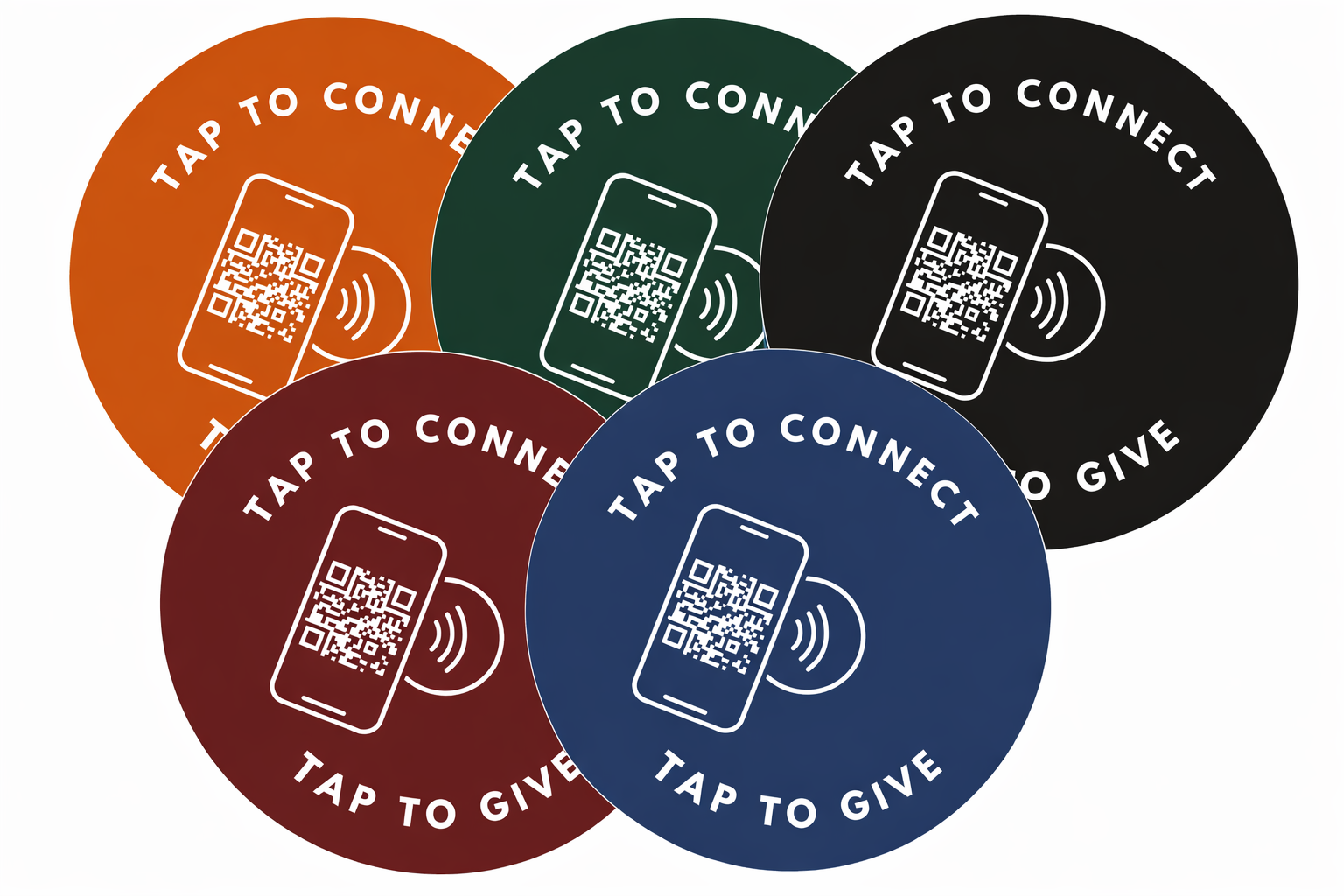
Theaters collect donations without cash by putting the donation page where the patron is sitting. A small NFC disc on the seatback or lobby wall opens the theater's existing donation page when a patron holds a phone to it, in seconds, with no cash, no line, and no app. The hardware is a one-time cost, and the theater keeps whatever donation platform it already uses. Here is why the old cash ask stopped working, and what replaces it.
Why did the cash ask stop working?
Your patrons did not get less generous. They stopped carrying cash. The impulse that used to fill a bucket by the lobby doors is still there at the curtain call. The dollar bills that used to answer it are not in anyone's pocket anymore.
The Federal Reserve measures this every year. In its 2024 Diary of Consumer Payment Choice, cash made up about 16 percent of payments in 2023, down from 31 percent in 2016. A patron who once dropped a five in the bucket now reaches for a pocket that holds a phone and a card, and nothing else.
That matters more for a theater than for most businesses, because earned income rarely pays the bills. Contributed income, the donations and grants raised on top of ticket sales, makes up a large share of a nonprofit theater's budget, as the Theatre Communications Group has tracked for years in its Theatre Facts reports. When the easiest small gift, the cash in the lobby, quietly disappears, the gap does not. It just moves to the fundraising team.
When is a patron most ready to give?
At the curtain call, not ten minutes later in a line. A patron feels the most generous in the seconds after the lights come up, while the show is still working on them. That feeling has a short shelf life.
By the time the same patron reaches the lobby, the spell has broken. They are finding a coat, texting the sitter, and deciding where to park the rest of the evening. A donation table competes for those minutes and usually loses, not because the person stopped caring but because the moment passed.
Intermission has the same problem. Fifteen or twenty minutes sounds like plenty, until you remember it is also restrooms, concessions, and conversation. The ask that lands is the one a patron can act on from the seat, before the feeling fades and before they have to stand in anyone's way.
What are the cashless options, and where does each fall short?
There are four common ways to collect a cashless gift in a theater, and only one of them meets the patron in the seat. It helps to be honest about the trade-offs before you buy anything.
- The lobby card reader or kiosk. It accepts a tap or a swipe, but it lives in the lobby, so it inherits the lobby's problem: the patron has already left the moment behind, and now there is a line and a staffer to pay for.
- A QR code in the printed program. Free to print, and useless in a dark house. A QR code needs light, a working camera, and a steady hand to frame it, which is exactly what an auditorium during a show does not offer.
- Text-to-give. The patron types a number and a keyword, waits for a reply, then taps a link. It works, but it is several steps, and most text-giving platforms add their own monthly or per-message fees on top of your processor.
- A tap-to-give disc at the seat. The patron holds a phone to the disc on the seatback, and the donation page opens. It works by touch, so the dark does not matter, and the gift happens before the patron ever stands up.
The pattern is simple once you see it. Every option except the last one asks the patron to move, to aim, or to type. The tap removes all three, which is why it fits the one moment that actually converts.
How does tap-to-give actually work at a theater?
A patron taps, your page opens, they give where they already give. Nothing about it is new for the patron, and nothing about it changes the platform you already use.
- A patron holds a phone to the disc on the seat in front of them. The NFC chip inside hands the phone a web address.
- Your donation page opens in the phone's browser. It is the page you already use, on the platform you already use.
- They give there, the way they already give online. The disc never touches the money.
The discs go on seatbacks, lobby walls, box office counters, and gala tables, mounted the same way they are on the backs of pews. Because the destination lives in a free dashboard rather than on the disc itself, you can point every disc in the house at a gala campaign on Friday and back at your main donation page on Saturday, with no reprinting. We lay out the vertical in full on the tap-to-give discs for theaters page.
Full disclosure on who is writing this. I build Tap.Giving, so I am not a neutral party. Here is the plain version anyway: Tap.Giving discs are $3.50 to $5.00 each, one time, with free shipping and no monthly fees. We sell the discs. You keep the donation platform you already chose, and the disc just opens your existing page when someone taps a phone to it. If a QR code in your program already works for you, keep it. The tap is for the patron sitting in the dark who will never pull out a program to scan it.
What does it cost, and why is there no monthly fee?
Discs are printed hardware, bought once, so there is nothing to subscribe to. Pricing drops as the quantity rises:
- 100 to 199 discs: $5.00 each
- 200 to 399 discs: $4.00 each
- 400 or more: $3.50 each
Walk the math for a real house. A 300-seat regional theater that orders one disc per seat pays 300 at $4.00 each, which is $1,200, one time. Add a dozen discs for the lobby and the box office and you are still inside the same tier. There is no setup fee, no monthly fee, and no per-gift fee from us, because we are selling you a printed object, not a subscription.
The minimum order is 100 discs, shipping is free, and turnaround is usually about 2-3 weeks from the day you approve the artwork, which is an estimate rather than a promise. You get a free proof of your own theater's disc before anything is printed, and there is a 30-day money-back guarantee. If you want to see the number for your seat count, the pricing page lays out every tier, or you can design your own disc and see its price on the order page.
The old cash bucket worked because it met people in the moment with nothing to download. A disc on the seatback does the same job for a room full of phones. For the wider picture of how contactless giving replaces the plate and the bucket, see how tap-to-give works.
Frequently asked questions
How do theaters collect donations if patrons do not carry cash?
They move the donation to the phone every patron already has. A tap-to-give disc on the seatback or lobby wall opens the theater's existing donation page when a patron holds a phone to it, so the gift happens in seconds with no cash, no line, and no app.
Does a tap-to-give disc work in a dark auditorium?
Yes. A tap works by touch, not by sight, so it does not need light, a camera, or steady aim the way a QR code does. Every disc also carries a printed QR code as a backup for the few phones that cannot tap.
Does Tap.Giving take a percentage of theater donations?
No. Tap.Giving sells the hardware and is never in the payment path. Donations run on the platform you already use, under your existing arrangement with it. The discs are a one-time cost with no monthly fee and no per-gift fee from us.
See your organization's disc and price in 30 seconds
Design it yourself on the next page. From $3.50 per disc, free shipping, no monthly fees.
Related Articles
Tap-to-Donate Plates for Nonprofits
The same seat-side giving, built for any nonprofit that gathers a crowd.
Theater Fundraising Ideas That Don't Interrupt the Show
Fundraising that happens in the seat, without stopping the show.
Tap-to-Give Discs for Theaters
The full vertical page: costs, placements, and setup.