NFC Tap-to-Donate Plates for Mission-Driven Nonprofits
Tap-to-donate plates are not just for churches. Any nonprofit with an online donation page can set a small NFC plate on a welcome desk, an event table, or a donation box and let supporters give in seconds by tapping their phone. Here is how they work, where to put them, and what they cost.
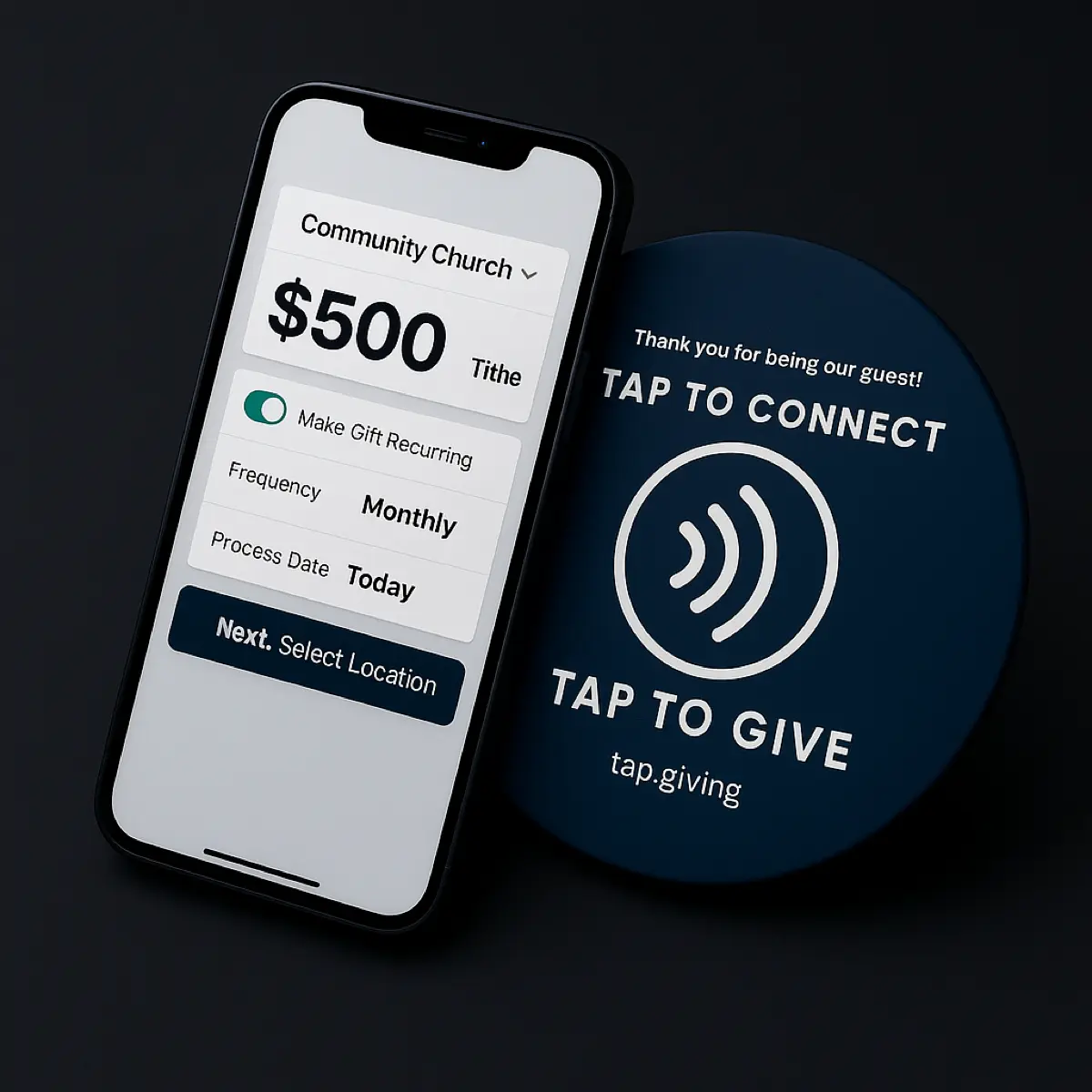
A tap-to-donate plate is a small, custom-branded card with an NFC chip inside that opens your donation page the instant a supporter taps it with a phone. It works for any nonprofit, not just churches, because it simply points at the online giving page you already use. The plates are a one-time hardware purchase with no monthly fees, and Tap.Giving is not a payment processor, so your existing platform keeps handling every dollar. For pricing, placement ideas by organization type, and the plain arithmetic on monthly fees, see the tap-to-donate plates for nonprofits page.
The short version
- ✓ One-time cost: $3.50 to $5.00 per plate by quantity, free shipping, 100 minimum
- ✓ No monthly fees and no transaction fees from Tap.Giving
- ✓ Works with the donation platform you already use (Givebutter, Donorbox, Zeffy, PayPal, Stripe, and more)
- ✓ Custom 4-inch plates, delivered about 2-3 weeks from artwork approval
- ✓ 30-day money-back guarantee
See your church's plate and price in 30 seconds
Design it yourself on the next page. From $3.50 per plate, free shipping, no monthly fees.
Tap-to-Donate Is Not Just for Churches
Tap.Giving started with churches, but nothing about the hardware is church-specific. The plate is a passive NFC chip programmed with a web address. When a phone taps it, that address opens. Point it at a food bank's donation page instead of a church's, and it works exactly the same way.
That matters because cash keeps fading. Pew Research Center found that 41% of U.S. adults made none of their typical weekly purchases with cash in 2022, up from 29% in 2018 (Pew Research Center). A donation box that only takes bills is quietly closing the door on the people most likely to walk past it.
Any mission-driven organization with a donation page can use a plate: food banks, homeless and domestic-violence shelters, animal rescues, museums and historic sites, schools and PTAs, community theaters and arts nonprofits, disaster-relief and missions groups, and volunteer fire departments. If you can hand someone a giving link, you can hand them a plate to tap.
How a Tap-to-Donate Plate Works
The experience is closer to tapping a card at a checkout than learning new software. Three steps, about eight seconds:
- A supporter holds their phone near the plate. No app to download, on either side. Every iPhone since 2018 and virtually every modern Android reads NFC with nothing to set up.
- Your donation page opens in their browser. The chip carries your giving URL, so the phone offers to open it with one tap.
- They give in seconds. They enter an amount and pay with Apple Pay, Google Pay, or a card. The gift flows straight into your existing platform, with its normal receipt and donor record.
The plate has no battery, no Wi-Fi, and no moving parts. See the full walkthrough on how it works.
Where Nonprofits Put Their Plates
Churches mount plates on pew backs and chairs. Everyone else puts them wherever a supporter already pauses. A few that work well:
- Welcome and reception desks: a plate in a small stand next to the sign-in sheet at a shelter or clinic.
- Event and gala tables: one plate per table centerpiece so guests give during the ask, not weeks later.
- Donation boxes and counters: a plate on the box itself for the visitor who has a phone but no cash.
- Exhibits and galleries: a museum places plates beside key displays with a "support this collection" line.
- Thrift stores and adoption desks: a plate at the register of a rescue's shop turns a browser into a donor.
- Festivals and pop-up booths: plates on a folding table for a fun-run or a farmers-market booth.
Plates come with adhesive backing or pre-drilled holes, so they stick to a table tent, a countertop stand, or a box without any special mounting.
What Tap-to-Donate Plates Cost
Plates are a one-time purchase. You pay once and own the hardware. There is no subscription and no per-gift fee from Tap.Giving.
| Quantity | Price per plate | One-time total |
|---|---|---|
| 100 to 199 | $5.00 | from $500 |
| 200 to 399 | $4.00 | from $800 |
| 400 or more | $3.50 | from $1,400 |
The comparison that matters for a nonprofit budget is the time dimension. Subscription giving tools bill you every month, year after year. A one-time plate order does not. A rescue that orders 100 plates spends $500 once and pays Tap.Giving nothing again. See the full breakdown on the pricing page.
Your donation platform still charges its normal processing fee on each gift (commonly around 2.9% plus $0.30), exactly as it does today. Adding plates does not add a fee; it just gives supporters a faster way to reach the page they were already going to.
Tap vs QR Codes
QR codes work, but they ask more of the donor: open the camera, frame the code, wait for it to focus, tap the link. A tap skips all of that. The phone comes near the plate and the page is already opening.
You do not have to choose. Every Tap.Giving plate has a QR code printed on the front as a fallback, so an older phone or a hesitant guest can scan instead of tap and land on the same page. One plate covers both habits.
Works With the Donation Platform You Already Use
Tap.Giving sells the hardware only. It is not a payment processor. The plates open whatever donation page you already have, so you keep your platform, your processor, your receipts, and your donor data. There is nothing to migrate.
That includes the tools nonprofits lean on most: Givebutter, Donorbox, Zeffy, PayPal, Stripe, Classy, Bloomerang, and a plain donation page on your own website. If it has a mobile-friendly URL, a plate can open it. If you use Donorbox or Givebutter, we have step-by-step guides for Donorbox and Givebutter.
We build the artwork for you. Send your logo and the donation URL, and you get an editable proof of your branded plate before anything is printed.
Change the Destination Anytime
Nonprofits run campaigns, and campaigns change. With the optional Smart Redirect, each plate points at a short link you control, so you can send this month's taps to a year-end match, next month's to a disaster-relief fund, and the following season's to a capital campaign, all without reprinting a single plate.
Order the plates once, then repoint them as your mission's needs shift.
See your nonprofit's plate before you order
Start a free design and you will see your branded plate and your price instantly, with your logo and your donation page already on it. New orders get 10% off, good for 7 days from the quote.
Design your plateFrequently Asked Questions
Do tap-to-donate plates only work for churches?
No. The plate simply opens a web page when a phone taps it, so it works for any nonprofit that has an online donation page. Food banks, shelters, animal rescues, museums, schools, and missions groups all use them. Tap.Giving started with churches, but the hardware is not church-specific.
Do I need a special payment processor or donation platform?
No. Tap.Giving sells the hardware only. The plates open whatever donation page you already use, whether that is Givebutter, Donorbox, Zeffy, PayPal, Stripe, Classy, or your own website. Your existing platform handles the payment, the receipt, the donor record, and the deposit.
What do tap-to-donate plates cost a nonprofit?
Plates are a one-time purchase: $5.00 each for 100-199, $4.00 each for 200-399, and $3.50 each for 400 or more, with free shipping and a 100-plate minimum. There are no monthly fees and no transaction fees from Tap.Giving. Your donation platform charges its normal processing fee, which does not change when you add plates.
Can I change where a plate points after it is printed?
Yes, if you use the Smart Redirect option. Each plate can point at a short link you control, so you can repoint it to a year-end campaign, a disaster-relief fund, or a new donation page at any time without reprinting a single plate.
Related Articles
How Tap to Give Works: A Plain-English Walkthrough
What the giver experiences, what is inside the plate, and how it fits your existing platform.
GuideThe Low-Cost Alternative to a Giving Kiosk
Why a tap plate beats a $2,000 kiosk for most in-person donation moments.
GuideThe Cheapest Way to Add Contactless Giving
A cost-first look at contactless donation options and where tap plates land.