Theater Fundraising Ideas That Don't Interrupt the Show
The best theater fundraising ideas work around the performance, not during it. You raise money in the moments the show already gives you, the curtain call, intermission, the program, the lobby, and the gala, and you make the gift itself take seconds so the moment is never lost to a line or a login. Below are the asks that fit a working house, and the one change that makes every one of them faster: putting the donation page at the seat.
Why do the best theater fundraising ideas work around the show, not during it?
Patrons came for the art, so the ask has to respect it. Nobody wants a fundraising pitch jammed into the middle of a second act, and no development director wants to be the reason a review mentions one. The money is not in the show. It is in the moments the show already hands you: the hush after the bows, the fifteen minutes of intermission, the program in every lap, the walk through the lobby.
Those moments share one feature. They are short. A patron who is moved at the curtain call is moved for about as long as it takes the house lights to come up. An idea only works if the patron can act inside that window, from where they are sitting, without being asked to stand, aim, line up, or type.
That is also why the shift to cashless matters here more than almost anywhere. The Federal Reserve's 2024 Diary of Consumer Payment Choice found cash was about 16 percent of payments in 2023, down from 31 percent in 2016. The lobby bucket worked because a moved patron had a five in a pocket. Most patrons no longer do. The ideas below assume the only thing a patron is carrying is a phone.
How do you turn the curtain call into a giving moment?
One honest line from the stage, and a way to give that is already at the seat. The curtain call is the single highest-emotion moment of the night, and it costs nothing to use. An artistic director or a cast member steps forward for ten seconds: "If tonight meant something to you, there is a tap disc on the seat in front of you. Your gift keeps this stage lit." Then the bows continue.
That works only if acting on it is instant. If the ask ends with "visit our website" or "find us in the lobby," the feeling is gone before the patron gets there. If it ends with a tap they can do without leaving the row, the gift happens while the room is still full and still moved. The line does the asking; the seat does the collecting.
Keep it to one sentence and one night a run, not every performance. An appeal that shows up at every curtain call stops feeling like gratitude and starts feeling like a telethon.
What can the program and the lobby do that an announcement can't?
They reach the patron who would never respond to a spoken ask, on their own time. Not everyone gives in the heat of the curtain call. Some decide at intermission, some in the quiet before the house opens, some on the way out. The printed program and the lobby are where those patrons live.
- A short appeal in the program. Half a page, not a full-page plea: what one gift pays for, and a tap-or-scan line to give right now. A patron reads the program in their seat, which is exactly where you want the gift to happen.
- A lobby-wall campaign by the doors. Mount a disc and a one-line appeal where every patron passes on the way in and out, including balcony and standing patrons who have no seatback of their own. A season campaign or a capital project can live here for months.
- Sponsor-a-seat or name-a-show boards. A classic that still works, now without the clipboard. A patron taps the board, lands on the campaign page, and names a seat from their phone while they are standing in front of it.
None of these interrupts anything. They sit in the room and wait for the patron who is ready, which is the opposite of a staffer calling across the lobby.
How do you raise money at intermission without a donation table nobody visits?
Stop competing with the restroom line and meet the patron in the row. Intermission sounds like plenty of time until you remember it is also restrooms, concessions, and conversation. A staffed donation table competes for those same minutes and usually loses, not because patrons stopped caring but because the clock is against them.
The patrons who stay in their seats at intermission, and many do, are the easiest gift in the building. A disc on the seatback lets them give in the thirty seconds before the lights dim again, without joining any line. For the patrons who do get up, a round-up at the concession counter, "add a dollar for the theater," captures the small gift that cash used to catch.
The rule is the same every time: the ask that converts is the one a patron can finish without giving up the thing they got up to do.
What about galas, opening nights, and special campaigns?
These are where the biggest single-night ideas live, and where repointing one disc beats reprinting anything. A gala, an opening night, or a capital campaign each wants the room pointed at a different page for one evening, then pointed back the next morning.
- A matching-gift moment. A board member pledges to match every gift given before the second act. Announce it, and let patrons give from their seats while the match is live. The urgency plus the instant tap is the whole engine.
- Table tap at the gala. A stand on every gala table, pointed at that night's campaign page, so a guest gives between courses without a paddle, a pledge card, or a trip to a table in the back.
- Peer-to-peer on the way out. Point the exit-door discs at a campaign page patrons can share, so the people who were moved tonight bring in the ones who were not there.
Because the destination lives in a free dashboard rather than on the disc, you aim the whole house at the gala page on Friday and back at your main donation page on Saturday, with nothing reprinted and no cap on how often you change it.
How do you make every one of these take seconds instead of minutes?
Remove the three things every ask secretly demands: moving, aiming, and typing. A lobby table asks the patron to move. A QR code in a dark house asks them to aim a camera they cannot steady. A "text GIVE to this number" ask makes them type and wait. Each step loses people, and in a theater the lights are usually too low for half of them anyway.
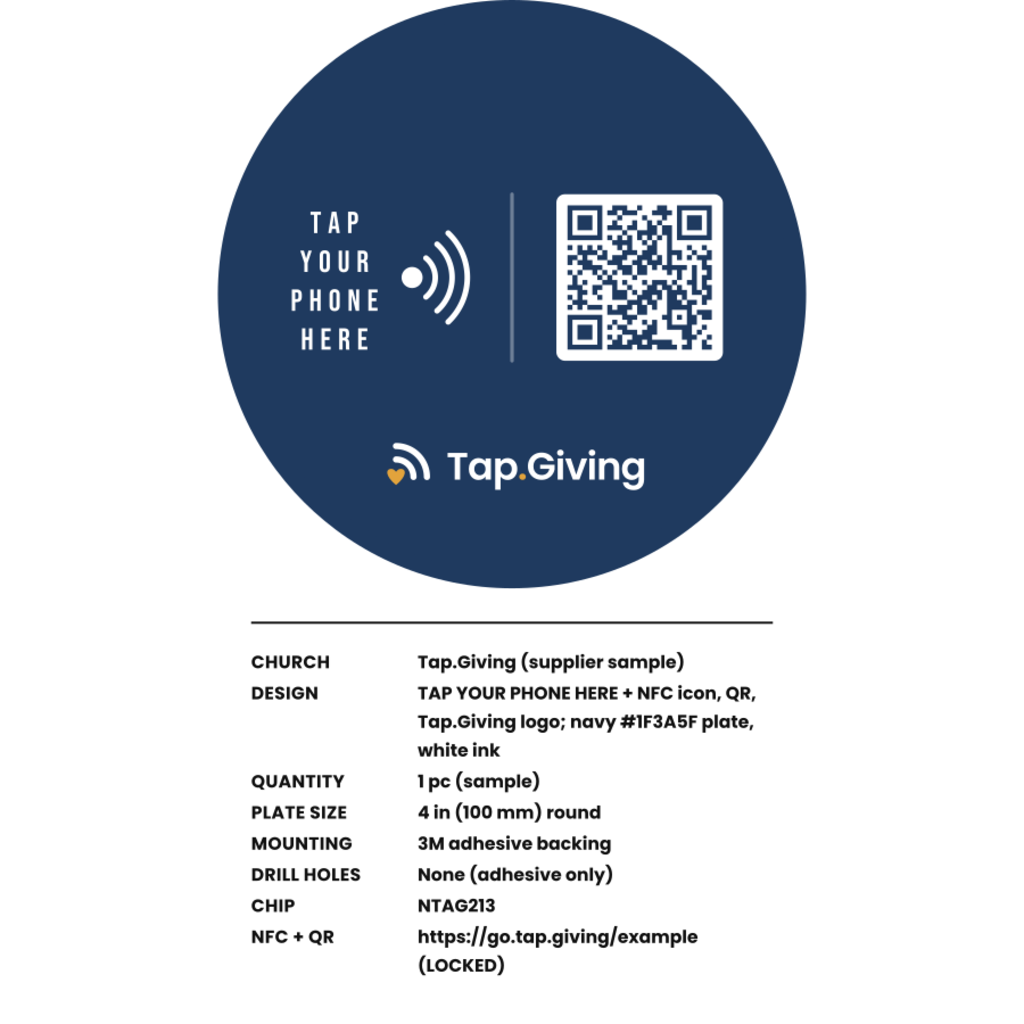
A tap-to-give disc removes all three. The patron holds the phone they are already holding against the disc on the seatback, and the theater's existing donation page opens in the browser. It works by touch, so the dark does not matter, and every disc carries a printed QR code as the backup for the few phones that cannot tap. There is no app to download and no account to create. We lay out the whole vertical, placements and all, on the tap-to-give discs for theaters page, and how tap-to-give works walks through the tap itself from the chip to the giving page.
Full disclosure on who is writing this: I build Tap.Giving, so I am not a neutral party. The plain version anyway: Tap.Giving discs are $3.50 to $5.00 each, one time, with free shipping and no monthly fees. We sell the discs. You keep the donation platform you already chose, and the disc just opens your existing page when someone taps a phone to it. If a QR code in your program already works for you, keep it. The tap is for the patron sitting in the dark who will never pull out a program to scan it. The same seat-side idea works for any nonprofit that gathers a crowd, which we cover in tap-to-donate plates for nonprofits.
What does seat-side giving cost to add?
Discs are printed hardware, bought once, so there is nothing to subscribe to. Pricing drops as the quantity rises:
- 100 to 199 discs: $5.00 each
- 200 to 399 discs: $4.00 each
- 400 or more: $3.50 each
Walk the math for a real house. A 300-seat regional theater that orders one disc per seat pays 300 at $4.00 each, which is $1,200, one time. Add a dozen for the lobby walls and the gala tables and you are still inside the same tier. There is no setup fee, no monthly fee, and no per-gift fee from us, because you are buying a printed object, not a subscription. Against even one matched-gift night or one capital appeal, the hardware pays for itself quickly.
The minimum order is 100 discs, shipping is free, and turnaround is usually about 2-3 weeks from the day you approve the artwork, which is an estimate rather than a promise. You get a free proof of your own theater's disc before anything is printed, and there is a 30-day money-back guarantee. To see the number for your seat count, the pricing page lists every tier, or you can design your own disc and see its price on the order page. If you want the longer argument for why patrons stopped giving cash and what replaces it, read how theaters collect donations without cash.
Frequently asked questions
What is the best way to ask for donations during a performance?
Ask around the performance, not during it. One short line at the curtain call, paired with a disc on the seatback that opens your donation page in seconds, raises money without pausing the show or breaking the mood.
How can a theater collect donations without a staffed table in the lobby?
Put the ask where patrons already are: a disc on the seatback, a short appeal in the program, and a campaign on the lobby wall by the doors. Each lets a patron give on their own phone, with no table and no staffer required.
Do these ideas require changing our donation platform?
No. Tap.Giving sells hardware only and is never in the payment path. Every idea here points patrons to the donation page you already use, on the platform you already chose. The disc is a one-time cost with no monthly fee and no per-gift fee from us.
See your organization's disc and price in 30 seconds
Design it yourself on the next page. From $3.50 per disc, free shipping, no monthly fees.
Related Articles
Theater Donations Without Cash
Why the lobby bucket stopped working, and what captures the gift now.
Tap-to-Donate Plates for Nonprofits
The same seat-side giving, built for any nonprofit that gathers a crowd.
Tap-to-Give Discs for Theaters
The whole theater vertical, placements and all, on one page.