See your church's plate and price in 30 seconds
Design it yourself on the next page. From $3.50 per plate, free shipping, no monthly fees.
Pushpay vs Zeffy for Churches: Which Giving Platform Fits?
The honest headline: Zeffy costs the church nothing and funds itself with an optional donor tip, while Pushpay is a paid all-in-one engagement platform that carries an annual contract plus per-gift processing. One is the cheapest way to take a gift online. The other is a full ministry system that happens to include giving.
Which One Should Your Church Pick?
Short answer: If you only need online giving and you want the church to pay nothing, pick Zeffy. It charges no platform fee and no processing fee, so the church keeps 100%, and it funds itself with an optional tip your donors can add at checkout. If you want one vendor to run your church app, your church-management software, and giving together, and you have the budget for it, pick Pushpay, which carries an annual platform contract plus per-gift processing. Both work with NFC tap-to-give plates so guests can give in the pew without typing a URL.
I'm a pastor, and I built Tap.Giving because our own church wanted an affordable way to add tap-to-give without ripping out the giving software we already used. So I want to be straight with you: this is not a story where one platform crushes the other. Pushpay and Zeffy are built for very different churches, and the money lands in very different places.
Below is what each one does well, where each frustrates churches, and how to decide based on what your weekend actually needs.
Zeffy Pricing & Features (2026)
As publicly listed by Zeffy in 2026. Verify before committing.
What Zeffy Is
Zeffy is giving and fundraising software that is free for the nonprofit. It handles donation forms, recurring gifts, receipting, event ticketing, and donor management. It has run this way across more than 100,000 nonprofits. Zeffy is software only: it does not sell a custom church app, a church-management suite, or NFC hardware.
Pricing (As Listed in 2026)
- Platform fee: $0. No monthly subscription.
- Card and ACH processing: $0 charged to the church. The church keeps 100% of what it raises.
- How it is funded: an optional tip your donor can add to Zeffy at checkout. Givers can set that tip to $0.
- Terms change: confirm the current model on Zeffy's pricing page.
Strengths for Churches
- Truly no cost to the church budget, which is hard to beat for a plant or a tight year.
- Recurring giving, receipting, and event ticketing included at no charge.
- Fast to stand up for a single donation page.
Trade-offs
- The cost does not vanish, it moves to your donors: a tip prompt is shown at checkout, and some givers find it confusing the first time.
- No custom church app, no church-management suite, and no media platform, this is giving software, not an all-in-one.
- Deeper reporting and staff workflows are thinner than an enterprise ministry platform offers.
Pushpay Pricing & Features (2026)
Pushpay does not publish pricing, so the figures below come from independent 2026 reviews. Get your own quote before committing.
What Pushpay Is
Pushpay is an all-in-one church engagement platform used by more than 14,000 churches. Giving is one piece of it, alongside a custom church app, church-management software (through its ChurchStaq and CCB tools), and congregation communications. Churches pick Pushpay when they want a single enterprise vendor for the whole digital stack, often across multiple campuses.
Pricing (Reported in 2026)
- Platform fee: Quote required. Pushpay lists no public price. Independent reviews report a typical annual contract of roughly $3,000 to $4,200, with monthly figures commonly cited between about $199 and $600.
- Tiers: three plans (Core, Advanced, Complete), scaled to church size and how much of the platform you use.
- Per-gift processing: reported at 2.9% plus $0.30 per card gift and about 1% plus $0.30 per ACH gift, charged on top of the platform fee.
- Contract: plans are annual and auto-renew, with a one-year minimum commitment.
Strengths for Churches
- One enterprise vendor for giving, a custom app, church management, and communications, which suits large and multi-site churches.
- Giving data flows into the same system your staff use for pastoral care and follow-up.
- Mature support, onboarding, and reporting built for higher-volume operations.
Trade-offs
- An annual platform contract plus per-gift processing is a real, ongoing cost that Zeffy's model avoids for the church.
- Pricing is quote-based, so you cannot compare the number on a public page before you talk to sales.
- The full value shows up when you use the app, management, and communications too. Paying for the ecosystem to run only giving is overkill.
Pushpay vs Zeffy at a Glance
The head-to-head for a church choosing between them
| Feature | Zeffy | Pushpay |
|---|---|---|
| Platform fee | $0 | Annual contract (~$3k+/yr reported, quote required) |
| Cost to the church per gift | $0 (donor tip funds it) | 2.9% + $0.30 card, ~1% + $0.30 ACH |
| Where the cost lands | On donors who tip | On the church (or donor-covered) |
| Recurring giving | Yes | Yes |
| Custom app & church management | No | Yes (all-in-one) |
| Contract | None | Annual, auto-renews |
| Best for | Cheapest possible giving, giving-only need | Large or multi-site churches wanting one full platform |
Zeffy figures as publicly listed in 2026; Pushpay figures reported by independent 2026 reviews (no public pricing page). Verify current rates before signing up.
How to Decide Between Them
Match the choice to what your church actually needs this year.
Plant or tight budget
Pick: Zeffy. When every dollar counts and you only need online giving, a model that costs the church nothing is hard to argue against. Just prepare your people for the tip prompt so it does not surprise a first-time giver.
Pair with: a few NFC plates on the welcome desk and front rows.
Large or multi-site
Pick: Pushpay. If you already want a custom app, church management, and communications from one enterprise vendor, adding giving there keeps staff logins and donor data in one place. The annual contract and per-gift processing are the price of that consolidation.
Pair with: 100-pack of NFC plates on every pew or chair.
Only need giving
Lean Zeffy if the app and management suite are not on your list. Paying an enterprise platform to use one slice of it rarely pencils out. Revisit Pushpay the year you actually want the whole system.
Pair with: 200-pack, every seat covered, lower per-plate cost.
Whichever way you lean, the right answer for in-service giving is the same: do not make people type a URL. Read our 2026 online giving platforms guide for the wider field, or our Pushpay pricing breakdown for a closer look at Pushpay costs. Weighing other options too? See Tithely vs Pushpay and how Zeffy compares to tap plates.
What Surprises Treasurers Later
Both platforms are honest about their headline terms. Here is what a church board tends to miss until the first statement lands.
Zeffy's cost is real, it just sits with donors
"100% free" is true for the church. But your donors see a tip request at checkout, and the ones who tip are effectively covering the cost. If a giver expects their whole gift to reach the church, walk them through it once so it reads as generosity, not a surprise.
Pushpay's real number is behind a quote and a contract
There is no public price, so budget from the quote you actually receive, not a headline range. Remember the annual commitment auto-renews, and that per-gift processing stacks on top of the platform fee, so the true yearly cost is the contract plus a percentage of everything you take in.
Paying for a platform to use one piece
Pushpay shines when you use the app, church management, and communications together. If you only want giving, the enterprise subscription is weight you may not need, which is exactly where Zeffy or a lighter tool wins.
QR signage that keeps getting reprinted
Whichever platform you pick, printed QR codes get bent, stained, and reprinted when your URL changes. NFC plates last for years and can be re-encoded to a new giving page without new artwork.
Add NFC Tap-to-Give to Either Platform
We sell the plates. You keep the platform you already chose.
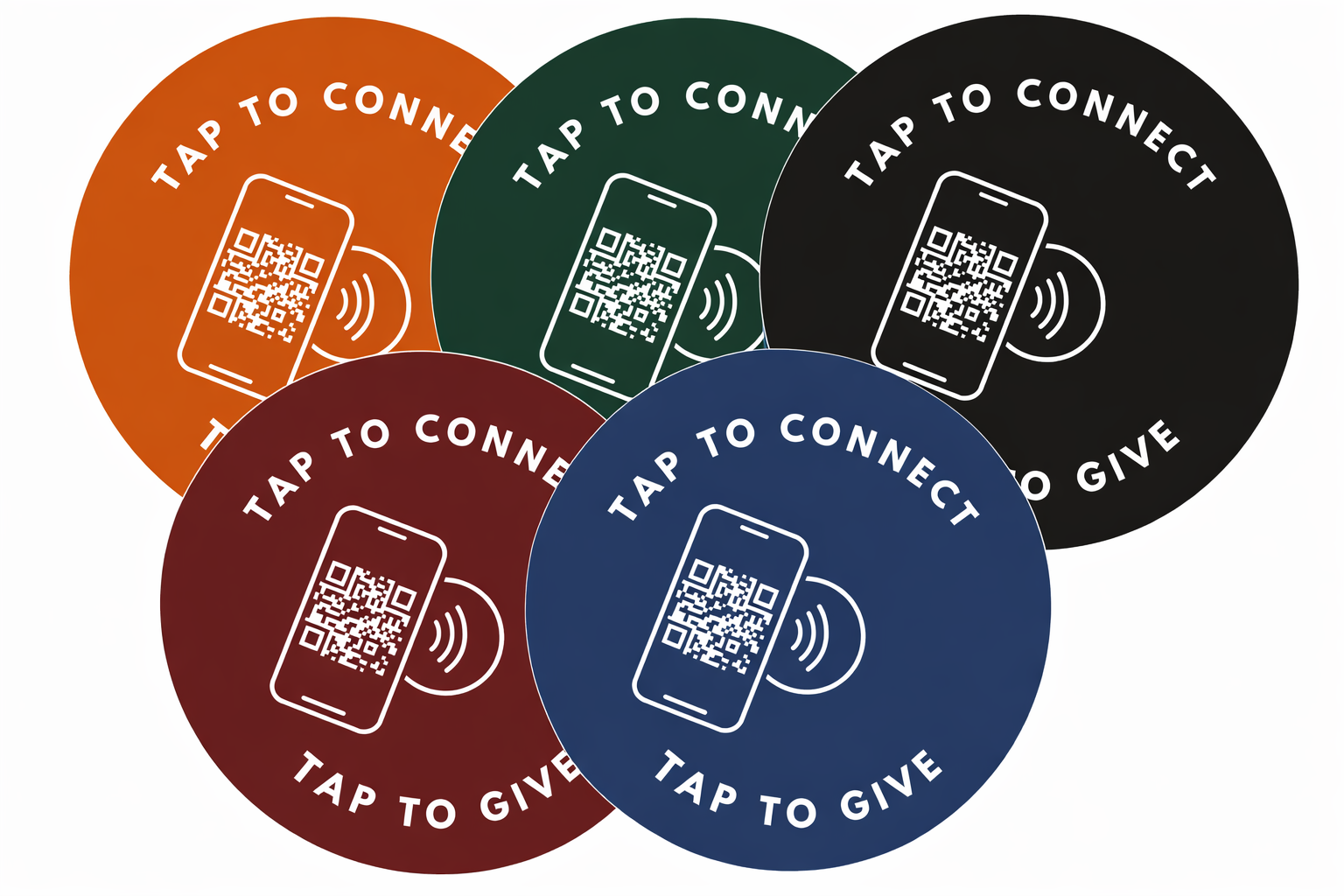
Tap.Giving does not process payments and does not compete with Pushpay or Zeffy. We sell physical NFC plates that mount on pew backs, chair backs, welcome desks, and lobby walls. Each plate is encoded with a web URL, your Pushpay giving page, your Zeffy donation form, anything you can open in a browser. A guest taps a phone to the plate and your giving page opens. No app, no QR code, no typing.
- One-time hardware cost, no monthly fees from us, ever.
- Works with Pushpay, Zeffy, Tithely, Givelify, Subsplash, any web URL.
- Free shipping; 2-3 weeks from artwork approval to delivery.
- First-time order? Start a quote to get 10% off for 7 days.
Want the wider field first? See our church donation technology guide for 2026 or the tap-to-give platform comparison.
Frequently Asked Questions
Is Zeffy really free for churches?
Yes. Zeffy charges churches no platform fee, no card-processing fee, and no monthly subscription, so the church keeps 100% of what it raises. Zeffy funds itself with an optional tip that donors can add at checkout, and donors are never forced to leave one. The trade-off is that a tip prompt is shown to your givers, and the effective cost is carried by the donors who choose to tip. Verify current terms on Zeffy's pricing page before committing.
What does Pushpay cost a church in 2026?
Pushpay does not publish its pricing, so the real number comes from a sales quote. Independent 2026 reviews report a typical annual contract in the range of about $3,000 to $4,200 for churches, sold in three tiers (Core, Advanced, Complete) with monthly figures commonly cited between roughly $199 and $600. On top of the platform fee, Pushpay charges per-gift processing, generally 2.9% plus $0.30 per card gift and about 1% plus $0.30 per ACH gift. Plans are annual and auto-renew. Confirm your own quote with Pushpay before committing.
Which is cheaper for a church, Pushpay or Zeffy?
For the church budget, Zeffy is almost always cheaper because it charges the church no platform fee and no processing fee, while Pushpay carries both an annual platform contract and per-gift processing. Pushpay earns its higher cost when a church actually uses the full engagement platform (custom app, church management, and communications), not just giving. If you only need online giving, Zeffy usually wins on cost. Both work with NFC tap-to-give plates from Tap.Giving.
Can I use NFC tap-to-give plates with Pushpay or Zeffy?
Yes. Tap.Giving plates can be encoded with any web URL, including your Pushpay giving page or your Zeffy donation form. A guest taps their phone to the plate and your giving page opens in the browser, with no app to install. Tap.Giving sells the hardware only; you keep whichever platform you already use.
Does Zeffy or Pushpay include a church app and management tools?
Pushpay is built as an all-in-one engagement platform: giving, a custom church app, church-management software (through its ChurchStaq and CCB tools), and communications under one vendor. Zeffy is giving and fundraising software only (donation forms, receipting, event ticketing, donor management) and does not build a custom church app or a full management suite. If the app and management tools matter to you, that difference usually decides the choice.
Whichever You Pick, Our Plates Work With It
Pushpay, Zeffy, or anything else, Tap.Giving plates link to whatever URL you give them. One-time cost. No monthly fees. Plates land on every pew or chair, and giving stops being awkward.
No monthly fees. Works with Pushpay, Zeffy, Tithely, Givelify, and more. Start a quote to get 10% off for 7 days.
Related Articles
Best Online Giving Platforms for Churches (2026)
A wider 2026 comparison of the major giving platforms for churches.
ComparisonPushpay Pricing and Fees in 2026
What churches actually pay for Pushpay's platform and per-gift processing.
GuideBest Church Donation Technology (2026)
How giving platforms, kiosks, and tap plates fit together.