See your church's plate and price in 30 seconds
Design it yourself on the next page. From $3.50 per plate, free shipping, no monthly fees.
Does Tap-to-Give Work With Your Church Accounting Software?
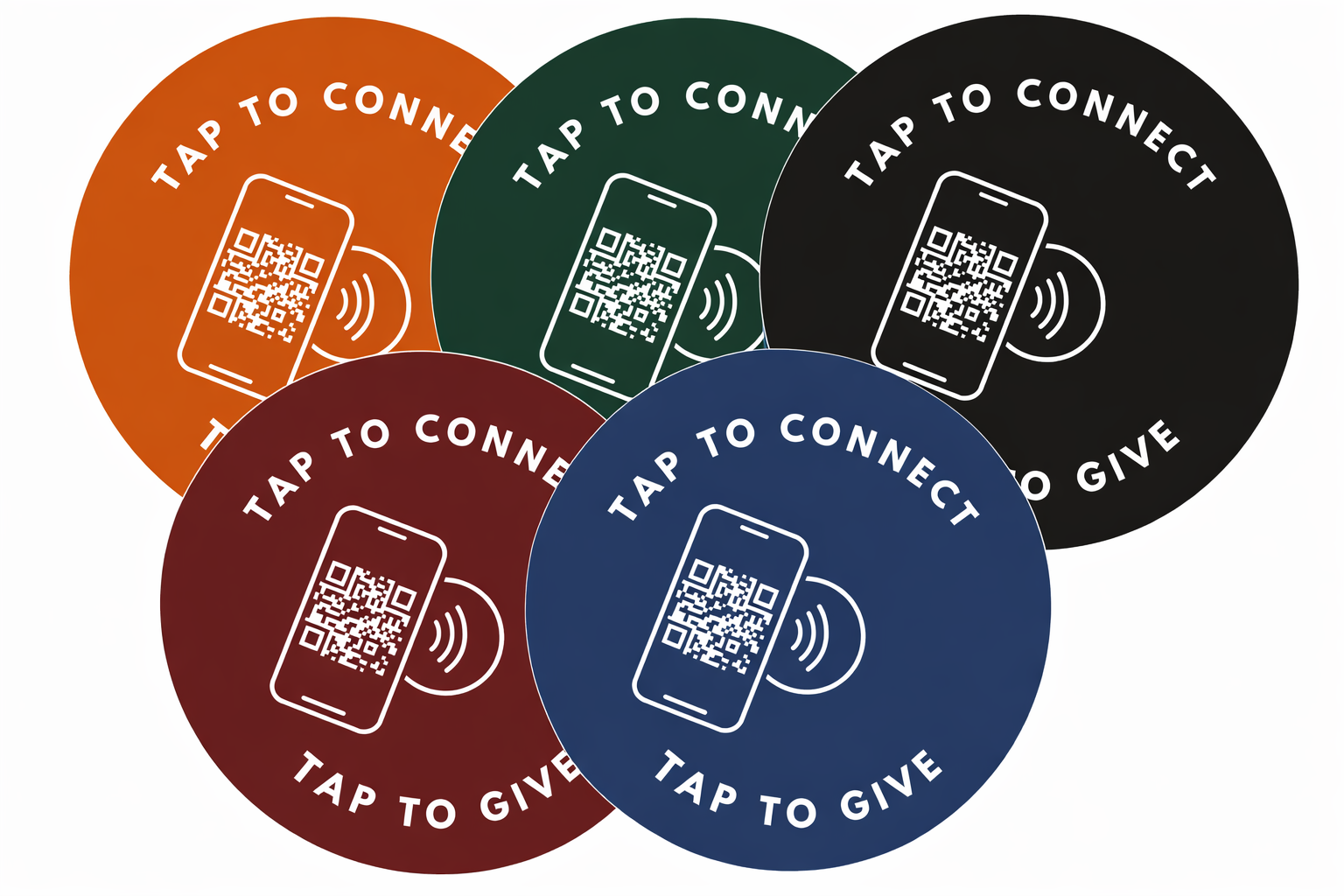
Short answer: yes, because the plate never touches your accounting software at all. A Tap.Giving plate is a small NFC disc that opens your church's existing giving page in a phone's browser. Whatever platform records that gift, Aplos, QuickBooks Online, PowerChurch, IconCMO, ChurchTrac, or anything else, keeps working exactly as it already does. There is nothing to connect, configure, or migrate.
Published September 28, 2026 by Ryan, pastor and founder of Tap.Giving
Why a treasurer asks this question
A board member evaluating any new giving hardware asks the same question first: what does this touch in our books? It is a fair question. Church accounting is fund-based, gifts have to be coded correctly, and a bookkeeper does not want a new system introducing a new export format or a new reconciliation step every month.
Tap.Giving plates sit one full layer above your accounting software, and they always have. A plate carries an NFC chip programmed with one thing: the URL of your church's giving page. When a phone taps it, the phone opens that page the same way it would if someone typed the address in by hand. The giving platform behind that page, and the accounting software the giving platform feeds, never know the tap happened any differently than a gift from the church website or the app.
| Accounting platform | Works with tap-to-give? | Anything to set up in it? |
|---|---|---|
| Aplos | Yes | Nothing |
| QuickBooks Online | Yes | Nothing |
| PowerChurch Plus | Yes | Nothing |
| IconCMO | Yes | Nothing |
| ChurchTrac | Yes | Nothing |
| Any other accounting or ChMS platform | Yes | Nothing |
Aplos, QuickBooks Online, PowerChurch Plus, and IconCMO are commonly cited as the most-used fund-accounting platforms among churches in 2026; ChurchTrac and other ChMS platforms with a bookkeeping module behave the same way for this purpose. The answer in the table does not change if your church runs a platform not listed here: the reason is structural, not a compatibility list we had to check one by one.
What actually changes when a gift comes through a plate
Nothing changes about how the gift is recorded. Walk it through:
- A giver taps their phone on the plate mounted on a pew or the back of a chair.
- The phone opens the church's giving page, the same page a QR code, a text-to-give number, or the church app already points to.
- The giver completes the gift on whatever giving platform the church already uses (Tithely, Pushpay, Subsplash, Givelify, or anything else).
- The giving platform processes the gift and reports it into the accounting software exactly the way it already does, with the same fund, the same batch, the same deposit record.
A bookkeeper closing the month sees no new source to reconcile. A gift from a tap plate looks identical in the ledger to a gift from a link in a bulletin, because as far as the accounting software is concerned, it is the same gift, arriving the same way.
What board members and treasurers actually want to know
Beyond compatibility, the real due-diligence question is cost, and this is where the math is simple. Plates are a one-time hardware purchase, $5.00 each for 100 to 199 plates, $4.00 each for 200 to 399, and $3.50 each for 400 or more, with free shipping and no monthly fee ever, from us or through your accounting software.
A 200-seat church buying 200 plates spends 200 x $4.00 = $800 one time, with a 10% first-order discount available for 7 days from the quote. There is no recurring platform fee to budget for next year, and no new line item for the accounting software vendor to bill separately, because the plates never became a vendor relationship for that software in the first place.
Do I need to tell my accounting software vendor about the plates?
No. Because the plate's only job is opening a URL, Aplos, QuickBooks, PowerChurch, IconCMO, and ChurchTrac have no reason to know the plates exist. There is no API key to request, no integration marketplace listing to install, and no setting inside any of those platforms that changes because of a tap plate. The only place any setup happens is on the giving-platform side, where a church already has a giving page URL to point the plate at.
What if we switch accounting software, or our giving platform, later?
The plates keep working. A plate is locked to a giving page URL, not to any accounting system, ChMS, or even the giving platform sitting behind that URL. Changing your accounting software, moving from one ChMS to another, or renegotiating with a giving processor never requires new plates. The only time a plate needs to be re-ordered is if the giving page's actual web address changes, which is a decision a church controls directly, not something an accounting-software switch forces.
The one-sentence version for a board meeting
"Tap.Giving plates are hardware that opens our current giving page. They don't touch our accounting software, integrate with it, or add anything for our bookkeeper to learn. If it works on our website today, it works from a tap."
See your church's plate in 30 seconds
No signup. No integration to configure. Just your existing giving page and a plate design.
Start a quote to get 10% off for 7 days
Related Articles
Aplos vs Tap.Giving (2026)
How Aplos fund accounting and Tap.Giving plates fit together, cost by cost.
GuideChurchTrac vs Tap.Giving (2026)
Where ChurchTrac's giving tools end and a physical tap plate picks up.
TutorialHow Tap to Give Works for Churches
A plain-English walkthrough of the giver experience, setup, and cost.