What to Ask Any NFC Tap-to-Give Vendor Before You Buy
Every NFC giving plate uses the same commodity chip, so the plate itself will not tell you much. The business behind it will. Ask these five questions before you sign anything, and a vendor's answers (or refusal to answer) will tell you more than any spec sheet.
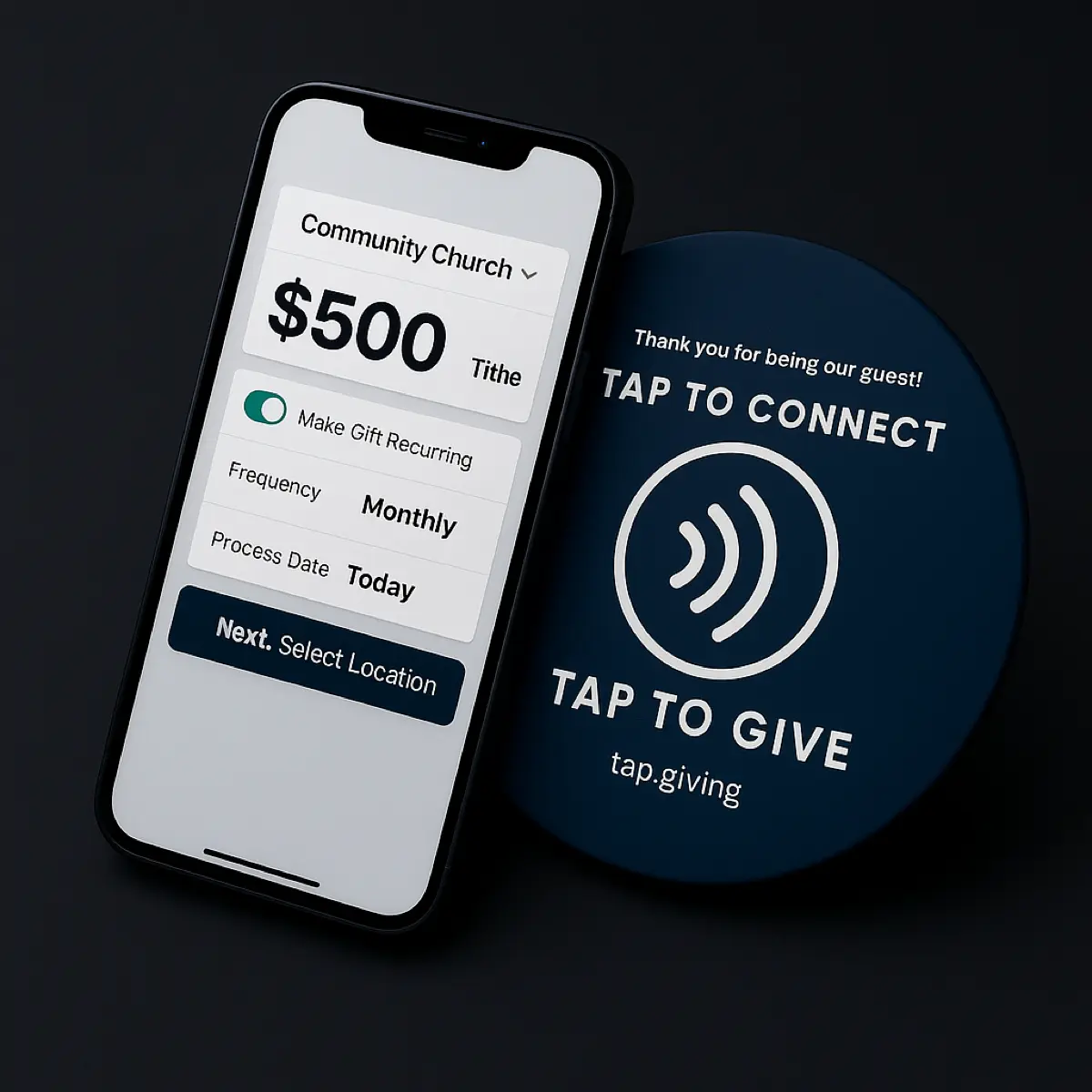
See your church's plate and price in 30 seconds
Design it yourself on the next page. From $3.50 per plate, free shipping, no monthly fees.
1. Do They Publish Real Pricing, or Do You Have to Book a Call?
A vendor with nothing to hide puts the price on the page. Some NFC sellers make you schedule a meeting before they will tell you a per-plate cost, even for a simple order of 100 plates. That is a sales process built around a live pitch, not a shopping experience.
Picture a treasurer at a Tuesday finance-committee meeting, trying to compare two vendors for next quarter's budget line. One has a pricing table she can screenshot into the minutes. The other requires her to schedule a call, sit through a pitch, and hope the number that comes out of it matches what a similar church down the road actually paid. The published price wins the committee every time, because it is the only one she can act on without another meeting.
Tap.Giving publishes exact per-plate pricing on a public page: $5.00 each for 100 to 199 plates, $4.00 each for 200 to 399, and $3.50 each at 400 or more, with free shipping. There is no call required to find out what your order would cost.
3. Are Their Results Sourced, or Just Repeated?
A specific, attributed result is worth reading. An unattributed multiplier is marketing copy. If a vendor's site says giving "increased 300%" or plates deliver "10x" more donations, ask which church that number came from, over what time period, and compared to what baseline. A number that appears on every page of a vendor's site, with no church named and no link to the source, has usually been repeated so many times nobody can trace it back to a real measurement anymore.
We hold ourselves to the same test. When we cannot source a number, we do not publish it, including on our own site: an unverifiable multiplier was removed from our own marketing copy this month for exactly this reason. If a claim about Tap.Giving ever reads like the kind of number this section warns against, tell us and we will fix it.
4. Are You Buying Hardware, or a Platform?
Ask whether the plate works with the giving platform you already have, or only with the vendor's own. Some tap-to-give products are really a giving platform with a plate attached, which means switching platforms later means throwing away the hardware too.
Tap.Giving is hardware, not a payment processor. A plate opens whatever giving page you point it to, whether that is Tithely, Pushpay, Givelify, or anything else your church already uses. If you ever change platforms, the plates keep working: you just update where they point.
5. What Happens When a Plate Fails?
Ask what the guarantee actually covers, and get it in writing before you order. An NFC chip is a simple, durable part, but mounting hardware on pews or the backs of chairs for years means something eventually gets scuffed, pried at, or replaced during a remodel. A vendor's warranty terms tell you what happens next.
Tap.Giving orders carry a 30-day money-back guarantee, and support is a phone call or email to the person who built the product, not a ticket queue.
6. The Checklist at a Glance
Print this, or paste it into an email to any vendor you are evaluating. A good answer is specific; a vague one is itself an answer.
| Question | Good answer looks like | Red flag looks like |
|---|---|---|
| What does a plate cost? | A public pricing page with a number per quantity tier | "Let's schedule a call to discuss" |
| Anything recurring? | A named, priced optional feature, stated up front | "No monthly fee" that turns out to mean the hardware only |
| Where did that stat come from? | A named church, a date, and a described method | A multiplier with no source, repeated on every page |
| Does it lock me into a platform? | "It works with whatever giving page you point it to" | The plate only works with the vendor's own giving product |
| What if it fails or I change my mind? | A written guarantee and a real person to call | No guarantee, or support only through a ticket form |
Frequently Asked Questions
Aren't all NFC tap-to-give plates basically the same?
The chip inside is a commodity part, so the plates themselves are similar. What differs is the business model behind them: whether the price is published or hidden behind a sales call, whether there is a recurring fee on top of the hardware, and whether the vendor's stated results are sourced or just repeated. Those differences show up on your invoice and your renewal date, not on the plate.
Won't asking these questions slow down getting a quote?
A vendor with nothing to hide answers all five in one reply, usually with a public pricing page you could have found yourself. If a vendor needs a call to answer a question that should be a fact, that delay is itself useful information.
What if a vendor won't answer these questions directly?
Treat a dodge as an answer. A vendor who will not say whether there is a recurring fee, will not name where a result number came from, or will not confirm the plates work with any giving platform is telling you those answers would not help their pitch.
Related Articles
VisitorTap vs Tap.Giving
A worked example of the subscription-versus-one-time math this checklist asks you to run yourself.
InsightsQR Codes vs NFC Tap-to-Give
An honest look at where each technology actually fits, before you decide which to buy at all.
InsightsWhy Churches Love Tap.Giving
From zero monthly fees to instant setup, why churches choose Tap.Giving plates for the offering moment.