Nucleus Church App vs Tap.Giving: When NFC Beats App Installs
Nucleus Church App and Tap.Giving solve different parts of the same problem. Nucleus replaces a downloadable church app with a free home-screen launcher and a hosted giving page. Tap.Giving is a one-time NFC tap plate (starting at $3.50 each) that lives on the pew so a guest can tap to give in 8 seconds without finding an app or scanning a QR code. For most churches the question is not which to pick, but where to add NFC tap plates on top of an existing Nucleus setup.
First-time visitors almost never install a church app, but they will tap a plate.
See your church's plate and price in 30 seconds
Design it yourself on the next page. From $3.50 per plate, free shipping, no monthly fees.
The 8-Second Tap vs the App-Install Funnel
A first-time visitor on a Sunday morning will not install your church app. They do not know your church's name well enough to find it in the App Store, they do not want another login, and they are sitting in a service while you ask them to give.
Tap-to-give erases the funnel. The giver holds their phone within an inch of a plate, the church's giving page opens in the browser the phone already has, and a donation completes with Apple Pay or Google Pay in about eight seconds. There is no download, no login, no account. NFC tap plates run on the same chip standard that powers contactless giving at a coffee shop, which is why every iPhone since 2018 (iPhone XS) and every mainstream Android phone reads them without setup.
NFC giving is also fewer steps than a QR code for in-room scenarios, because a tap is a single physical motion versus aim, focus, scan, tap. That is the number most directly relevant to what happens during the offering.
What Nucleus's "No App" Strategy Actually Looks Like
Nucleus's whole pitch is that your church does not need a downloadable native app. Instead, Nucleus Launcher gives your members a home-screen icon that opens a web-app shell: prayer requests, group signups, giving, sermon notes, all in a single mobile-optimized page. It is free, it ships fast, and it works on any phone.
Nucleus Giving is the matching donation product. It uses Stripe under the hood, charges the standard 2.9% + $0.30 per transaction, and exposes a hosted giving URL plus configurable Trigger Links for things like sermon series funds. The reporting lives in the Nucleus dashboard. There is no monthly subscription for Launcher; Nucleus monetizes the giving fee.
The Launcher approach is genuinely strong for the moment a regular attender is on their couch on a Tuesday. They tap the icon, the page opens fast, and giving takes seconds. The gap is the in-room moment. A visitor on a folding chair on Sunday morning is not going to add a launcher to their home screen during the offering. They need something physical to interact with, and that is where NFC tap plates fit.
What Tap.Giving Plates Add to a Nucleus Setup
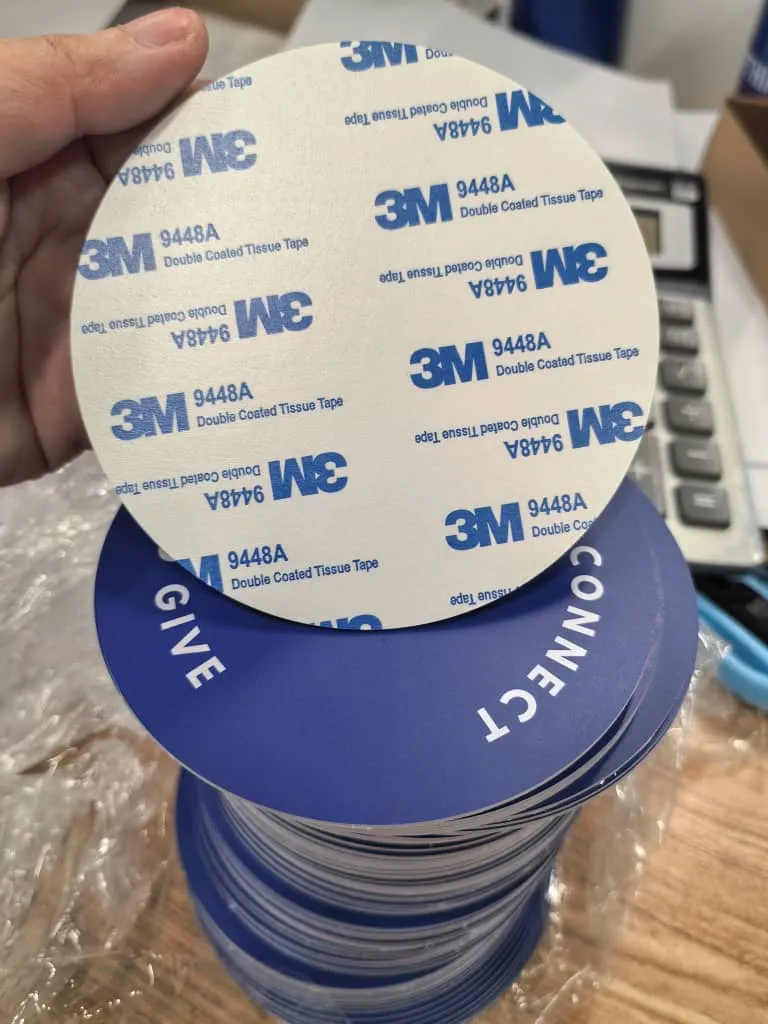
A Tap.Giving plate is a four-inch printed disc with an NFC chip laminated inside and a QR code printed on the front as a fallback. Each plate is encoded with one URL: the URL of your Nucleus giving page. When someone taps, the phone reads that URL and offers to open it. The donation lands in Nucleus the same way an at-home gift would, with the same donor record and the same deposit schedule.
What Nucleus owns
- Home-screen launcher and web app
- Hosted giving page and Trigger Links
- Payment processing and receipts
- Donor records and reporting
- The at-home, on-the-couch moment
What Tap.Giving plates add
- A physical trigger on every seat
- An 8-second path for first-time givers
- A QR fallback for older phones
- No login or account required
- The in-service, in-the-pew moment
Mounting takes a volunteer team about 60 to 90 minutes for 200 plates with the adhesive backing, or longer if you choose the pre-drilled screw holes. The plates work the day they arrive. We ship a launch kit (script, slides, troubleshooting notes) at tap.giving/launch so the demo on Sunday morning lands clean.
The 5-Year Cost Math (200-Seat Church)
Run the numbers for a 200-seat church doing about $300,000 in annual giving, with most of it electronic. The transaction-fee line is the same on both sides because Nucleus (or Tithely, Pushpay, Subsplash, Donorbox, Givelify, Anedot, Planning Center Giving) processes every gift either way. The only place plates show up is a one-time hardware line.
| Cost line | Nucleus alone | Nucleus + Tap.Giving plates |
|---|---|---|
| Year 0 setup (plates) | $0 | $800 once (200 × $4.00), or $720 with the 7-day first-order discount |
| Monthly software fee | $0 (Launcher is free) | $0 |
| Per-transaction fee | 2.9% + $0.30 | 2.9% + $0.30 |
| Year 1 transaction fees ($300k giving) | ~$9,000 | ~$9,000 |
| Year 1 total | ~$9,000 | ~$9,720 |
| 5-year cumulative | ~$45,000 | ~$45,720 |
The plates add roughly $720 to a five-year run. If plates produce even one additional $40 first-time gift per Sunday across a year, they more than cover their hardware cost in the first month.
See the full pricing table (with quantity breaks up to 1,000+) on our pricing page.
When Nucleus Alone Is Enough
Be honest about this. If your church is fully online, gives entirely between Sunday services, and has a tight community where every regular attender already knows how to find the giving page, the Launcher alone covers the job. Likewise for a church plant in a borrowed room without any seat-back surface to mount plates on. In both cases there is no in-service touchpoint to capture, so adding plates is overkill.
The other case: if your offering moment is intentionally analog (a passed basket, paper envelopes) and your leadership wants to keep it that way, NFC tap plates would feel out of place. Stick with Nucleus Launcher and revisit the question when you see first-time visitor numbers climb.
When NFC Plates Beat App Installs
The case for adding Tap.Giving plates on top of Nucleus is strongest when your church meets any of these markers:
- You see new faces every Sunday.
- Your offering moment matters. A passed plate or visible giving cue during service is part of how you teach generosity. Tap technology for churches gives that cue a working physical surface.
- You have pews, theater seats, or row chairs with backs. Plates mount in under a minute each with adhesive.
- You want one path that does not depend on phone literacy. Tap and give works the same on an iPhone XS as on a brand-new Pixel. A church app does not.
The two products are complements. Nucleus Launcher handles the digital giving for churches who already know where to look. Tap to give plates handle the room.
Ready to add tap to donate plates to your Nucleus setup?
One-time hardware cost. No monthly fees. Plates work with Nucleus Giving and every other major giving platform. Most churches are tapping by week three.
Start a quote to get 10% off for 7 days
FAQ
Is Tap.Giving a replacement for the Nucleus Church App?
No. Nucleus replaces a downloadable native app with a home-screen launcher and a hosted giving page. Tap.Giving is a physical NFC plate that lives in your pew or on the back of a chair. They sit on different parts of the funnel: Nucleus owns the at-home, on-the-couch moment; Tap.Giving owns the in-service, hands-on-the-pew moment. A church using both pays a one-time $720 for 200 plates and keeps its Nucleus setup unchanged.
Do Tap.Giving plates work with Nucleus Giving?
Yes. The plates open whatever URL you encode them with. Nucleus Giving exposes a hosted giving URL (or a Trigger Link), and that URL is what the plate hands to the giver's phone. The donation flows into your Nucleus account exactly the way it would if the giver typed the URL themselves. We have a step-by-step Nucleus tap-to-give setup guide that walks through finding the right URL.
What does the Nucleus Church App cost vs Tap.Giving?
Nucleus Launcher is free for churches; their giving product charges the standard 2.9% + $0.30 per transaction. Tap.Giving is a one-time hardware purchase: $5.00 each for 100 to 199 plates, $4.00 for 200 to 399, and $3.50 for 400 or more, with free shipping and no monthly fees. A 200-seat church that adds plates on top of Nucleus pays $800 once, or $720 with the 7-day first-order discount.
Why would I add NFC tap plates if I already have a church app?
Church apps depend on download, login, and remembering to open the app. Tap-to-give bypasses all three. Plates capture the gift in 8 seconds without an account, so the people most likely to skip your app are the people most likely to tap a plate.
Does the giver need a Nucleus account to use a plate?
No. The plate opens your hosted giving page in the phone's browser. Nucleus does not require login for one-time gifts, and neither do Tithely, Pushpay, Subsplash, Donorbox, Givelify, Anedot, or Planning Center Giving. Recurring givers can log in if they want to manage future gifts, but visitors give as guests in well under a minute.
How fast can a church get from order to first tap?
The editable proof is available instantly. After artwork approval, delivery typically takes 2-3 weeks; then mount the plates and demo the tap from the stage. Rush service is available for a fee.
Will adding plates change how Nucleus reports giving?
No. The donation lands in Nucleus the same way an at-home gift does, with the same donor record, the same emailed receipt, and the same deposit schedule. The only thing that changes is where the gift originated: a tap on a pew plate instead of a couch click on a phone. Nucleus does not need to know anything about the plate. For background on the security model see the NFC standard on Wikipedia.
Related Articles
Nucleus Tap-to-Give Setup
Step-by-step guide to encoding NFC tap plates with your Nucleus giving URL or Trigger Link.
GuideNucleus Launcher + NFC Tap Plates
Why Launcher and plates together give your church a complete tap-to-connect stack for $0 per month plus a one-time hardware cost.
StrategyChurch Giving Without an App
Every app-free giving method ranked by friction, and why NFC tap-to-give outperforms QR codes, text-to-give, and kiosks.