Church Campaign Pledges: Closing the Gap Between Pledged and Collected
Most church campaigns collect 80–90% of what gets pledged. On a $2 million campaign that is $200,000 to $400,000 that was promised and never arrived. Some of that gap is life happening and cannot be recovered. A real share of it is friction, and friction is the part you can actually design away.
Campaigns Are Measured in Pledges. Budgets Run on Deposits.
Commitment Sunday produces a number, and that number goes on the slide, in the newsletter, and into the board minutes. It is a real number. It is just not the number that pays the contractor.
Fundraising practitioners generally put pledge fulfillment somewhere in the 80–90% range, with one widely cited benchmark landing at 84%. Campaign consultants who work in this space every day describe some attrition as normal and expected rather than a sign anything went wrong.
Run the arithmetic on your own campaign before you set the construction budget. A church that announces $2,000,000 pledged and plans against it is, on typical fulfillment, planning against $200,000 to $400,000 it will never receive. That is not pessimism. That is the base rate.
The useful response is not to shave the announcement. It is to know which slice of that gap is recoverable and to spend your effort there.
Three Reasons a Pledge Goes Unpaid (Only One Is a Technology Problem)
Unpaid pledges are not one problem. They are three, and they need completely different responses.
1. Life changed
A job ended. A family moved for work. Someone died. Health costs arrived. This is the largest and most honorable share of the gap, and no software recovers it. Plan for it in your budget and release those families graciously.
2. The giver drifted
They stopped attending, or the vision stopped feeling like theirs. This is a relationship and communication problem. It is solved by pastoral contact and by reporting honestly on progress, not by a payment method.
3. They meant to and did not get around to it
They are still in the room. They still believe in the project. The payment just never got made, because making it required remembering, finding the link, and typing a card number on a phone. This is the slice that responds to design, and it is the only one this article claims to help with.
Being clear about that division matters. Any vendor who tells you their hardware fixes pledge attrition is selling you something. Hardware addresses the third bucket. The third bucket is worth addressing because it is quietly large and because it is made of people who are still sitting in your services.
A Three-Year Pledge Is Thirty-Six Chances to Forget
Most capital campaigns run on a three-year commitment. A household pledging $150 a month has to complete that action thirty-six separate times.
If they set up an automatic recurring gift on Commitment Sunday, they complete it once and the system does the rest. Those pledges fulfill at very high rates. The attrition lives almost entirely in the manual payers: the family who intends to give monthly and does it by hand, or the giver who plans to make several larger gifts across the campaign and lets the date slide.
So there are only two real levers on bucket three. Move as many pledges as possible onto recurring at the moment of commitment, and for everyone else, make the individual gift take seconds and happen in the room where the campaign is being talked about.
Where a Tap Plate Actually Helps
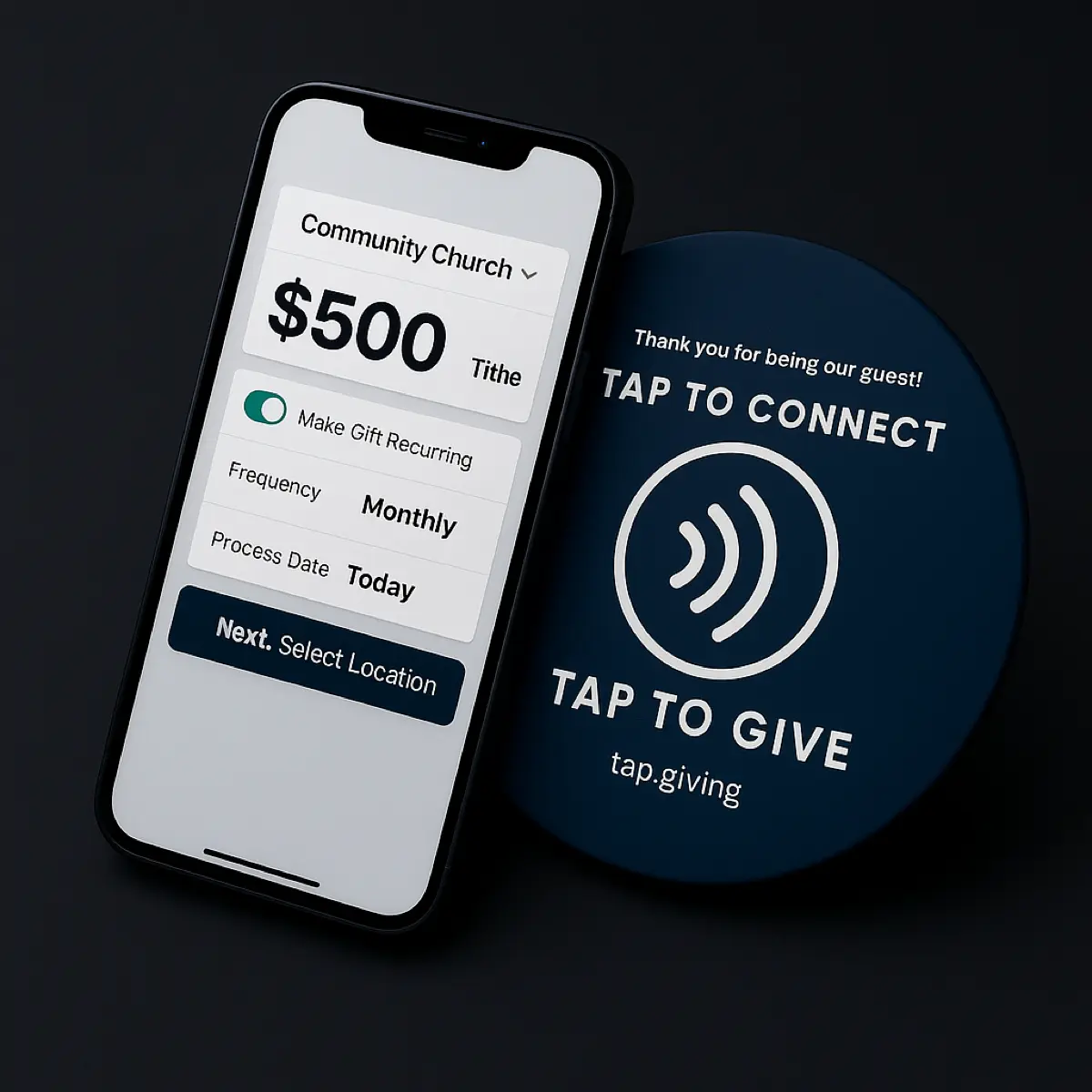
An NFC tap plate is a small disc mounted on a pew back, a chair, or a seat. A giver holds their phone near it and their giving page opens. No app to download, no code to scan, no typing a URL.
For a campaign, it does two specific things:
- It closes the distance between the moment and the gift. The campaign update happens from the stage. The intention peaks right then. A plate on the seat in front of them turns that intention into a completed payment before the service ends, instead of into a task that has to survive the drive home.
- It is a standing, silent reminder. A campaign that gets mentioned once a quarter fades. A plate that is physically present every week keeps the commitment visible without another announcement.
What it does not do is reach the giver who has stopped attending. If a meaningful share of your unpaid pledges belong to people who left, plates will not find them, and a mailed statement and a phone call will.
The Two-Plate Setup: Campaign and General Giving, Side by Side
Here is the setup worth knowing about, because it solves a problem most campaigns run into: the campaign competes with the general fund.
If you point every plate at the campaign page, weekly tithes get harder to give. If you point them all at general giving, the campaign has no in-room path at all. Churches running both are increasingly ordering two sets of plates and giving each a different destination:
Plate set one
Points at your normal giving page. Tithes and offerings, unchanged, all year.
Plate set two
Points at the campaign page, with the campaign name printed on the plate so there is no ambiguity about where the gift lands.
Because each plate carries the destination you choose, the two sets can be told apart at a glance and reported on separately. And when the campaign closes, the second set does not become scrap: with our redirect dashboard you can point those plates at something else from a browser, without touching the hardware or reprinting anything. A building campaign becomes a missions push becomes a benevolence fund, on the same plates.
What the Campaign Giving Page Has to Do
The plate is only as good as the page it opens. Whatever platform you use, that page should:
- Load with the campaign fund already selected. A giver should never have to pick the right fund from a dropdown.
- Offer a recurring option on the same screen. This is where you convert manual payers into automatic ones, which is the single highest-value move in the whole campaign.
- Accept the wallet payment methods your people already use. A tap that opens a page demanding a hand-typed card number gives back most of the speed you just bought.
- Show progress. A simple thermometer converts a payment into participation.
- Work on a phone first. Every tap gift is a mobile gift, without exception.
Tap.Giving does not process payments and does not replace your giving platform. The plates point at whatever page you already run, whether that is Tithely, Pushpay, Givelify, Subsplash, or your own site, so the campaign page above stays entirely yours.
What It Costs, Year One and Every Year After
Campaign tooling is usually sold as a subscription, which means the cost recurs for every year the campaign runs and often past it. Hardware is bought once.
| Plates | Price each | One-time total | Cost in year three |
|---|---|---|---|
| 100 | $5.00 | $500 | $0 |
| 200 | $4.00 | $800 | $0 |
| 400 | $3.50 | $1,400 | $0 |
Free shipping, no setup fee, no monthly fee, and no transaction fee from us on any gift, ever. Your platform's own processing fees are unchanged, because we never sit in the payment path. Against a three-year campaign, that is the whole difference: a subscription bills you in year two and year three, and plates do not.
A 200-plate order at $800 needs to recover roughly one mid-sized pledge payment to have paid for itself. Every completed gift after that is margin against the gap.
When Plates Are the Wrong Buy
Two honest cases:
Your campaign is being funded by a handful of major gifts. If eight households are carrying 70% of the total, your fulfillment work is eight relationships and a calendar, not hardware. Buy plates for the congregational half of the campaign, if you want the broad participation, but do not expect them to move the major-gift number.
Your room seats well under a hundred. Our minimum order is 100 plates, which is more than a small room needs on its own. Church plants and small congregations often still clear it by covering multiple campuses, a fellowship hall, and the entryway, and at $5 a plate a 100-plate order is $500 one time. But if you genuinely need thirty, wait until you need a hundred.
Outside those two cases, the argument for plates during a campaign is straightforward: you are about to ask people for thirty-six payments, and the cheapest thing you can do is make each one take three seconds.
Get plates in hand before your kickoff
Delivery runs about two to three weeks from artwork approval, so order with a month of margin ahead of Commitment Sunday. Design yours and see the price in about a minute.
Design your plate →One-time cost. Free shipping. 30-day money-back guarantee.
FAQ
What is a normal pledge fulfillment rate for a church campaign?
Fundraising practitioners generally cite 80–90%, with 84% a commonly referenced average. Budget against the collected figure rather than the pledged one, and treat a 10–20% shortfall as the expected case rather than a failure.
Can an NFC tap plate accept a pledge rather than a one-time gift?
The plate opens whatever page you point it at, so it can absolutely open a pledge form or a recurring-gift setup screen. The plate itself does not record commitments; your giving platform does. Pointing campaign plates at a recurring setup page is the highest-leverage configuration available to you.
Should campaign plates replace our regular giving plates?
No. Run both. A campaign should not make weekly tithing harder, and a general giving plate should not quietly absorb gifts a family intended for the building. Two sets with two destinations keeps both paths open and keeps the reporting clean.
What happens to campaign plates when the campaign ends?
They keep working. With our redirect dashboard you re-point them from a browser to any URL you like, so the same hardware carries the next initiative. Without it, the destination is fixed at manufacture, which is why churches running time-bound campaigns should ask about the dashboard when they order.
Do tap plates work with our existing giving platform?
Yes. Tap.Giving sells hardware only and is not a payment processor. The plates open your existing giving page on platforms like Tithely, Pushpay, Givelify, or Subsplash, so gifts land in the same donor records and reports you already use and you change nothing about your processing.
How long before a campaign kickoff should a church order plates?
Delivery is typically two to three weeks from artwork approval, and approval takes a few days of back and forth. Ordering a month before Commitment Sunday leaves comfortable margin. Rush service is available for a fee if you are closer than that.
See your church's plate and price in 30 seconds
Design it yourself on the next page. From $3.50 per plate, free shipping, no monthly fees.
Related Articles
Capital Campaign NFC Tap Plates: Setup & Cost
The full campaign rollout: a four-week plan, the five-year cost math, and what to put on the campaign giving page.
How Many NFC Tap Plates Does Your Church Need?
Sizing by room and seat count, including how to plan a second set for a campaign.
How to Boost Church Giving With NFC Donation Plates
What actually moves in-service giving, and the announcement patterns that work from stage.