Capital Campaign NFC Tap Plates: A 2026 Setup and Cost Playbook
NFC tap plates put a one-tap gift or one-tap pledge inside arm's reach of every seat during a church capital campaign. For a 200-seat church, that's $960 one-time for 240 plates, less than 0.25 percent of a typical $400,000 campaign, with no monthly fee and no app to download. Here's the math, the 4-week rollout, and the honest tradeoffs.
0.24%
of a typical $400,000 capital campaign is what 240 NFC tap plates cost a 200-seat church, one time, with zero monthly fees.
See your church's plate and price in 30 seconds
Design it yourself on the next page. From $3.50 per plate, free shipping, no monthly fees.
The 12-Week Window That Decides a Capital Campaign
Capital campaigns are won in the room. A consultant will tell you the heavy lifting happens in private donor visits months before the public launch, and that's true for the lead gifts. But the difference between a campaign that hits its goal and a campaign that limps to 70 percent of it is the broad participation tier, the ushers, the small group hosts, the families in the back two rows. They decide in the moment, often during the kickoff service itself or in the four to six weeks of dedicated campaign Sundays that follow.
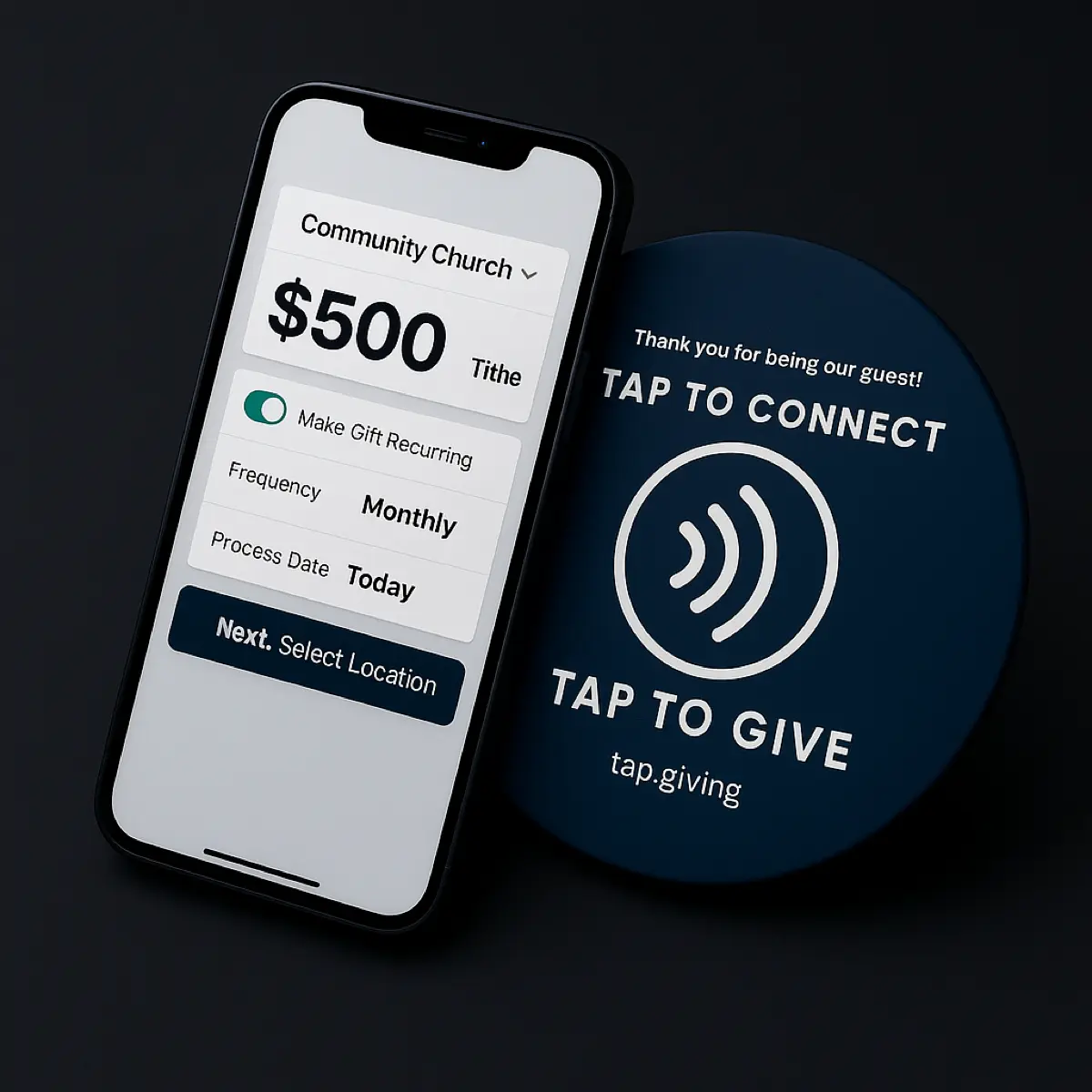
Friction kills broad participation. Asking a young family to fish out a phone, find your website, hunt for the giving menu, choose the right fund, and type a card number while a toddler tugs at a sleeve is the opposite of decision-easy. Most of them mean to give later. Most of them never do. NFC giving plates collapse that whole sequence into one tap. Hold the phone near the plate, the campaign page opens, choose pledge or one-time gift, confirm with Apple Pay or Google Pay, done. Eight seconds, including the toddler.
That is why so many capital campaigns add NFC tap plates as a line item in the launch budget, alongside the printed pledge cards, the campaign brochure, and the video. The plates are the only piece of campaign collateral that captures a decision in the moment, every seat, every Sunday.
What Capital Campaign NFC Tap Plates Actually Do
A Tap.Giving plate is a 4-inch printed disc with an NFC chip and a thin copper antenna inside. The chip stores one thing: a web address. For a capital campaign, that's the URL of your dedicated campaign giving page on the platform you already use (Tithely, Pushpay, Subsplash, Donorbox, Givelify, Anedot, Planning Center Giving, Nucleus Giving). The plate does not store payment information, does not have a battery, and does not need Wi-Fi. It is a sign-post pointing at a URL you control.
What a campaign plate handles
- One-tap open of your campaign giving page
- Pledge form or one-time gift, your choice
- Apple Pay, Google Pay, Samsung Pay, or card
- QR fallback printed on the front for older phones
- Re-encodable after the campaign ends
What it doesn't replace
- Your major-donor visits and ask meetings
- Your existing giving platform (it still processes)
- Your campaign consultant's strategy
- The 90-second pulpit moment that frames the ask
Plates are a participation lever for the middle and back rows. Treat them that way. They will not close a $250,000 lead gift, but they will catch fifty $40 monthly pledges from people who would have meant to follow up Wednesday and never did. For a deeper walk-through of how the hardware works at the chip level, see how tap to give works for churches and the NFC giving explained guide.
The 5-Year Cost Math: Plates vs Subscription Campaign Tools
Capital campaigns sometimes get bundled with paid software (campaign micro-sites, pledge tracking dashboards, donor portals). These tools have a place, but the cost adds up fast when the campaign stretches three to five years. The hardware side, NFC tap plates, is fixed and finite by comparison.
| Line Item (200-seat church, 3-year campaign) | Tap.Giving Plates | Typical Subscription Campaign Suite |
|---|---|---|
| Setup / hardware | $960 (240 plates × $4.00) | $0 to $2,000 (setup fee) |
| Monthly software fee | $0 | $99 to $200 / month |
| Transaction fee (from Tap.Giving) | $0 | 2.9% + $0.30 |
| 3-year total (hardware/software only) | $960 one time | $3,564 to $9,200 |
| 5-year total (campaign + 2-year afterlife) | $960 (still works) | $5,940 to $14,000 |
The 2.9 percent + $0.30 per transaction does not disappear in either column, your existing giving platform charges that whether you add plates or not. The plate is hardware, not a processor. The math above isolates the hardware/software line item that you control independently. Full breakdowns by quantity are on our pricing page.
The other line worth running: contactless giving plates pay for themselves at roughly one extra small gift per plate. If 240 plates each capture one additional $20 gift across the campaign, the hardware is net free. Most campaigns see far more than that.
How to Roll Out Tap to Give for a Campaign in 4 Weeks
The window from "order plates" to "tap on kickoff Sunday" is 4 weeks. Here is the timeline that works.
Week 1: Build the campaign giving page
Create a dedicated campaign fund or page on your current platform. Add two pathways on the same page: a pledge form (intent to give over the campaign period) and a one-time gift form. Mobile-check it on three phones (an old iPhone, a new iPhone, and an Android) before approving the URL.
Week 2: Order plates
One plate per seat plus 10 to 20 percent extra for the lobby, kids check-in, the capital campaign info booth, and the giving table. A 200-seat sanctuary orders 220 to 240 plates. The plate sizing guide covers the math for every common church size. Add your logo (AI, SVG, or vector PDF) and campaign URL in the design tool. The editable proof updates instantly, and manufacturing begins only after artwork approval.
Week 3: Mount the plates
Adhesive backs for pews or screw mounts for chairs. A 6-person volunteer team typically mounts 240 plates in 60 to 90 minutes. Spot-test 10 random plates with both an iPhone and an Android before Sunday so you catch any phone-setting weirdness early.
Week 4: Launch from stage
Demo one tap during the kickoff service. Put the giving page on the main screen, walk through pledge vs one-time gift, and offer a 20-second invitation during the offering. Most churches see their highest single-week digital giving total of the year on this Sunday. The 4-week deployment playbook has more pulpit-language ideas.
Weeks 5 onward: Track and follow up
Use the platform's own reports (your church giving technology stack already produces these). Thank every campaign giver within 48 hours. Re-invite stalled pledges at month 3, month 6, and month 12. The plates keep working in the background.
The setup is shorter than installing a new printer. There is no software to install, no integration to maintain, no accounts to create on the giver's side. The plates do their job the day they arrive.
What to Put on the Campaign Giving Page
The plate opens a URL. The URL has to do the work. Here is the campaign page checklist that tap to donate flows convert against, drawn from churches that ran successful campaigns alongside their tap technology for churches rollout.
- One headline that names the campaign, not "Give to General Fund". If the brochure says "Build Together 2027", the page header says "Build Together 2027".
- Two clear options at the top: "Pledge" (intent to give over months) and "Give now" (one-time gift). Anything more than two choices in the first scroll bleeds conversion.
- Suggested gift amounts tied to the campaign math ("Sustain $40 / month", "Build $100", "Foundation $500"), with a custom field below.
- Apple Pay and Google Pay enabled. Confirm in your platform's settings. If they are off, you are leaving roughly half the mobile givers on the table because typing a card number on a Sunday morning is friction nobody needs.
- A single sentence of why under the form, not a paragraph. "Every gift goes to the new building, debt reduction, and missions partnership through 2029" is plenty.
- Reply-receipt set to send within 60 seconds, including a thank-you note from the lead pastor by name. First-time givers decide whether to give again based on that receipt.
For more on what makes a campaign giving page convert during a Sunday service, the in-service giving playbook covers the moment-of-decision UX, and the year-end giving strategy piece walks through the same mechanics for the December push.
When to Skip Plates and Use Software Only
Honest answer: not every capital campaign needs NFC tap plates.
Skip the plates (or delay them to phase two) if your campaign is primarily lead-gift driven and you are not running a participation tier. A capital campaign that funds itself off 10 to 20 lead families does not benefit much from broad-room hardware. Phone calls, dinner visits, and pledge cards do the work. The plates are a participation lever, not a major-gift lever.
Skip them also if you do not have a mobile-friendly campaign page yet. The plates only amplify what's on the other end of the URL. If the page is broken on mobile, the plates make the broken experience easier to find. Fix the page first, then add the hardware. The kiosk-to-plates migration guide walks through that decision tree.
For most multi-Sunday capital campaigns at churches of 100 seats or more, though, the math works. NFC tap plates are the cheapest piece of campaign collateral that captures a decision in the moment, every seat, every Sunday. Tap and give beats "give later" almost every time.
Get NFC tap plates in time for your campaign kickoff
One-time hardware. No monthly fees. Works with the giving platform you already use. Delivery typically takes 2 to 3 weeks from artwork approval, with rush service available for a fee.
Start a quote to get 10% off for 7 days
FAQ: Common Capital Campaign Questions
How many NFC tap plates does a capital campaign need?
One per seat plus 10 to 20 percent extra for the lobby, kids check-in, the capital campaign info booth, and the giving table. A 200-seat sanctuary running a campaign typically orders 220 to 240 plates. A 400-seat church orders 440 to 480. See the sizing guide for every common church size.
Can tap to give plates accept a pledge instead of a one-time gift?
Yes. The plate opens whichever campaign URL you encode it with. Most platforms let you publish a pledge form (intent to give over time) and a one-time gift form on the same campaign page, with a toggle at the top. Tithely, Pushpay, Subsplash, Donorbox, Anedot, and Planning Center Giving all support this pattern.
Will the plates still work after the campaign ends?
Yes. The plates ship unlocked on request, which means after the campaign you can re-encode each plate with your standard general fund giving URL. Most churches keep them in service indefinitely as the everyday tap to donate option. The hardware does not expire, the chip is rated for tens of thousands of taps.
What does NFC giving cost a church during a capital campaign?
NFC tap plates are a one-time hardware purchase: $5.00 each for 100 to 199 plates, $4.00 for 200 to 399, and $3.50 for 400 or more (full pricing here). There are no monthly fees, no setup fees, and no transaction fees from us. The church's existing giving platform charges its normal 2.9 percent plus $0.30 per transaction, that part is unchanged.
Do tap plates work with platforms like Tithely, Pushpay, or Subsplash for a capital campaign?
Yes. The plates open any mobile-friendly giving URL, which means they work with Tithely, Pushpay, Subsplash, Donorbox, Givelify, Anedot, Planning Center Giving, Nucleus Giving, and any other platform with a hosted campaign page. The church keeps its existing platform and adds the hardware on top.
How much do NFC tap plates lift capital campaign giving?
Churches that move from passing a plate or kiosk to NFC tap to give see a 300 percent or greater lift in in-service donation totals on average, with 81 percent of givers participating during the service. For a deeper look at the engagement data, see our NFC FAQ.
How fast can we get plates in hand for a campaign kickoff?
Plan on 2 to 3 weeks from artwork approval to delivery. For a campaign kickoff Sunday, start at least 4 weeks ahead to leave time for artwork approval and mounting before the launch service.
Related Articles
How Many NFC Tap Plates Does Your Church Need? 2026 Sizing
The plate-count math for every common church size, including the 10 to 20 percent buffer for lobby and check-in.
StrategyHow to Boost Church Giving With NFC Donation Plates
A 4-week deployment plan, setup, placement, and pulpit scripts, for using NFC plates to lift in-service participation.
StrategyWays to Increase In-Service Giving
The moment-of-decision UX for Sunday giving: pulpit language, plate placement, and what to put on the page.