Tap-to-Give on Church Chairs: A Guide by Chair Type
Almost every church chair takes a tap plate. What changes from one chair to the next is where the plate goes and how you attach it. Here is the answer for the seven kinds of seating churches actually own, and the one situation that needs a different plate.
See your church's plate and price in 30 seconds
Design it yourself on the next page. From $3.50 per plate, free shipping, no monthly fees.
The two ways to mount, and when metal changes things
Every plate ships ready to mount both ways, so this is a choice your church makes, not a spec you order around.
Screws — the most secure hold
Plates can ship with pre-drilled holes. Screwed into a seat back, a plate is not coming off, ever. This is the right call for high-traffic rooms, rental venues, and anywhere chairs get stacked and moved every week.
3M adhesive — included, and non-destructive
Most churches do not want to put holes in their chairs or pews, which is why every plate comes with heavy-duty 3M adhesive backing as standard. On a flat surface it holds well and leaves the furniture intact.
The one exception is metal. NFC cannot read through a metal surface, so a plate mounted directly onto metal will not tap at all. If that is where yours are going, order the anti-metal version: it looks identical, and carries an interference-blocking layer behind the chip so the tap works normally. Just tell us the surface when you order.
Your chair type, and where the plate goes
1. Padded stacking chairs
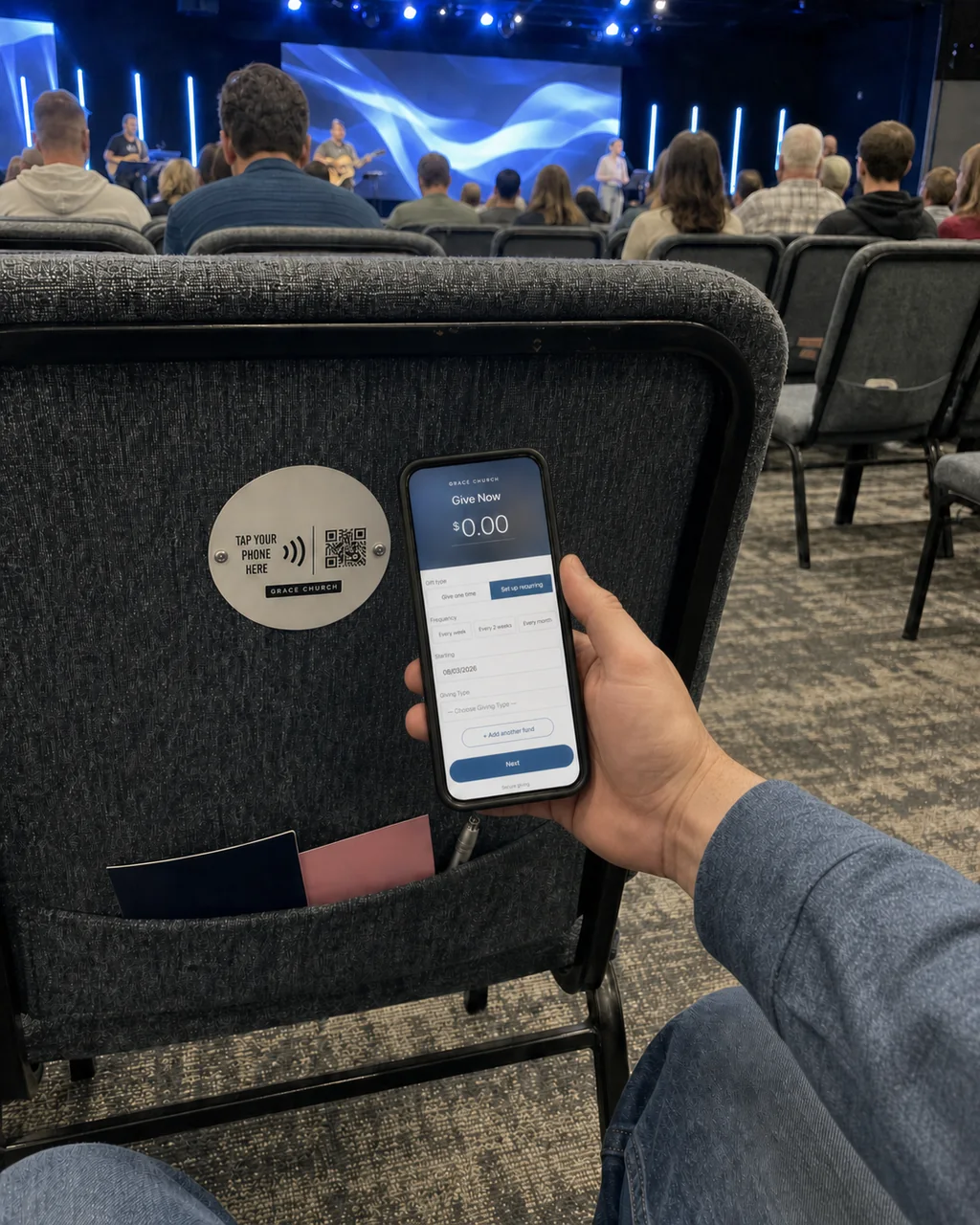
The most common church chair in America: a steel frame, a padded seat, and a firm upholstered back panel, usually with a book pouch. The plate goes on the flat of that back panel, above the pouch, at the height of the row behind. Adhesive holds on the firm panel; screws if the chairs stack and travel.
2. Poly and plastic stacking chairs
The easiest surface we ship to. A moulded poly back is hard, smooth and flat, which is exactly what the adhesive is designed for. Wipe it with rubbing alcohol, press for thirty seconds, done.
3. Theater and auditorium seating
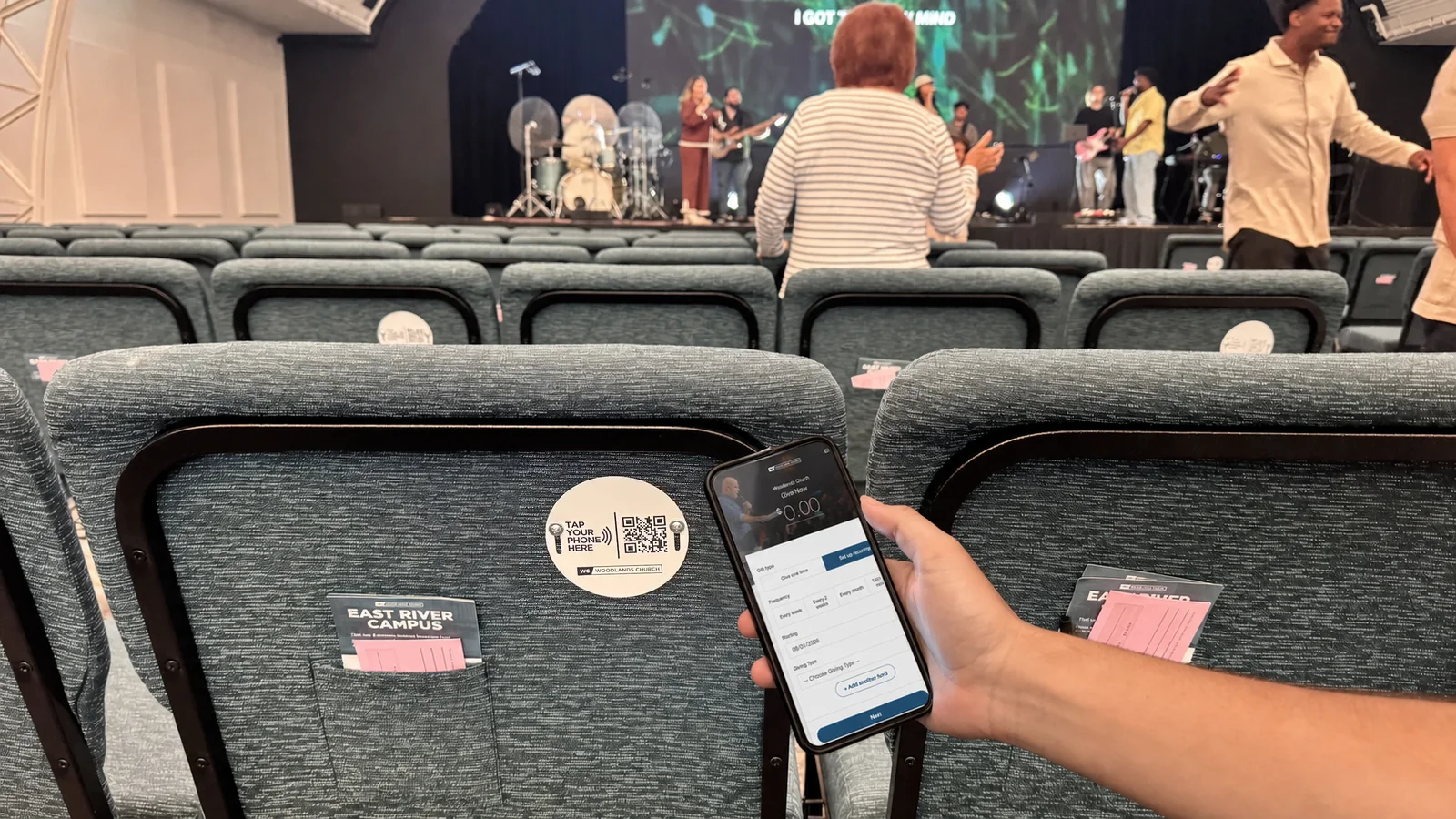
Fixed seating usually gives you a hard frame rail or a rigid trim panel across the back. That rail is the natural home for the plate: it is flat, it is at eye height for the row behind, and it keeps the pouch below clear.
4. Wooden chairs
Sealed or varnished wood is an excellent adhesive surface. If the back is a narrow slat rather than a panel, measure first: a 4″ plate needs a flat run wider than four inches, and the 3″ or 2″ sizes exist for exactly this.
5. Wooden pews
The classic case, and the easiest. A pew back is a wide, flat, hard surface at perfect height. Adhesive is the usual choice because nobody wants holes in a hundred-year-old pew, and it holds without a problem.
6. Folding chairs
Usually a steel or aluminium back, which means the plate is going directly onto metal. Order the anti-metal version and it taps normally. Worth thinking about whether folding chairs are where you want plates at all, since they get stacked, dragged and swapped more than anything else in the building.
7. Any chair with an exposed metal back
Same answer as folding chairs. Metal frames around the outside are fine, because the plate is not sitting on them. It is only metal directly behind the plate that stops the tap, and only that case needs the anti-metal version.
Height and placement in the row
Whatever the chair, the plate wants to land where a seated person's eye already goes: centred on the back, at roughly upper-back height, above any book pouch. Keep it clear of the ganging brackets at the edges, because chairs pull tight together in rows and an edge-mounted plate ends up half-hidden by its neighbor.
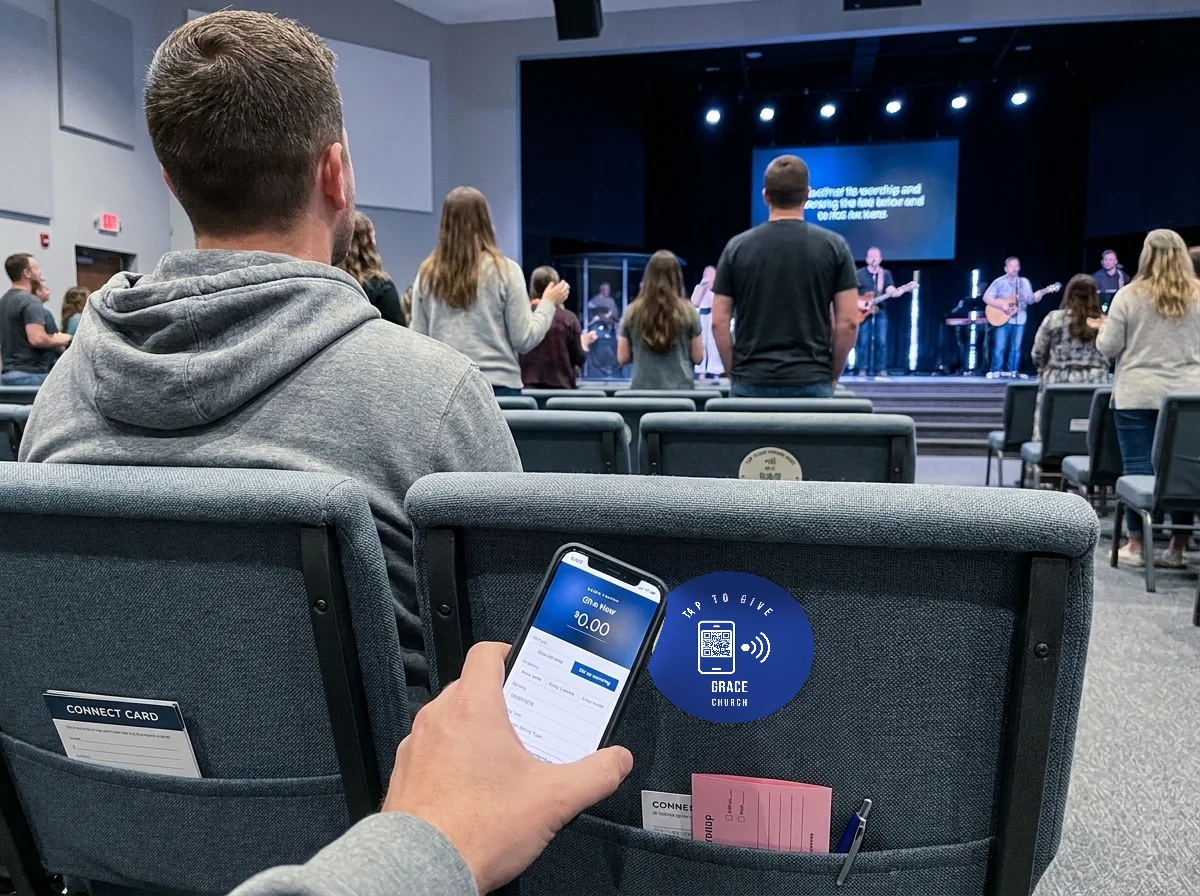
You also do not need one on every seat. A plate has to be within reach of the moment somebody decides to give, which for most rooms means the seat backs plus a few at the welcome desk and the giving station. Churches often start with a section, see how it gets used, and fill in from there.
Frequently asked questions
Will the adhesive damage our chairs or pews?
No. The included 3M adhesive backing is non-destructive, which is the main reason churches choose it over screws. It bonds to a flat surface without drilling and leaves the furniture intact.
Should we use adhesive or screws?
Screws give the most secure hold and are worth it for chairs that stack, travel or live in a rented room. Adhesive is the usual choice everywhere else because it holds well on a flat surface and does not mark the furniture. Every plate ships ready for both.
Do tap plates work on metal chairs?
Yes, with the anti-metal version. NFC will not read through metal, so a standard plate mounted directly on a metal surface will not tap. The anti-metal plate looks identical and adds an interference-blocking layer behind the chip so it works normally. A metal frame around the edge of an upholstered or poly back is not a problem.
Do tap plates interfere with stacking chairs?
No. The plates are about 1 mm of laminated PVC and sit flush like a sticker, so chairs still nest normally. Thicker puck-style tags are the ones that foul a stack.
Where exactly on the chair should it go?
Centred on the back at upper-back height, above the book pouch, clear of the ganging brackets at the edges. That is where a seated person is already looking at the row in front.