How Long Do NFC Giving Plates Last? Lifespan Guide (2026)
Well-made NFC giving plates last 10 or more years indoors with normal church use. The chip inside has no battery, no moving parts, and is rated for 100,000+ read cycles. This is what actually ages, what to inspect, and the real cost per year over a plate’s life.
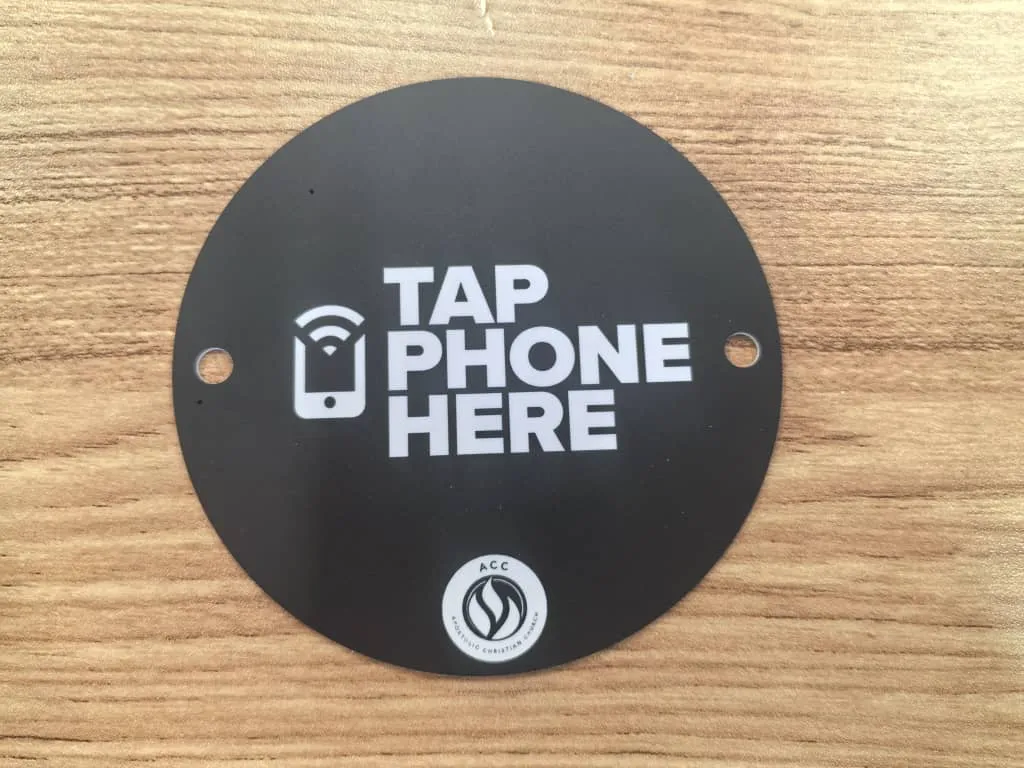
10+ years
Expected indoor lifespan of a Tap.Giving NFC plate. The chip alone is rated for 100,000+ read cycles, roughly 260 taps per week for a decade.
See your church's plate and price in 30 seconds
Design it yourself on the next page. From $3.50 per plate, free shipping, no monthly fees.
The Short Answer: 10+ Years in a Normal Sanctuary
NFC giving plates last well over a decade in typical indoor church use. The NFC chip in each plate is a passive component with no battery, no moving parts, and no electronic circuits to fail. Chip manufacturers publish endurance ratings of 100,000+ read cycles for the standard NTAG-family chips used in NFC tap plates. That is more taps than a single plate on a single pew will ever see in the lifetime of your building.
In practice, when a Tap.Giving plate does eventually need attention, the chip is almost never the reason. The chip outlives the adhesive that holds the plate to the pew, the printed face that carries the church logo, and often the pew itself. That is the same durability story behind the NFC chips embedded in credit cards, transit cards, and building access fobs, all rated for millions of daily interactions. See the entity overview at Wikipedia’s NFC article for the underlying standard.
So the honest answer for a pastor or board member evaluating tap to give is: assume 10 years, plan for 12, expect a handful of cosmetic touch-ups along the way. That timeline holds whether you are running Tithely, Pushpay, Subsplash, Donorbox, Givelify, Anedot, Planning Center Giving, or any other platform behind the NFC giving experience, the plates do not care which URL they carry.
Why NFC Tap Plates Last So Long
To understand the lifespan, look at what is actually inside an NFC tap plate. It is a printed disc with a tiny chip and a copper antenna laminated into the middle, plus an adhesive or screw-mount back. That is the entire device.
Reasons the chip survives
- No battery to leak, swell, or die
- No moving parts to wear out
- Chip is laminated inside the plate body
- Rated for 100,000+ read cycles by the manufacturer
- Passive design, powered by the phone in the moment of the tap
The math on read cycles
- 100,000 read cycles per chip
- 52 Sunday services per year
- Even at 5 taps per plate per Sunday, that is 260 per year
- Chip endurance covers roughly 380 years of that pace
- Real limit is the physical body, not the chip
Contrast that with a giving kiosk, which typically has a screen backlight rated for around 30,000 to 50,000 hours, a card reader with moving contacts, a power supply, and a small computer inside. Any of those can fail, and when one does, the whole unit is offline until it is repaired. Kiosks average a 5 to 7 year lifespan under weekly church use, and repair calls tend to hit before then. NFC tap plates skip almost all of that failure surface, which is a big part of why churches replace kiosks with plates in the first place. We wrote a full breakdown in Replace a Giving Kiosk with NFC Plates if you want the side-by-side.
The same durability logic applies to contactless giving as a category. Whether you call it tap to give, tap to donate, NFC giving, or contactless church collection plate, the physical device on the pew is the same class of hardware, a passive NFC tag encased in a printed plate. The engineering of tap technology for churches is optimized around low friction on the giver side and low maintenance on the church side. That is the whole point.
What Actually Ages First (and What Never Does)
We have shipped NFC tap plates to churches across the country for several years, so we see what tends to break down first. There are three real failure modes, and none of them involve the chip.
1. Adhesive fatigue (usually year 4 to 7)
The peel-and-stick backing works fine for the first several years, but in hot rooms with big temperature swings (unconditioned sanctuaries, camp chapels, outdoor pavilions), the adhesive can slowly release. The fix is to peel the plate off, add a fresh strip of 3M VHB tape, and stick it back down. Total time per plate: about 30 seconds. Our mounting guide covers this and the screw-mount alternative for churches that want a permanent solution.
2. Printed face wear (usually year 6 to 10)
The top layer carries the church logo and the words Tap to Give. The lamination on Tap.Giving plates is scratch-resistant, but heavy use, cleaning with harsh solvents, or plates riding loose in a portable-church trailer will scuff the face over time. The chip underneath is fine. If a plate’s face looks tired, replacing that single plate at $4 or so is cheaper than a can of touch-up paint.
3. Physical damage (occasional, any year)
Kids peel plates off. Someone tries to pry one with a car key. A plate falls when a pew is moved. This is the rare-but-real category. The good news is that individual plates are cheap to replace, and the whole church does not go down because one plate is gone. Compare that to a kiosk crash on a Sunday morning where all giving stops until it reboots.
What we essentially never see fail: the NFC chip itself, the antenna, the internal lamination bond, or the QR code fallback printed on the front. Those are the parts that actually make tap to give work, and they are the parts built to last the longest.
Cost Per Year Over the Full Lifespan
A plate that lasts 10 years costs very little per year, and that is where the math really pulls away from a monthly giving platform subscription. Here is the breakdown at three common church sizes, using our published tiered pricing.
| Church Size | Plates Ordered | Per Plate | One-Time Total | Cost Per Year (10 yr) |
|---|---|---|---|---|
| 150 seats | 150 | $5.00 | $750 | $67.50 |
| 200 seats | 200 | $4.00 | $800 | $80.00 |
| 500 seats | 500 | $3.50 | $1,750 | $175.00 |
Even the largest of these lands at less than $15 per month averaged across a decade, and that number is total hardware for the entire sanctuary, not per user. A single Pushpay or Subsplash tier tends to run in the low four figures per year on its own. For deeper comparison, see Pushpay vs Tap.Giving and Subsplash Tap vs Tap.Giving. Tithely users can check the 2026 Tithely pricing breakdown.
The other math worth noting: NFC tap plates deliver up to less friction and higher in-service participation in real deployments, because the gift happens in the moment rather than later (see the numbers on our How It Works page). So the cost-per-year number is even lower on a cost-per-dollar-of-lift basis. A plate that raises Sunday giving by even a few percent pays for itself in the first month and then keeps working, quietly, for the rest of the decade.
How to Test and Inspect Plates Over Time
We recommend a light quarterly check. It takes one volunteer and about 15 minutes for a 200-plate sanctuary. Do this and problems get caught before a Sunday morning giver notices.
- Sweep test. Walk down the aisles with a phone and hold it near a random sample of plates (maybe 1 in 10). Confirm each plate opens the giving URL banner within about a second.
- Visual scan. Look at the face for scratches, adhesive lift at the edges, or plates that have shifted on their mount.
- Corner tug. Press gently on a corner of the plate. If it flexes noticeably or peels, it is time to re-adhere or move to a screw mount.
- Log any failures. Keep a simple note per plate ID (they are numbered on the back). If you see the same location fail twice, it may be a mounting-surface issue, not the plate.
- Swap and reorder. Pull failed plates, replace from a small spare pool, and reorder spares once per year. Ten spare plates for a 200-plate church is more than enough.
The whole routine is closer to inspecting hymnals than servicing a piece of technology. There is no software patch to install, no firmware update, and no login required. If a plate reads, it works. If it does not, replace the plate.
Warranty, Replacement, and Reorders
Tap.Giving replaces any plate that fails from a manufacturing defect within the first 12 months at no cost. Beyond that, we sell replacement plates at cost so the church can maintain a small spare pool without a full reorder. Because plates are one time hardware between $3.50 and $5.00 each, even the out-of-warranty scenario stays cheap.
A few realistic scenarios and what they cost:
Rebrand in year 4. New church logo means new plate face. Reorder at your original tier price. Peel off the old plates, install the new ones over the existing mount points. Under one hour of volunteer labor for a 200-seat sanctuary.
New campus in year 6. Order plates for the new location. Use the same giving URL if the campuses share a giving account, or a campus-specific URL if they do not. See Tap-to-Give for Multisite Churches for the full playbook.
Kid peels a plate off in year 3. Grab a spare from the closet. Total cost: about $4. Compare to the recovery cost when a $200/month platform’s app crashes on Christmas Eve.
First-time customers receive 10% off during the 7-day quote window. Returning churches get a same-day quote by dropping a note through our order page or via the NFC FAQ. Lead time is 2-3 weeks from artwork approval for a full run, faster for small reorders when we have stock on hand.
Ready to add tap-to-give plates that last a decade?
One-time hardware, no monthly fees, and a chip rated for 100,000+ read cycles. Works with the giving platform your church already runs.
Start a quote to get 10% off for 7 days.
FAQ: Common Durability Questions
How long do NFC giving plates last?
Well-made NFC tap plates last 10 or more years indoors with typical church use. The NFC chip itself is rated for at least 100,000 read cycles, which is more taps than a single plate would see in decades of Sunday services. What actually ages is the adhesive backing and the printed face, not the chip.
Do NFC giving plates have batteries that wear out?
No. NFC tap plates are passive, they have no battery. The plate draws a tiny amount of power from the phone’s own magnetic field for the fraction of a second the phone is close. Nothing to charge, nothing to replace, nothing to leak. Batteries are the single most common failure point in donation kiosks, so no battery is a big reason plates outlast a kiosk two to one.
What actually fails on an NFC giving plate?
In real church use we see three failure modes: adhesive letting go on a hot summer day, print scuffing when a plate rides in a padded bag between multi-site services, and physical damage from a plate being pried off with a car key. All three are cosmetic or mounting issues. The NFC chip is protected inside the laminated body and almost never fails on its own.
Do NFC giving plates come with a warranty?
Yes. Tap.Giving replaces any plate that fails from a manufacturing defect within the first 12 months, no questions asked, and offers replacement plates at cost for accidental damage after that. Because plates are one time hardware from $3.50 to $5.00 each, even out of warranty replacements land under the cost of one month of a giving platform subscription.
How do I test whether a plate still works?
Hold a smartphone within about an inch of the plate. Within a second, the phone should show a notification banner with the giving URL. Tap the banner and confirm the giving page loads. Do this once a quarter on a random sample of plates. If a plate does not read, try a fresh spot on the plate face, then swap it with a spare, no tools required.
What is the cost per year over the plate lifespan?
At $4.00 per plate for a 200-seat church, the full order is $800 one time. Amortized over a conservative 10-year expected lifespan, that is $80 per year for the entire church, or 40 cents per seat per year. A monthly giving platform subscription costs more than that in a single week.
How often should we reorder plates?
Most churches never do a full reorder. They order once, mount, and use those plates for years. The common reason for a small reorder is a rebrand (new logo), a new campus, or a growth spurt that adds seats. When those happen, use the 7-day first-order discount on the reorder if the church has never used it, or contact us for a returning-customer quote.
Related Articles
How Tap to Give Works for Churches
A plain-English walkthrough of what happens in the eight seconds between a phone and a plate.
ComparisonReplace a Giving Kiosk with NFC Plates
Why the maintenance profile of plates beats the maintenance profile of a giving kiosk, in real dollars.
GuideHow to Mount NFC Plates on Church Chairs
The step-by-step for adhesive and screw-mount installs, plus what to do when adhesive lets go later.