NXP NTAG Tags vs Tap.Giving: True DIY NFC for Churches
Raw NXP NTAG215 stickers cost about $0.40 each in bulk from a distributor like Digi-Key. Tap.Giving plates cost $3.50 to $5.00 each with branded artwork, the giving URL pre-encoded, chip locking, and mounting included. For a 200-seat church, the all-in DIY total lands within $70 of the Tap.Giving price after you count the work most churches forget to budget.
Should My Church Build Its Own NFC Tags or Buy Tap.Giving Plates?
Ordering raw NXP NTAG stickers instead of Tap.Giving plates makes sense for small, one-off needs: 10 to 30 tags for a single campaign card or handout, a non-plate form factor like a wristband or key fob, or a church with an in-house designer and patient volunteer willing to do the encoding themselves. It is also a reasonable way to pilot contactless giving for about $25. For a full production rollout, where every seat needs a consistent branded surface and the encoding has to be right every time, the bundled plate avoids the DIY route's compounding volunteer hours.
$870
All-in loaded cost to build 200 branded, encoded, locked, and mounted NXP NTAG215 tags from raw parts. Tap.Giving plates for the same 200 seats are $800 with everything included.
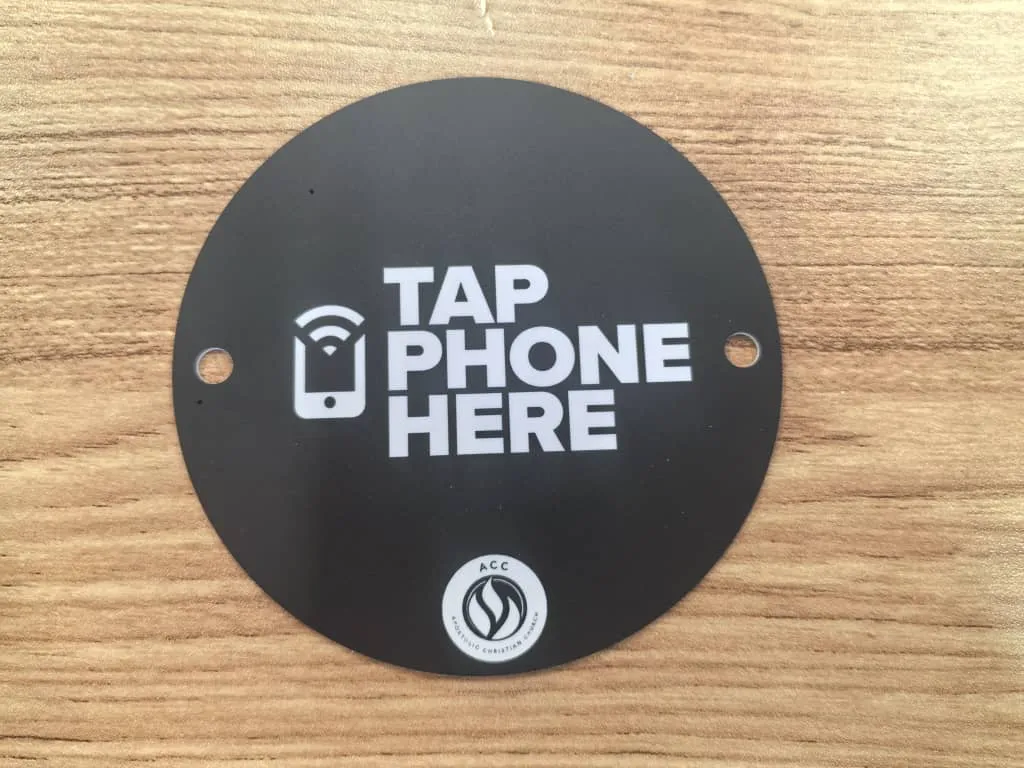
See your church's plate and price in 30 seconds
Design it yourself on the next page. From $3.50 per plate, free shipping, no monthly fees.
What an NXP NTAG Tag Actually Is
NXP Semiconductors is a Dutch chipmaker that designs the NTAG product family, the silicon that sits inside almost every passive NFC sticker, plate, card, and wristband sold for tap to give and tap to donate use cases. When a pastor reads about NFC giving on a vendor's site, the chip being described is, nine times out of ten, an NTAG213, NTAG215, or NTAG216 from NXP. The shell around the chip changes; the chip itself is a commodity.
Tap.Giving plates use NTAG215, which holds 504 bytes of writable memory. That sounds tiny but it is plenty for a giving URL, plus campaign parameters, plus a future migration buffer. NTAG213 (180 bytes) is the cheaper variant and works for short URLs; NTAG216 (888 bytes) is rarely necessary in a church context. All three share the same read protocol, so phones cannot tell them apart at the point of tap.
The relevant point for churches: the chip in a generic NTAG sticker and the chip in a Tap.Giving plate are functionally identical. Anyone selling the line that our NFC technology is better is selling a story, not silicon. The honest version is that the chip is the commodity; the product around it (the printed artwork, the locked encoding, the mount, the QR fallback) is where vendors actually differ.
The plain answer: NTAG is a chip. A tap plate is a finished product built around that chip. When a church compares "NXP NTAG tags" to NFC tap plates, the real comparison is parts kit vs finished product. Our complete buyer's guide to NFC tags for churches covers chip variants in more depth.
For background on the underlying technology, NXP publishes the NTAG product datasheets and Wikipedia has a clear overview of near-field communication as a standard. None of it is proprietary to any one vendor.
Where Churches Actually Buy NTAG Stickers
NXP does not sell direct to consumers. To buy raw NTAG stickers a church has to go through a distributor or reseller. The realistic options as of 2026:
- Electronics distributors (Digi-Key, Mouser, Arrow). Cheapest per unit at scale, around $0.30 to $0.50 per NTAG215 sticker in 1,000-unit reels. The catch: they are bare-tape adhesive labels, no print, no encoding, no QR fallback, no mounting hardware.
- NFC-specialist resellers (GoToTags, Seritag, NFC Tagify, Identiv). Slightly higher per unit ($0.60 to $1.10), with optional custom printing and bulk pre-encoding for extra fees per tag. Still requires the church to handle artwork, mounting, and the overall product feel.
- Amazon and similar marketplaces. The convenience option. Quality is uneven; some Amazon listings ship counterfeit chips that fail to lock or read inconsistently on iPhone. Hard to recommend for a 200-pew install.
- Custom-print shops with NFC inlay capability (4OVER, Sticker Mule with NFC add-on, MOO Cards Plus). Best print quality, but per-unit prices climb to $2 to $4 once branding is added, and encoding is still on the church.
We have written separate honest comparisons against most of these: GoToTags vs Tap.Giving, Seritag vs Tap.Giving, and NFC Tagify vs Tap.Giving. The pattern is the same across all three: cheaper sticker, more church-side work.
The Tap.Giving angle: we are not pretending the chip costs $4.00. We are pricing the bundle that takes the chip from a reel of unprinted adhesive labels to a mounted, branded, locked, in-pew surface that a guest can tap on Sunday. See our pricing page for the full plate price ladder.
5-Year Build Math for a 200-Seat Church
Here is the honest line item math for a 200-seat church that wants tap to give in every row. Both routes are one-time purchases (no monthly fees, no subscriptions), so 5-year cost equals year-one cost. Conservative public pricing from 2026.
| Line Item | Raw NXP NTAG Build (DIY) | Tap.Giving (Done For You) |
|---|---|---|
| 200 NTAG215 tags or plates | $80 (200 x $0.40 from Digi-Key) | $800 (200 x $4.00 plate) |
| Branded artwork on the tag face | $300 to $400 (designer fee or local print shop) | Included |
| Pre-encoding the giving URL on every tag | $80 to $120 (2 to 3 volunteer hours) | Included |
| Locking the chip read-only | Manual per tag (irreversible if mis-set) | Default on every plate |
| QR code fallback printed on the face | Not standard, requires second print pass | Included |
| Mounting (adhesive or screw) | $50 to $100 hardware, plus labor | Included (3 options shipped on request) |
| US shipping | $20 to $60 across multiple vendors | Free |
| Year 1 loaded total (typical) | $870 (range $530 to $980) | $800 |
| Years 2 to 5 recurring | $0 (plus rework if URL changes) | $0 |
| 5-year total | $870 | $800 |
The honest read: at the rock-bottom corner of the DIY range (cheapest tags, volunteer artwork, no mounting hardware), a raw NTAG build comes in around $530 and Tap.Giving is $270 more. At the realistic loaded number, where most churches actually land, the two are within $70 of each other. The decision stops being a price decision and becomes a workload decision.
For comparison against subscription-based digital giving for churches instead of a parts-bin build, see the Tithely Tap 3-year TCO breakdown and the Pushpay VisitorTap hidden cost teardown. The hardware-vs-subscription comparison is where the dollar gap gets dramatic.
The Encoding Workflow Nobody Mentions
A reel of raw NTAG215 stickers arrives blank. Every single tag has to be written with the church's giving URL before it goes on a pew. The free NFC Tools app on Android is the standard workflow:
- Open NFC Tools, tap Write, add a URL record, paste the giving page URL.
- Hold a blank sticker to the back of the phone until the write completes (typically 1 to 2 seconds).
- Tap Read to verify the URL came back correctly.
- Switch on the lock toggle and write again to make the tag read-only.
- Move to the next sticker. Repeat 199 more times.
Realistic throughput is 30 to 60 seconds per tag including verification and labeling. A 200-tag batch is 2 to 3 focused hours of volunteer labor, or roughly $80 to $120 if the church values the time at minimum wage. Our step-by-step NFC Tools guide walks through every screen.
The hidden risk in a DIY encoding session is the miss-rate. In a 200-tag batch a careful volunteer typically writes 3 to 8 bad tags: tag failed to lock, tag wrote a typo, tag wrote a staging URL by accident, or tag flagged itself as broken on verification. None of those are catastrophic, but every one is a tap that goes nowhere on Sunday. Tap.Giving's pre-encoded plates ship with a 100% verified write rate because the encoding happens on a manufacturing line, not a kitchen table.
Locking and Security: Where Raw Tags Fall Short
An NTAG sticker that has not been locked is writable by anyone with a phone and the same NFC Tools app. In a sanctuary that means a single hostile actor (or a curious teenager, or a misguided prank) can silently rewrite a tag's URL to point at a different page. The plate still says tap to give on the face, but it now opens an arbitrary destination.
On a raw DIY build the locking step is a manual checkbox in NFC Tools. Miss it on a few tags during the encoding session (which happens, especially after the second hour of repetitive taps) and those tags are permanently unlocked in a public space. There is no fleet-wide audit; the church has to re-read every tag periodically to know.
Tap.Giving plates ship locked from the factory. The URL on the chip cannot be rewritten in the field. If a church explicitly wants rewritable plates (for a campaign URL that rotates every quarter), we offer them on request, but the default is hardware-enforced read-only. Same chip standard, different default. Our NFC FAQ covers the security tradeoffs in more depth, and the DIY NFC giving guide covers what most churches miss the first time through.
The bottom line on chip security: the silicon supports locking. Whether the locking actually gets applied is a workflow problem, and workflow problems compound across a 200-tag batch. The plate is the encoding workflow paid for in dollars instead of volunteer hours.
When a Raw NTAG Build Is the Right Call
There are real situations where ordering raw NXP NTAG stickers from a distributor is better than ordering plates from us. The honest list:
- You need 10 to 30 tags for a one-off project. A capital campaign card, a connect-card insert, a single ministry handout. The setup time per tag is the same; at small scale the per-unit savings dominate.
- You need a non-plate form factor. A wristband for a youth camp, a key fob for a small group leader, a PVC card insert for a guest packet. Tap.Giving sells plates only; NTAG-based suppliers sell every other shape.
- You have an in-house designer, a patient volunteer, and a Sunday-school room to do the encoding in. The labor is free in your accounting, and the savings against a 200-plate order are real.
- You want to pilot contactless giving before committing. Buying 25 raw NTAG stickers from Amazon for $25 is a fine experiment. If the data looks good after a month, you can graduate to a proper plate run.
For the production rollout, where every seat needs a consistent branded surface on day one and the encoding has to be right 100% of the time, the bundled plate exists because the DIY route burns volunteer hours that compound into Sundays where the plate works for some pews and not others. We learned that the hard way before building the product.
A few practical next steps depending on where you are: read how it works for the giver-side walkthrough; see how tap to give works for churches for the pastor-friendly explainer; review the church guide to tap discs and plates for a wider view of church giving technology; or skim the founder story if you want to know why a pastor ended up running a hardware company.
Skip the parts-bin build and receive plates 2-3 weeks from artwork approval
NTAG215 chip, branded artwork, pre-encoded giving URL, locked from the factory, free shipping to every destination we agree to serve. Works with the giving platform your church already uses.
Start a quote to get 10% off for 7 days
FAQ: NXP NTAG vs Tap.Giving Plates
Does Tap.Giving use NXP NTAG chips?
Yes. Tap.Giving plates use NTAG215 chips from NXP, the same silicon family that sits inside Apple AirTag, most contactless business cards, and the vast majority of NFC tags for churches on the market. The chip is a known commodity; the value of a tap plate is the surrounding product, branded artwork, pre-encoded giving URL, locked write protection, mounting options, and US shipping included. See our pricing page for the full plate price ladder.
Can a church just buy NXP NTAG stickers directly?
NXP sells to manufacturers, not directly to churches. The way to buy raw NTAG stickers is through electronics distributors like Digi-Key, Mouser, or Arrow, or general resellers like Amazon, GoToTags, or Seritag. Expect roughly $0.40 to $1.10 per blank sticker depending on quantity and form factor. Programming, branding, locking, and mounting are still up to the buyer. The DIY NFC giving guide walks through the full self-build.
Which NTAG chip do I want for tap to give?
NTAG213 (180 bytes of writable memory) works for short giving URLs and is the cheapest option. NTAG215 (504 bytes) is the practical choice for most churches because it leaves room for branded URL parameters, campaign codes, and future migrations. NTAG216 (888 bytes) is rarely necessary for a giving page URL. Tap.Giving plates ship with NTAG215 by default.
What does the loaded cost of a DIY NTAG build actually look like?
For a 200-tag deployment with branded artwork, encoded URLs, and chip locking, expect roughly $870 all-in: about $200 in raw stickers and a small markup over the cheapest reels, $300 to $400 in artwork and printing, $80 to $120 in encoding labor (2 to 3 volunteer hours), $50 to $100 in mounting hardware, and $20 to $60 in shipping. Tap.Giving's done-for-you equivalent for 200 plates is $800 (see pricing).
Is it hard to encode and lock NTAG stickers?
Encoding is straightforward with the free NFC Tools app on Android: hold the sticker to the back of the phone, write the URL, tap save. Locking is a one-way switch that prevents the URL from being rewritten, and once you flip it the sticker cannot be re-encoded. The risk is missing a few tags in a 200-tag batch; an unlocked plate in a public pew can be silently redirected to a different URL by anyone with a phone. See the NFC Tools step-by-step guide.
Are NTAG stickers compatible with iPhones?
Yes. Every iPhone since the iPhone XS (2018) reads NTAG family chips without any app, and every modern Android phone reads them out of the box. The NFC reading hardware is the same standard powering Apple Pay and Google Pay, so any phone that can tap a card reader at a store can tap an NTAG-based giving plate. The NFC giving explained guide covers phone compatibility in detail.
When is a raw NXP NTAG build the right call?
Small pilots (10 to 30 tags), one-off campaign cards, internal staff badges, or any project where a church already has a designer and a patient volunteer. For a 100+ unit production deployment in pews where every seat needs a consistent branded surface, the bundled plate exists for a reason. The break-even point is usually around 50 tags. Start a quote to get 10% off for 7 days if you decide to skip the parts bin; start at the order page.
Related Articles
NFC Tagify vs Tap.Giving: Generic NFC Tags vs Church-Purpose Tap Plates
The reseller angle on the same parts-bin vs done-for-you tradeoff, with a side by side cost build for 200 tags.
GuideDIY NFC Giving With No Monthly Fees: What It Actually Takes
A full self-build walkthrough: tag sourcing, encoding, mounting, signage, and the labor cost most pastors miss the first time.
TutorialNFC Tools App: Program Church Tags Step by Step
The free Android app workflow for encoding a church's giving URL on raw NTAG stickers, including the locking step most volunteers skip.