PayPal for Churches vs Tap.Giving: 5-Year Cost Compared (2026)
PayPal is one of the cheapest online donation processors a church can use. Tap.Giving is the cheapest way to add tap to give in the room. They are not the same product, and the most useful comparison is what each one actually costs and what each one actually does for digital giving for churches.
Short answer: a 200-seat US church on PayPal's nonprofit Donate rate (1.99% plus $0.49 per transaction) pays roughly $5,050 in fees over 5 years on $3,000 per month of online giving.
5-Year Number to Remember
$5,050
What a 200-seat church spends on PayPal nonprofit processing fees over 5 years at typical online giving volume. The plates that capture the in-room half of that giving cost $800 once.
See your church's plate and price in 30 seconds
Design it yourself on the next page. From $3.50 per plate, free shipping, no monthly fees.
The Short Answer in Dollars
PayPal is a payment processor with no monthly subscription. Tap.Giving is a hardware company with no monthly subscription. They overlap in zero places. The choice most churches think they are making in their church giving technology stack, PayPal or Tap.Giving, is actually two choices: which processor handles the money, and what physical experience lives on the seat backs during the offering.
If your church already takes online donations through PayPal, you are paying fees per transaction. The current published rate for enrolled US nonprofits on the PayPal Donate product is 1.99% plus $0.49 per donation. A 200-seat church averaging $3,000 a month in online giving (the rough midpoint for that size in 2026) pays about $84 a month in PayPal fees. Five years of that is $5,050.
NFC tap plates do not change that processing cost. They change where the giving happens. Lifeway research and our own customer data point the same direction: when people are willing to give but the in-service path is awkward, you lose them.
The takeaway, in one sentence:
PayPal handles the money, Tap.Giving handles the moment. Pick PayPal as your processor if its rates fit, then add NFC tap plates so the moment of the offering is actually capturable.
What PayPal Actually Does for a Church
PayPal sells two things a church might use: a PayPal Donate button (a direct merchant account for the church) and PayPal Giving Fund (a 501(c)(3) charity that collects on behalf of enrolled nonprofits and grants the money in batches). For most churches the Donate button is the practical choice because the money lands in the church account directly, not as a batched grant 15 to 45 days later.
What PayPal does well
- Cheap per-transaction rate for nonprofits (1.99% plus $0.49)
- Trusted brand with most US adults already having a PayPal account
- Apple Pay, Google Pay, and Venmo accepted on the same checkout
- No monthly fee, no setup fee, no annual fee
- Direct deposit to the church checking account on a normal schedule
What PayPal does not do
- Sell any NFC hardware, no plates, no discs, no tags
- Provide a contactless giving experience in the room
- Hand the giver a 1-tap path the way NFC tap plates do
- Replace a church management system or pledge tracking tool
- Build a branded giving page beyond the standard PayPal form
The PayPal Donate URL looks like paypal.com/donate?hosted_button_id=YOUR_ID. That URL is mobile friendly and works in any phone browser. It is also the exact kind of URL that can be encoded onto an NFC chip, which is where Tap.Giving comes in.
What Tap.Giving Actually Does for a Church
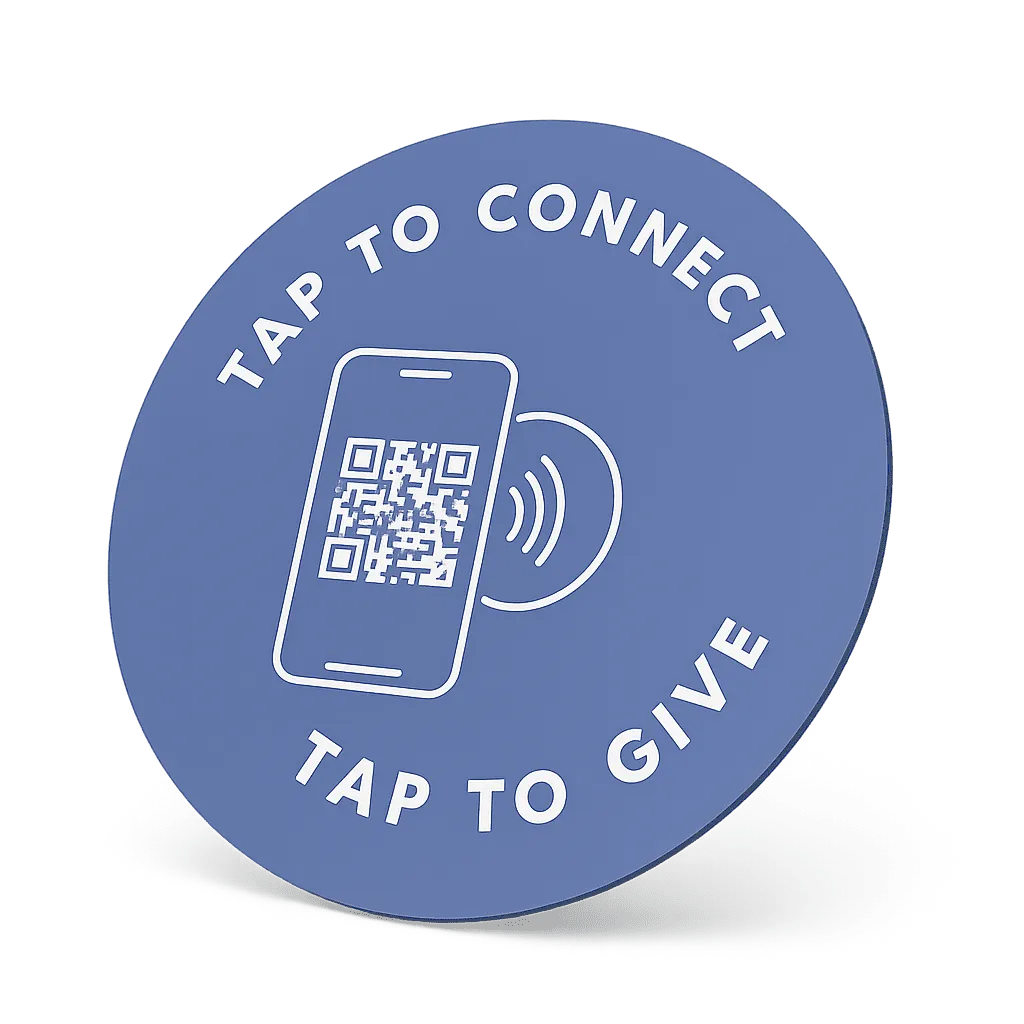
Tap.Giving is hardware, not software, and not a processor. Each NFC tap plate is a 4-inch printed disc with a passive NFC chip that holds one URL. The plate mounts to a pew back, a chair back, or a connect-card pocket. When a member holds a phone within an inch or two, the phone reads the URL and offers to open it in the browser. The browser is whatever the phone already uses. The URL points to the church's existing giving page (a PayPal Donate link, a Tithely page, a Pushpay page, anything). The donation runs through the processor that already serves the church, and the money lands where it already lands.
Because the plate is just a URL, tap to give and tap to donate work with anything. PayPal, Tithely, Pushpay, Subsplash, Donorbox, Givelify, Anedot, Planning Center Giving, Nucleus Giving, a custom Stripe checkout, all of it. We do not need to integrate, the church does not have to switch processors, and the plate cannot be locked to a single vendor.
The point of NFC tap plates is the moment of the offering. A first-time NFC giver completes the donation in about 8 seconds, no app, no signup, no QR scan, no URL to type. The same chip standard powers Apple Pay and Google Pay, so any phone that taps to pay at a coffee shop can tap a plate. Tap technology for churches is the same NFC stack consumers already use at the grocery store, which is why no setup or app is required on the giver side. Our how-it-works page walks through the giver experience step by step.
The 5-Year Cost Table, Side by Side
Numbers below assume a 200-seat US church that processes about $3,000 a month online (a typical figure for that size by 2026), with an average gift of $60 and about 50 online transactions a month. Rates are public, the math is plain.
| Line item | PayPal alone | PayPal plus Tap.Giving plates |
|---|---|---|
| One-time hardware | $0 | $800 (200 plates at $4.00) |
| Monthly subscription | $0 | $0 |
| Per-transaction (1.99% + $0.49) | About $84/mo | About $84/mo, more transactions captured |
| 5-year processing fees | About $5,050 | About $5,050 on the same base, plus fees on whatever lift you capture |
| In-service participation | Remember the URL later | Give in the seat |
| 5-year total spend on tools | $5,050 | $5,850 |
The extra $800 over 5 years is $160 a year, less than $14 a month, to give every seat a tap to give path. Even a small lift in giving (one extra $50 gift per Sunday across the year) pays the plates back many times over. Our ROI breakdown runs the same math at multiple church sizes.
Compared to a Tithely subscription ($99 a month for the full Pro tier, see Tithely pricing 2026) or Pushpay (typically $1,475 a month for a 200-seat church, see Pushpay vs Tap.Giving), PayPal is by far the cheapest processor by sticker price. The dollars saved by skipping a SaaS subscription are real. But those dollars only matter if the in-service path is good enough to actually capture giving, which is what the plates do.
Feature Comparison: PayPal vs Tap.Giving
A row-by-row look at what each one actually does. The shorthand: PayPal is in the green column for processing, Tap.Giving is in the green column for the in-service experience, and most churches are best served using both.
| Capability | PayPal (Donate) | Tap.Giving |
|---|---|---|
| Processes payments | Yes | No (hardware only) |
| Sells NFC tap plates | No | Yes |
| Monthly fee | $0 | $0 |
| Transaction fee | 1.99% + $0.49 | $0 (we do not touch the money) |
| In-service tap experience | No native NFC giving option | Yes, 1 tap, no app |
| Recurring giving | Yes | N/A (depends on the URL) |
| Works with any giving platform | Only PayPal | Yes, any platform with a mobile URL |
| QR code fallback | No | Yes, printed on every plate |
| Donor-side app required | PayPal app helpful, not required | No app required |
When PayPal Alone Is the Right Call
We sell plates, but plates are not the answer for every situation. Be honest about a few cases where PayPal as the only digital giving setup makes sense.
- Pop-up congregations, house churches, or short-term plants. If the church does not have permanent seating to mount to, the plates do not have a home. Use the PayPal Donate URL in a printed flyer for now, revisit when there are pews or chairs.
- Online-only ministries. If 100% of giving is online and 0% is in-service, the PayPal page is the whole experience. Tap plates are designed for the room.
- Under 50 seats. Our minimum order is 100 plates. Below that, you are better off with a single PayPal QR sign at the back wall and revisiting plates when the congregation grows.
- Pre-launch, no giving URL yet. Set up the PayPal page first, get one real donation, confirm the URL is mobile friendly, then call us. The plates encode whatever URL you point them at, get the URL right before printing 200 of them.
For everyone else (a permanent room with seats, a real Sunday service, members who use phones), tap plates plus your existing PayPal account is the combo that turns a fine processor into a great giving experience.
How to Use PayPal and Tap Plates Together
The setup is simpler than most church tech projects. Five steps, no integration work, no API keys, no migration.
1. Confirm your PayPal Donate URL
Open your PayPal nonprofit Donate page on a phone. It looks like paypal.com/donate?hosted_button_id=YOUR_ID. Confirm a guest can give without a PayPal account (the form allows guest checkout by default, but verify in your PayPal settings).
2. Order plates with that URL encoded
Send us a vector logo and your PayPal Donate URL. Tap.Giving plates are $5.00 each at 100 to 199, $4.00 each at 200 to 399, and $3.50 each at 400 or more. Free shipping. See full pricing.
3. Mount plates on pews or chair backs
Adhesive backing for pews or pre-drilled holes for screws. A volunteer team can install 200 plates in about 90 minutes. Step-by-step mounting guide.
4. Demonstrate from the stage
A 30-second demo on a Sunday morning is the single most important thing you will do. Sample scripts for the announcement.
5. Watch the PayPal dashboard
PayPal transactions tagged to the Donate button show up like every other donation. There is no "tap-to-give" line item in PayPal; you will see them in the same dashboard as web gifts. The lift shows up as new givers and more frequent gifts, not a separate report.
That is the whole project. No integration, no migration. The plates work the day they arrive, and they will keep working in 5 years when the next staff turnover happens and someone tries to remember what to do with them. There is nothing to remember, the chip stores a URL.
Keep PayPal. Add tap to give to every seat.
One-time hardware cost. No monthly fees. Works with your existing PayPal Donate page (or any other giving URL). Most churches are tapping by week three.
Start a quote to get 10% off for 7 days
FAQ
Is PayPal free for churches?
PayPal does not charge a monthly fee for its standard nonprofit account, but it does charge per donation. Enrolled US 501(c)(3) churches on the PayPal Donate product pay 1.99% plus $0.49 per transaction as of 2026 published rates. A 200-seat church processing about $3,000 a month online pays roughly $84 a month in fees, or about $1,010 a year. There are no setup fees, but the per-transaction cost is the real expense.
Does PayPal support NFC tap-to-give?
PayPal does not sell NFC plates, tap discs, or any in-service tap hardware. The PayPal Donate button and PayPal Giving Fund are designed for online and mobile giving, not for the moment of the offering. To accept a tap during a Sunday service, you need a separate NFC product. Tap.Giving plates open whatever giving page you already have, including a PayPal Donate URL.
Can I use Tap.Giving plates with my PayPal donation page?
Yes. Each plate is programmed with one URL, and that URL can be your PayPal Donate link or any other giving page. When a member taps the plate, the phone opens your PayPal donation form in the browser and the donation is processed exactly as if they had typed the URL themselves.
What is PayPal Giving Fund and how is it different from regular PayPal donations?
PayPal Giving Fund is a 501(c)(3) charity that collects donations on behalf of enrolled nonprofits, then grants the money to the nonprofit, typically within 15 to 45 days. PayPal Giving Fund itself charges 0% in fees, but the model is different from a direct PayPal Donate button. Money flows through PayPal Giving Fund first, not to the church directly, and grants are batched. Many churches still pick the PayPal Donate button for direct deposit.
How many tap plates does a church need?
The rule of thumb is one plate per seat. A 200-seat sanctuary orders 200 plates, a 400-seat sanctuary orders 400. Plates are $5.00 each at 100 to 199, $4.00 each at 200 to 399, and $3.50 each at 400 or more. A 200-seat church spends $800 once, which is less than what most churches pay PayPal in a single year of online giving fees. Our sizing guide walks through the math by congregation size.
Can a church drop PayPal entirely and just use tap plates?
No. The plates are hardware only. They open a URL on a phone. You still need a giving page on the other end of that URL, with a real payment processor behind it. That processor can be PayPal, Tithely, Pushpay, Donorbox, Givelify, Anedot, Planning Center Giving, or any other platform with a mobile-friendly giving URL. Tap.Giving is not a payment processor and does not replace one.
What happens to the money when someone taps a plate that opens PayPal?
The giver lands on your PayPal donation page, picks an amount, and pays with Apple Pay, Google Pay, a PayPal balance, or a card. PayPal processes the payment, deducts its 1.99% plus $0.49 per transaction, and deposits the net into your church PayPal account on its normal schedule. Tap.Giving never touches the money. We sold the plate, and the plate's job was to open the URL.
Related Articles
Stripe vs Tithely for Churches (2026)
Two of the cheapest church-giving stacks, compared on processing fees, ease of use, and what each one misses.
GuideBest Online Giving Platforms for Churches in 2026
A ranked roundup of the giving platforms most US churches actually use, with pricing and the trade-offs that matter.
GuideNFC Giving ROI: The Church Numbers That Matter
Real dollar payback math for adding NFC tap plates: how fast they pay for themselves at 100, 200, and 400 seats.