QR Code Fatigue Is Quietly Costing Your Church Real Giving
Short answer: QR code fatigue is the real, measurable friction of unlocking a phone, opening the camera, aiming it at a code, and waiting for a link to load, all while a live moment to give is passing. An NFC tap plate removes that whole sequence: a giver holds their phone near the plate and the giving page opens, no camera and no aiming required. The honest limit is that NFC only works where a plate physically sits, so it fixes the offering at a pew, a kiosk, or a connect card table. It does not replace a QR code on a projector screen, a bulletin insert, or a website link, which still need a printed or projected image.
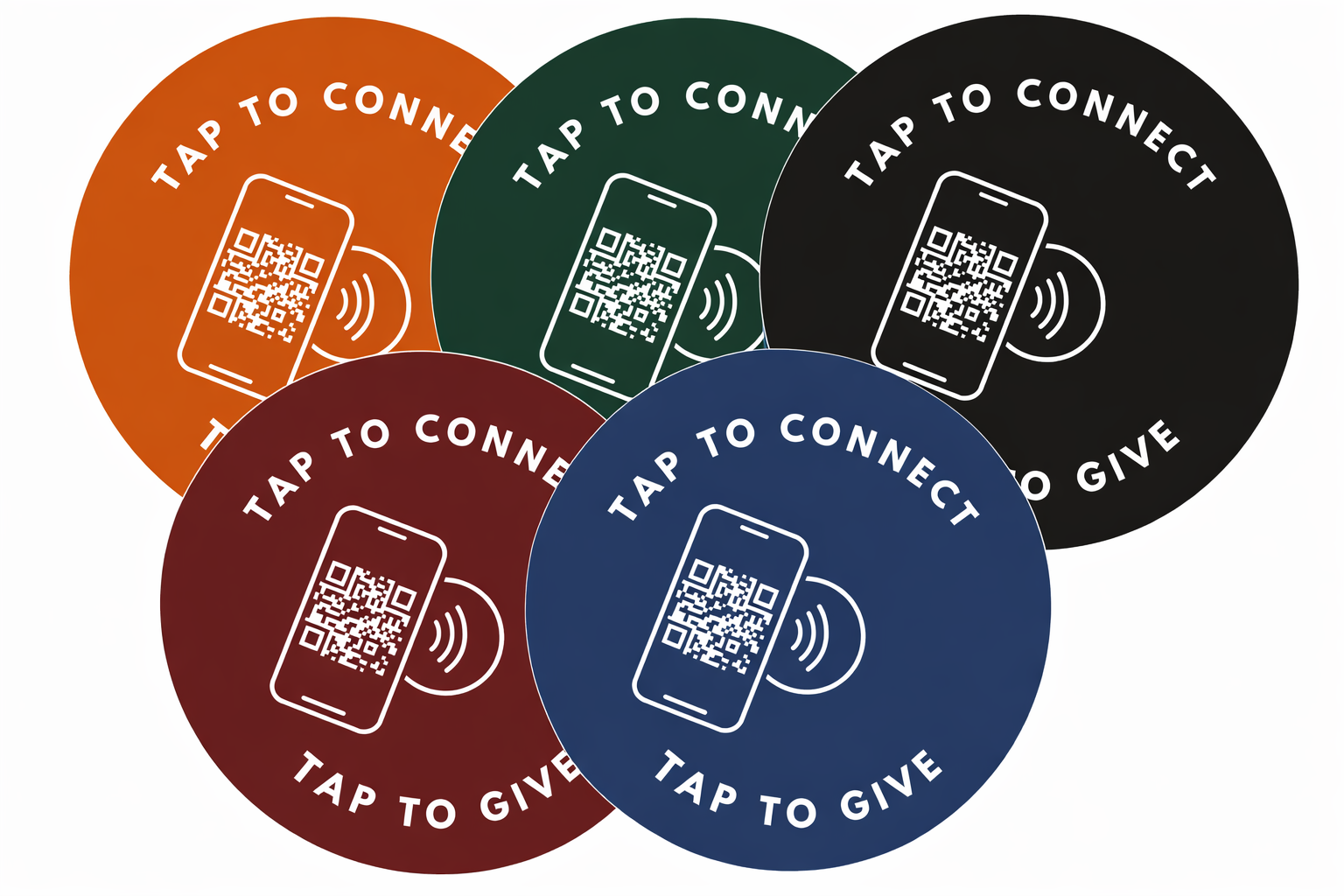
See your church's plate and price in 30 seconds
Design it yourself on the next page. From $3.50 per plate, free shipping, no monthly fees.
The Fifteen Seconds Nobody Talks About
You know the moment. The slide goes up during the offering. Someone in row twelve feels the nudge to give right now, while the thought is still fresh. She pulls out her phone. It is locked, so she unlocks it first. Then she has to find the camera app, because most phones do not open it from the lock screen by default. She points it at the screen, waits for the little frame to snap into focus, and hopes the glare off the projector does not wash out the code. A banner appears. She taps it. A browser opens. She waits for the page to load.
By the time the giving page finally appears, the sermon has already moved on to the next point, and so has her attention. Sometimes the link does not resolve at all: the screen dims before the camera focuses, the code was printed a little too small on the bulletin insert, or someone typed the giving URL into the browser by hand and fat-fingered a character, landing on a dead page instead. None of that is dramatic. It is just friction, one small delay stacked on another, and it is enough.
We measured this sequence in detail on our full QR-versus-NFC comparison: four to five distinct steps, roughly 15 to 30 seconds from unlocking the phone to the giving page actually loading. That is not a guess. It is what happens, step by step, every time someone tries.
Why the Scan Itself Is the Problem
A QR code is not unreliable because people are bad at using their phones. It is unreliable because scanning one requires a working camera, good light, a steady hand, and a code that is close enough and sharp enough to read, all at once. Take away any one of those and the scan fails. A dim sanctuary during worship removes the light. A projector screen thirty feet away removes the distance a camera can resolve. A creased bulletin insert removes the sharp edges the scanner needs to lock onto.
When a scan fails, there is no graceful retry. The giver tries again, a little more self-conscious the second time, or she gives up and tells herself she will do it online later, which most people quietly never do. The specific thing QR fatigue describes is not one bad scan. It is the accumulated hesitation of everyone who has had a scan fail on them before, so they approach the next one already braced for it not to work.
Why NFC Removes the Step Instead of Just Speeding It Up
NFC does not make scanning faster. It removes scanning entirely. An NFC tap plate holds a tiny radio chip, and a phone's NFC radio can read that chip the moment it gets within about an inch of it, the same way a contactless card taps at a checkout counter. There is no camera involved, no lighting requirement, and no aiming.
On most modern iPhones and Android phones, that read happens even through a locked screen: holding the phone near the plate triggers a system-level notification before the giver has opened anything, and tapping that notification opens the giving page directly in the browser. No app to find first, no unlocking required before the tap itself.
That is the honest mechanical reason it works: fewer steps means fewer places for the sequence to break. A QR code can fail at the light, the distance, the focus, or a mistyped URL if someone has to type it by hand. An NFC tap has exactly one condition to satisfy: the phone has to physically get close enough to the plate. There is no retry loop, because there is very little that can go wrong in the first place.
The Honest Limit: NFC Needs a Plate, QR Needs Only Ink
None of this makes NFC a universal replacement for QR codes, and it would be dishonest to pretend otherwise. A QR code is just a pattern. You can print it on paper, project it on a screen, or stick it on a window, and it works the moment it is visible. An NFC tag is a physical piece of hardware. It has to be mounted somewhere a hand can actually reach and touch, within about an inch, for the read to happen.
That means you cannot put an NFC tag on a projector screen, a slide, or a bulletin insert the way you can print a QR code there. If your giving ask lives on a screen forty feet from the nearest seat, or in a take-home flyer, or in an email, a QR code is still the right tool, because there is nothing physical for a phone to tap.
What NFC solves is narrower and more specific: the moment someone is already holding their phone, already willing to give, and sitting or standing somewhere a plate can physically be. That is a pew back, a chair back, a connect card table, or a kiosk near the entrance, not a screen or a printed page.
Where Tap-to-Give Actually Fits
The fixed locations where people already sit or stand during the offering are exactly where the friction is worst and exactly where a plate can go: the back of a pew, the back of a chair, a small kiosk by the entrance, or a connect card table where a visitor is already filling out a card. Anywhere a hand naturally rests is a place a tap plate can remove the camera-and-aim sequence completely.
Tap.Giving plates are one way to add this: custom, church-branded NFC plates starting at $3.50 to $5.00 each, one-time, with free shipping and no monthly fees. The plate is hardware only. It opens whatever giving platform your church already uses, Tithely, Pushpay, Subsplash, Givelify, or anything else, the same way a QR code would, just without the scan. If you want the fuller side-by-side on cost, reliability, and accessibility beyond the offering moment, our full QR-versus-NFC comparison walks through all of it.
Want to see your own church's plate? Start an order or see full pricing.
FAQ: QR Fatigue and the NFC Fix
Does NFC tap-to-give really work through a locked phone screen?
On most modern iPhones and Android phones, yes. Holding an NFC-capable phone near a tag triggers a system-level prompt even before the phone is unlocked, and tapping that prompt opens the link in the browser. A giver never opens an app first.
Can we put an NFC tag on our projector screen the way we print a QR code there?
No. NFC only works when a phone physically touches or gets within about an inch of the tag, so it has to live somewhere a hand can reach: a pew back, a chair back, a kiosk, a connect card table. A QR code works anywhere you can print or project an image, including a screen 40 feet away, which NFC cannot replace.
Should we replace every QR code in the building with NFC?
No, just the ones at a fixed giving location. A QR code on a bulletin insert, an email, or a website still works fine there, because none of those carry the live, in-the-moment friction of the offering. NFC solves a specific problem: the moment someone is already holding their phone and wants to give right now.
Related Articles
QR Codes vs. NFC Tap-to-Give for Church Giving
The full honest comparison: cost, reliability, accessibility, and when each one actually fits.
GuideHow Tap to Give Works for Churches
A plain-English walkthrough of how NFC tap plates work and what the church has to set up.
GuideWhy Churches Love Tap.Giving
From zero monthly fees to instant setup, why churches are choosing Tap.Giving NFC plates.