Catholic Tap to Give: Card Terminals vs Phone Plates
When a parish or diocese starts pricing "tap to give," they quickly find two very different products wearing the same name. Knowing which is which saves a parish from a monthly bill it did not need.
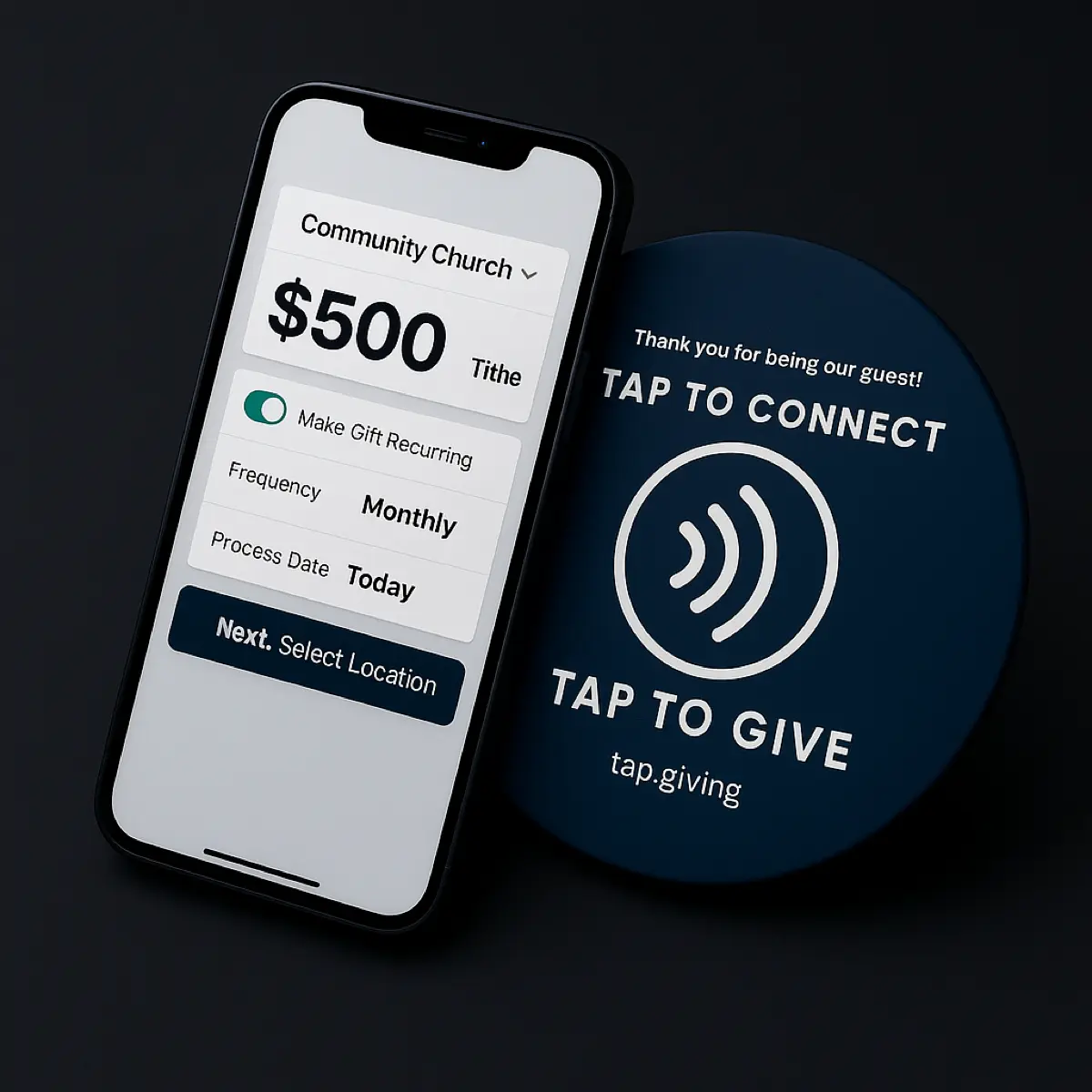
For Catholic parishes, tap to give means one of two things. A card-tap terminal is a powered device where a parishioner taps a physical card for a preset amount, usually for $20 to $35 per device per month plus about 2.75 percent. An NFC phone plate is a passive disc the parishioner taps a phone against; it opens the parish giving page, the giver chooses the amount, and it costs $3.50 to $5.00 once with no monthly fee. Plates fit the pews; a terminal fits a single narthex station.
The cost that decides it
$0/mo
NFC phone plates carry no monthly fee, so a parish can cover every seat for a one-time $3.50 to $5.00 each. Card-tap terminals run $20 to $35 per device per month, which only pencils out for one or two stations.
See your church's plate and price in 30 seconds
Design it yourself on the next page. From $3.50 per plate, free shipping, no monthly fees.
Two Things Called Tap to Give
The confusion is real enough that dioceses have written memos about it. The Archdiocese of Washington circulated a 2025 guide to its parishes explaining tap-to-give options, and the vendors it surveyed were card-tap terminals with monthly service fees. That is one meaning of the phrase. The other, the one you see marketed as tap to give or tap to donate plates, is a passive NFC disc that a parishioner taps with a phone.
They are not competitors so much as different tools. The distinction that matters to a parish budget is simple: one carries a recurring per-device fee, and one does not. Everything else follows from that.
Card-Tap Terminals, Plainly
A card-tap terminal is a small powered device, similar to the contactless reader at a store checkout. A parishioner taps a physical credit or debit card (or a phone wallet) and the device charges a preset amount, often something like $10 or $20 chosen when the device is programmed.
- Strength: fast for a fixed gift, and it works for a visitor who has a card but does not want to pull up a website.
- Cost: commonly $20 to $35 per device per month plus around 2.75 percent per gift. That is a per-device subscription that never ends.
- Limit: the amount is usually preset, so a parishioner who wants to give more has to tap several times or give elsewhere.
- Practicality: at a monthly fee per device, a parish realistically deploys one or two, not one per pew.
None of that makes a terminal a bad product. It makes it a station product: good for a spot in the narthex, not for covering a sanctuary.
NFC Phone Plates, Plainly
An NFC phone plate is a passive disc, about four inches across, with no battery and no network connection. It stores one thing: your parish giving URL. A parishioner holds a phone near it, and the phone opens that giving page in its normal browser, where the giver chooses an amount and pays with Apple Pay, Google Pay, or a card.
- Cost: $3.50 to $5.00 per plate, one-time, with free shipping and no monthly fee.
- Amount: chosen by the giver, and recurring giving is available if your platform offers it.
- Coverage: because it is one-time and inexpensive, you can put one on every seat.
- Platform: it opens your existing parish giving page, so nothing about your processor, fees, or reporting changes.
The tradeoff is that a phone plate needs a phone. That covers the vast majority of parishioners (fewer than 5 percent of active smartphones lack NFC), and a small QR code printed on the plate catches the rest. The full mechanics are in our complete guide to NFC tap-to-donate plates.
Head-to-Head Comparison
| Feature | Card-Tap Terminal | NFC Phone Plate |
|---|---|---|
| What the giver taps | A physical card | Their own phone |
| Upfront cost | Device cost or included with contract | $3.50-$5.00 per plate |
| Monthly fee | $20-$35 per device | $0 |
| Gift amount | Usually preset | Chosen by giver |
| Power source | Battery, needs charging | None (passive) |
| One per seat? | Not practical | Yes |
| Uses your giving platform | Often ties to a processor | Yes, any giving URL |
| Best role | Narthex donation station | In-pew giving during Mass |
Set against the national trend, the per-seat option is what moves the needle: weekly giving fell from 49 percent of donors in 2015 to 39 percent in 2025 per Vanco's research, and the parishes recovering it are the ones that made giving effortless in the pew, not at a single kiosk.
Which Fits a Catholic Parish
Here is the honest split, because both have a place.
- For the offertory during Mass: NFC phone plates on every seat. This is the moment most giving happens, and covering it is only affordable one-time.
- For a candle stand, feast-day gift, or narthex station: a single card-tap terminal can be a fine fit for a fixed, quick gift from someone without a phone in hand.
- For a second collection or the annual appeal: phone plates, because the giver sets the amount and the same plates can point at the appeal page during the campaign.
Most parishes end up wanting plates in the pews and, at most, one terminal by the door. For the parish-wide picture, see our guide to NFC giving for Catholic parishes, and for equipping many parishes at once, the diocese rollout guide.
Both Should Respect Your Platform
Whatever you choose, protect the back office you already run. Many parishes are on ParishSOFT Giving, OSV, Pushpay, Vanco, GiveCentral, or eCatholic, and those systems handle receipts and reporting the way your finance council expects.
NFC phone plates are platform-neutral by design: the plate opens whatever giving URL you encode, so nothing about your processor or fees changes. Tap.Giving is hardware, not a payment processor. Before signing a card-terminal contract, ask which processor it locks you into and whether it changes your parish's fees. See the platforms we work with and our ParishSOFT comparison for how plates sit alongside a Catholic-specific platform.
Put tap to give on every seat, not one kiosk
One-time hardware. No monthly fees. Works with your parish or diocesan giving platform. Tell us your seat count and we will send a quote.
Start a quote to get 10% off for 7 days
FAQ
What does tap to give mean for a Catholic parish?
It refers to two different products. One is a card-tap terminal: a powered device where a parishioner taps a physical credit or debit card for a preset amount, typically for a monthly service fee of $20 to $35 per device plus around 2.75 percent. The other is an NFC phone plate: a passive disc the parishioner taps a phone against, which opens the parish giving page where they choose their own amount. Plates are a one-time cost with no monthly fee.
Which is cheaper for covering every seat?
NFC phone plates, by a wide margin. Plates are $3.50 to $5.00 each, one-time. A card terminal at $20 to $35 per device per month is only practical as one or two donation stations per parish, not one per seat. Covering a 200-seat church with plates is $800 once; the same coverage with monthly-fee terminals is not financially realistic.
Do the givers need to download anything?
No, in both cases. A card terminal reads a physical card. A phone plate opens the parish's giving page in the phone's normal browser, where the parishioner pays with Apple Pay, Google Pay, or a card. Neither requires an app on the giver's phone.
Can a parishioner choose their own amount with a phone plate?
Yes. A phone plate opens the parish giving page, so the giver enters any amount and can set up recurring giving if the platform supports it. Most card-tap terminals are preset to a single fixed amount, which limits a larger gift.
Does either option change our parish giving platform?
NFC phone plates do not: the plate just opens whatever giving URL you encode, so ParishSOFT Giving, OSV, Pushpay, Vanco, or a parish page all keep working unchanged. A card terminal usually ties to a specific processor, so check what platform and fees it locks you into before signing.
When does a card-tap terminal actually make sense?
As a single staffed or unstaffed donation station, often in the narthex, for candle offerings, feast-day gifts, or visitors without a phone handy. For giving during Mass at every seat, one-time NFC phone plates are the practical choice.
Related Articles
NFC Giving for Catholic Parishes
How tap plates fit the offertory during Mass and work with your diocesan giving platform.
GuideTap to Give for Catholic Dioceses
Equip every parish at once as one-time hardware, with each parish on its own platform.
GuideThe Complete NFC Tap-to-Donate Plates Guide
How the plates work, NFC vs QR, platform integration, and the five-year cost math.