Tap to Give for Catholic Dioceses: A Multi-Parish Rollout Guide
Offertory is moving off cash across every diocese in the country, and dioceses are being pitched tap-to-give card terminals with a monthly fee on each device. There is a simpler, one-time way to put tap to give in every parish at once.
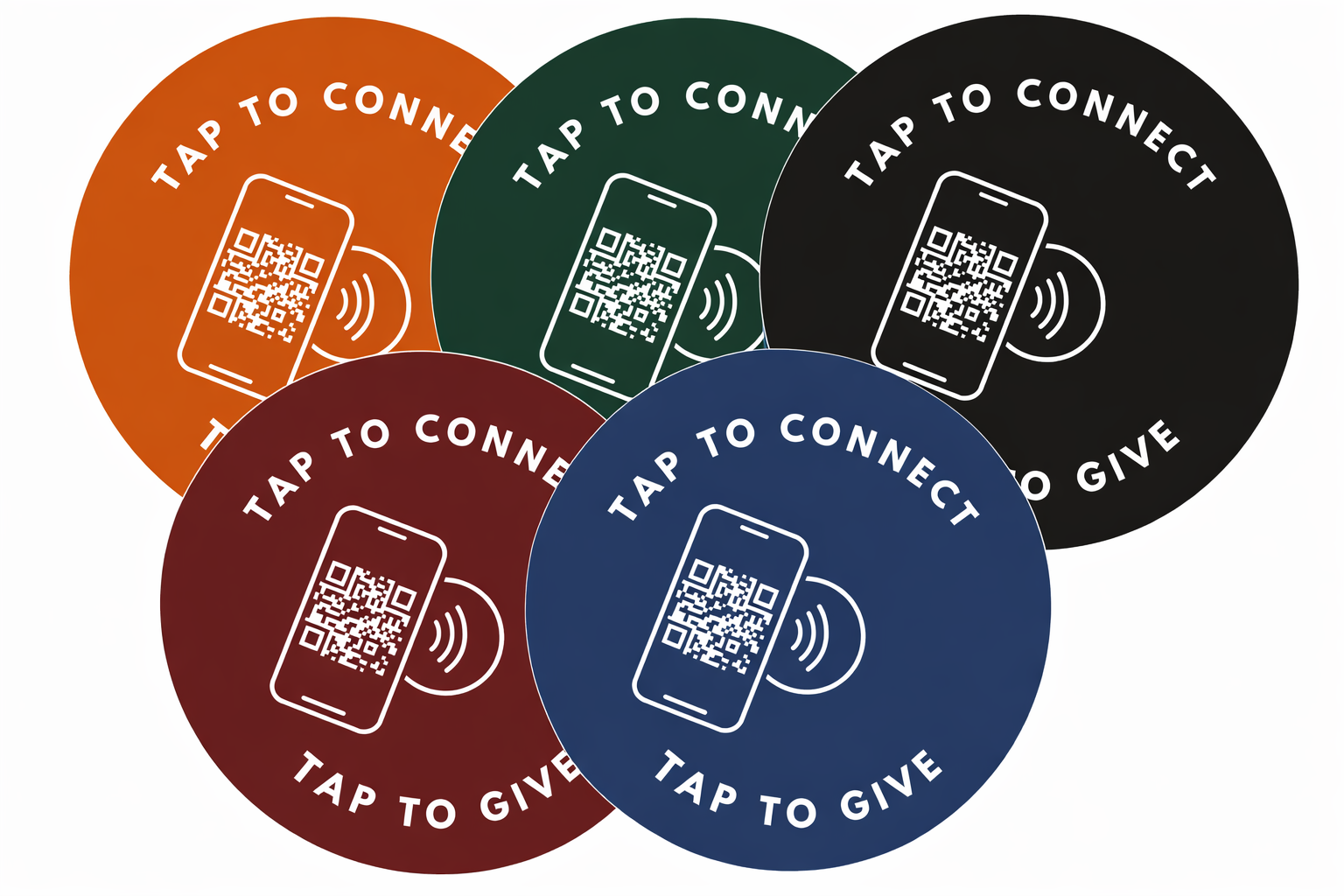
A Catholic diocese can equip every parish with tap to give as one-time hardware: NFC plates from $3.50 each at the 400-plus tier, with no monthly fees and no change to any parish's giving platform. Each plate opens that parish's own giving page (ParishSOFT, OSV, Pushpay, Vanco, or a parish page), so a diocese standardizes the in-pew experience without standardizing the back office.
Diocese-scale math
$3.50
Per plate at the 400-plus tier, one-time, free shipping, no monthly fees. A 20-parish diocese averaging 200 seats is about $14,000 once, for a tap to give path on every seat in the diocese.
See your church's plate and price in 30 seconds
Design it yourself on the next page. From $3.50 per plate, free shipping, no monthly fees.
Why Dioceses Are Looking at Tap to Give Now
The parishioner who used to put a check in the collection basket now carries a phone and rarely any cash. Weekly giving across churches fell from 49 percent of donors in 2015 to 39 percent in 2025, according to Vanco's church-giving research. Offertory has not disappeared; it has moved to the phone, and the parishes that make phone giving effortless in the pew are the ones holding their numbers.
Dioceses have noticed. The Archdiocese of Washington circulated a 2025 guide to its parishes on tap-to-give technology, and diocesan stewardship offices are fielding the same question from pastors: what is the simplest way to let people give during Mass without an app or a fumble with a camera. The answer at diocesan scale is NFC tap plates: one-time hardware, one per seat, that opens each parish's existing giving page.
For the parish-level view of the same shift, see our guide to NFC giving for Catholic parishes. This guide is written for the diocese: the office equipping many parishes at once.
The Two Kinds of Tap to Give a Diocese Gets Pitched
The phrase "tap to give" (also sold as "tap to donate") now covers two very different products, and the difference matters at diocesan scale where a per-device monthly fee multiplies across hundreds of devices.
| Feature | Tap-to-Give Card Terminal | NFC Tap Plate (Tap.Giving) |
|---|---|---|
| What the giver taps | A physical credit or debit card | Their own phone (Apple Pay, Google Pay, or card) |
| Amount | Preset on the device | Chosen by the giver |
| Power | Powered device, needs charging | Passive, no battery |
| Cost | $20-$35 per device per month + ~2.75% | $3.50-$5.00 once, no monthly fee |
| One per seat? | Cost-prohibitive; usually 1-2 per parish | Yes, one per seat |
Both are legitimate; they solve different problems. A card terminal is a good fit for a fixed donation station in the narthex. But covering every seat with a monthly-fee device is not realistic, and a preset amount limits generosity. The full breakdown is in our post on card terminals versus phone plates for Catholic parishes.
One In-Pew Experience, Every Parish's Own Platform
The concern every chancery raises is platform fragmentation: parishes are on ParishSOFT Giving, OSV, Pushpay, Vanco, GiveCentral, eCatholic, and a few homegrown pages. The good news is that NFC tap plates do not touch any of that.
An NFC plate stores one thing: a web address. Tap.Giving is hardware, not a payment processor, so each plate simply opens the giving page it is encoded with. A parish on OSV keeps OSV. A parish on Pushpay keeps Pushpay. Processing fees, receipts, and diocesan reporting are all unchanged. The diocese standardizes the moment of the offering, a phone tap, while every parish keeps the back office it already runs. See the platforms we work with and the ParishSOFT comparison for specifics.
The one setup detail worth getting right up front: point each parish's plates at a go.tap.giving/parish-name redirect rather than the raw platform URL. Then, if a parish later switches platforms, the diocese changes one redirect and every plate in that parish opens the new page. No reprint, no reorder.
What a Diocese-Wide Rollout Costs
Because plates are one-time hardware, diocesan budgeting is a single line item, not a recurring subscription that grows with every parish added. A combined order of 400 or more plates is $3.50 each. Here is the math at a few diocese sizes, assuming one plate per seat.
| Diocese Size | Approx. Plates | One-Time Cost (at $3.50) |
|---|---|---|
| 10 parishes, 200 seats each | 2,000 | $7,000 |
| 20 parishes, 200 seats each | 4,000 | $14,000 |
| 50 parishes, 250 seats each | 12,500 | $43,750 |
That number does not recur. Compare it to a subscription tap-terminal program at $25 per device per month: even 300 devices across a diocese is $90,000 in year one and $500,000 over five years, before processing fees. The one-time model is what makes covering every seat, rather than one station per parish, financially possible. Our ROI breakdown shows the payback math per parish.
Tying It to the Annual Appeal
The Diocesan or Bishop's Annual Appeal and the second collection are natural fits for tap technology, because both ask people to give in a moment when they are already seated and attentive. A tap plate on the seat turns "please prayerfully consider the appeal" into an eight-second action instead of a card to mail later.
Some dioceses keep the parish offertory as the default plate destination year-round, then temporarily re-point a go.tap.giving redirect to the appeal page during the campaign and switch it back afterward. Because the redirect is central, the diocese can run that campaign across every parish at once without touching a single plate. For the announcement language, our guide on how to explain tap plates to a congregation gives a script that works from any ambo.
A Five-Step Diocesan Rollout
1. Confirm each parish's giving page
Collect the public giving URL for every parish. It does not matter whether they share a diocesan platform or run separate pages; each plate opens that parish's own page.
2. Point plates at a per-parish redirect
Give each parish a go.tap.giving/parish-name short link that forwards to its giving page, so any parish can change platforms later without reprinting plates.
3. Order at the diocese tier
Total the seats across parishes. A combined order of 400 or more plates is $3.50 each, one-time, free shipping. See pricing or request diocese pricing.
4. Distribute and mount per parish
Ship plates to each parish with mounting hardware: adhesive for chairs, screws for pew backs. One plate per seat, plus a few for the narthex.
5. Launch with a common bulletin insert
Give every parish the same one-sentence announcement and a 15-second offering cue. Tie the launch to the annual appeal or a demonstration at all Masses one weekend. Parishes that communicate through Flocknote can push the same launch note to every registered household, and pairing Flocknote with tap plates keeps the announcement and the giving link in one place.
A diocese can move from decision to plates in pews in a matter of weeks. The plates arrive pre-encoded and locked, mounting is a volunteer afternoon per parish, and the launch is a single coordinated weekend. For the full product view, see the complete NFC tap-to-donate plates guide.
Bring tap to give to every parish in your diocese
One-time hardware. No monthly fees. Every parish keeps its own giving platform. Tell us your parish count and seat totals and we will put together a diocese quote.
Start a quote to get 10% off for 7 days
FAQ
Can a diocese buy tap-to-give plates for all its parishes at once?
Yes. A diocese can place one combined order and have plates shipped per parish, each pre-encoded with that parish's own giving URL. At 400 or more plates the price is $3.50 each, one-time, with free shipping and no monthly fees. A 20-parish diocese averaging 200 seats is 4,000 plates for about $14,000 one-time.
Does every parish have to use the same giving platform?
No. Each plate opens whatever URL it is encoded with, so parishes on ParishSOFT Giving, OSV, Pushpay, Vanco, GiveCentral, or a parish page all work side by side. Tap.Giving is hardware, not a payment processor, so it does not change any parish's platform, fees, or reporting.
How is this different from the tap-to-give card terminals dioceses are being pitched?
Those are powered card-reader devices that charge a monthly service fee per device (commonly $20 to $35 per device per month plus about 2.75%) and take a preset amount. NFC tap plates are passive: the parishioner taps a phone, opens the parish giving page, and chooses the amount. Plates are a one-time cost with no monthly fee and no fixed amount.
Can plates be re-pointed if a parish changes platforms?
Yes, if you set each parish up on a go.tap.giving redirect. When a parish moves platforms, you change the redirect once and every plate in that parish opens the new page. Without a redirect, a locked plate holds one fixed URL for its life, so plan the destination first.
Can we tie a rollout to the diocesan annual appeal?
Yes. Some dioceses encode a second set of plates, or a temporary redirect, that points to the Bishop's Annual Appeal or a second-collection page during the campaign, then switch it back to the parish offertory afterward. The hardware does not care which page it opens.
What does a diocese-wide rollout cost over five years?
Because plates are one-time hardware, the five-year cost is the purchase price and nothing more. A 4,000-plate order is about $14,000 one-time. A subscription tap-terminal program at $25 per device per month across even a few hundred devices runs into six figures over five years, before processing fees.
Related Articles
NFC Giving for Catholic Parishes
The parish-level view: how tap plates fit the offertory during Mass and work with your diocesan platform.
ComparisonCard Terminals vs Phone Plates
The two things "tap to give" can mean for a parish, and which one covers every seat affordably.
ComparisonParishSOFT Giving vs Tap.Giving
How NFC plates complement the Catholic-specific platform many parishes already run.