NFC Tap-to-Donate Plates for Churches: The Complete Guide
Churches have passed offering plates for centuries. The motion is familiar, even sacred. But the moment a congregant reaches for their wallet and finds only a phone, that tradition quietly breaks down. NFC tap-to-donate plates (also called tap to give, tap to donate, or tap and give plates) solve that exact problem.
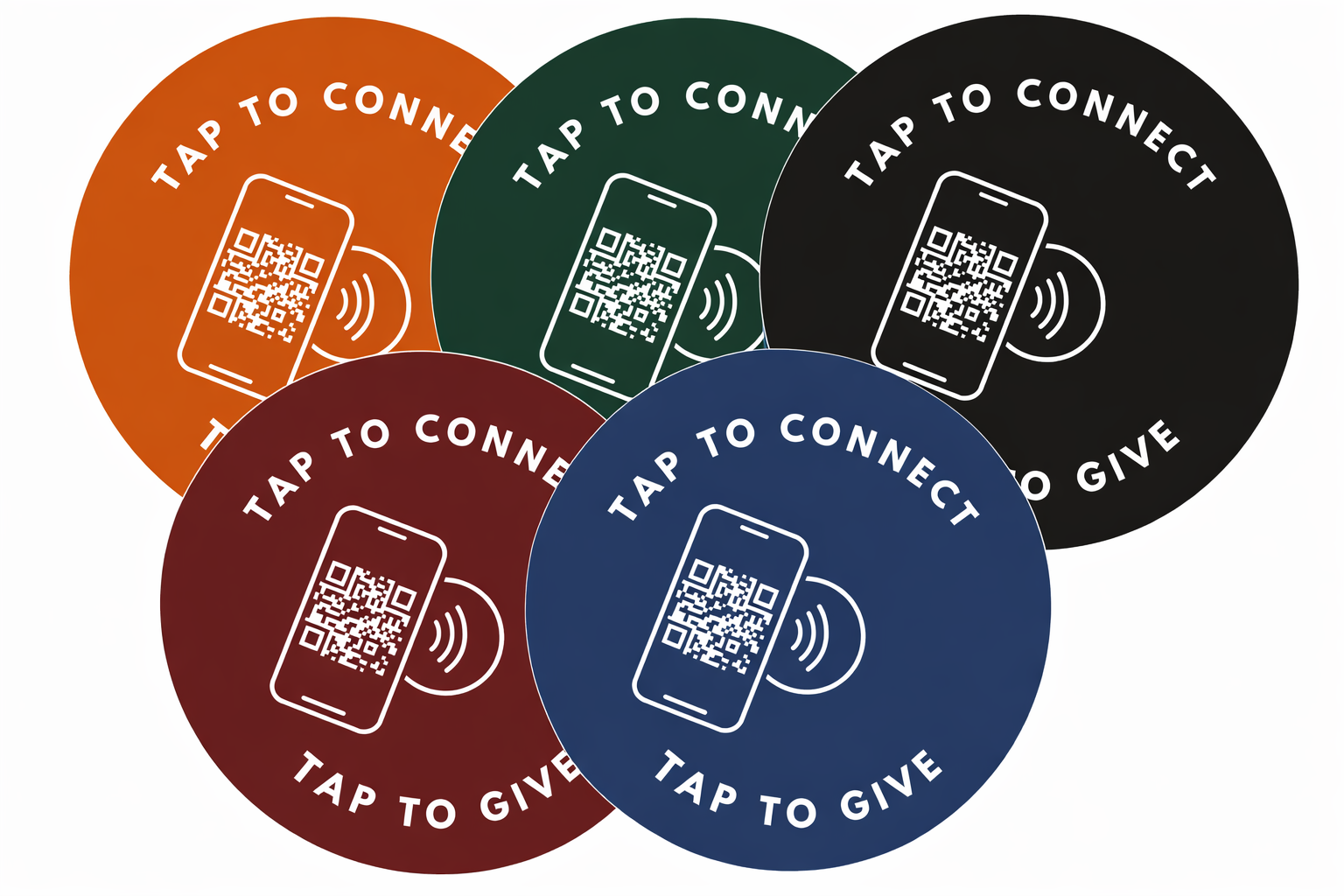
An NFC tap-to-donate plate is a small pew-mounted disc with a passive NFC chip inside. A congregant holds a phone near it, the church's giving page opens in two to three seconds, and the gift is complete in under ten seconds. No app to download, no camera to aim, no URL to remember. NFC generates fewer steps than a QR code, and 53 percent of NFC givers are first-time givers to the congregation.
The number that decides it
1 tap
More engagement from NFC tap than from a QR code in head-to-head tests. That gap is the difference between a giving method that works and one that actually converts during a 90-second offering.
See your church's plate and price in 30 seconds
Design it yourself on the next page. From $3.50 per plate, free shipping, no monthly fees.
How NFC Tap-to-Donate Plates Work
NFC stands for Near Field Communication, the same short-range wireless standard that powers Apple Pay, Google Pay, and every contactless credit card terminal. The technology has been in smartphones since 2014 and is now native on every iPhone since the XS (2018) and virtually every modern Android device. No app installation is required on either end.
A tap-to-donate plate is a disc, typically four inches in diameter, containing a small NFC chip and a thin copper antenna. The chip stores one piece of information: a web address. When a congregant holds a phone within about an inch of the plate, the phone reads that URL and opens it in the device's default browser.
What Happens in the Eight Seconds After a Tap
- Congregant holds phone near the plate (1-2 seconds)
- Phone vibrates and the giving page opens in the browser (2-3 seconds)
- Congregant enters an amount and confirms with Apple Pay, Google Pay, or a card (3-5 seconds)
- Gift is complete and processed by the church's existing giving platform
The entire sequence runs in roughly eight seconds. For context, a typical offering window during a service lasts 60 to 120 seconds. NFC is the only giving method that fits comfortably inside that window for a first-time giver.
What the Plate Does Not Do
This is the part most churches miss on first evaluation:
- The plate does not process payments
- The plate does not store donor information
- The plate does not require Wi-Fi, Bluetooth, or a battery
- The plate does not replace the church's giving platform
The plate is passive hardware. It has no power source of its own; it draws a tiny amount of energy from the phone's NFC radio during the tap. Its only function is to deliver a URL to a phone. That URL points to the church's existing online giving page, which handles everything else: payment processing, receipts, recurring gift setup, and church management system sync.
Think of it this way: the plate is the front door. The giving platform is the house. Removing friction at the front door does not change what happens inside.
NFC vs QR Codes for Church Giving: A Head-to-Head Comparison
QR codes became common during the pandemic, and many churches adopted them as a low-cost path to contactless giving and digital giving for churches. They work. But engagement data tells a stark story about the gap between "works" and "converts."
NFC generates fewer steps than a QR code in head-to-head tests. That is not a rounding error. It reflects a fundamental difference in how the two technologies interact with human behavior during a worship service.
The Friction Difference
Every additional step between intention and action reduces the likelihood of completion. Here is how each method plays out in a real service:
| Method | Steps to Complete a Gift | Typical Time |
|---|---|---|
| NFC tap plate | Tap plate, enter amount, confirm payment | ~8 seconds |
| QR code on screen | Open camera, aim and hold, tap notification, complete | ~25 seconds |
| Text-to-give | Open Messages, type number, tap link, complete | ~30 seconds |
| Giving app (first-time) | Download, sign up, log in, navigate, give | 3-5 minutes |
The offering window closes. Attention moves on. For a first-time visitor who has never given digitally to this church before, NFC is the only method that reliably captures the moment. This is why the deeper QR-versus-NFC breakdown lands the same way every time.
Where QR Codes Still Make Sense
QR codes are not useless; they are just the wrong primary tool for in-service giving. They stay valuable in specific contexts:
- Printed bulletins and mailers: QR codes work well on paper where line-of-sight is easy and there is no time pressure.
- Backup access: a small QR code on the back of each NFC plate covers the rare phone (fewer than 5 percent of modern smartphones) that lacks NFC or has it disabled.
- Outdoor or well-lit signage: camera scanning is practical when ambient light is good and there is no 90-second countdown.
The honest assessment: QR codes are the right starting point for a church with zero budget for giving technology. But once a congregation is ready to invest in in-service giving, NFC consistently outperforms QR codes on the metrics that matter: participation rate, completion rate, and first-time giver capture.
The First-Time Giver Advantage
One data point deserves special attention. Among churches using NFC tap-to-give, 53 percent of NFC givers are first-time givers to that congregation. That figure matters because first-time visitors are the hardest audience to convert. They have no established giving habit, no saved payment method in a church app, and often no awareness that digital giving is even an option.
NFC removes every barrier that would otherwise stop a visitor from giving: no app, no account, no typing, no awkward fumbling with a camera in a dim sanctuary. The tap is intuitive because it is the same motion they use to pay for coffee.
The real risk of sticking with QR codes: every Sunday that passes with a QR-only strategy is a Sunday where first-time visitors are not converting. Given that 53 percent of NFC givers are new to the congregation, that is a compounding loss of generosity over time.
Church Giving Platform Integration: How NFC Plates Work With Your Existing Software
The most common concern administrators raise when evaluating NFC plates is whether they will need to switch giving platforms. The answer is no, and understanding why clarifies the entire value proposition.
An NFC plate stores a URL. That is the complete extent of its software relationship with any platform. As long as your giving platform has a publicly accessible donation page with a web address (every major platform does), NFC plates work with it. No API connection, no integration agreement, no vendor approval required.
Platforms That Work With NFC Tap Plates
Any platform with a hosted giving page is compatible. The plates simply open that page when tapped. Here are the platforms most commonly used alongside NFC plates:
| Platform | What NFC Opens | Notes |
|---|---|---|
| Tithely | tithe.ly/give/yourchurch or custom domain | Works with free and paid tiers |
| Planning Center Giving | give.planningcenteronline.com/yourchurch | Supports fund selection on the giving page |
| Donorbox | donorbox.org/yourchurch | Supports recurring gift setup on the landing page |
| Givelify | givelify.com/give/yourchurch | Mobile-optimized; works well on tap |
| Anedot | Custom giving page URL | Supports multiple funds |
| OnlineGiving.org | onlinegiving.org/donate/yourchurch | No change to processing fees or ChMS sync |
| Any platform | Any mobile-friendly giving URL | If it works in a phone browser, a plate can open it |
The key requirement: the giving page must work without requiring a login. Most platforms offer a public-facing giving page by default. If yours requires an account before displaying a donation form, contact your platform to enable a public giving link. Our integrations hub covers the major platforms in more detail.
What Does Not Change When You Add NFC Plates
This is worth stating explicitly because it eliminates the most common objection in church board meetings:
- Processing fees stay the same. The plate is hardware; it does not sit between the donor and the processor.
- Church management system sync continues as normal. Gifts appear in your platform exactly as they would from any online donation.
- Tax receipts are generated by your platform, as always.
- Recurring gift management is handled entirely by your giving platform.
- Donor records stay in your existing system.
Nothing in your back office changes. The only thing that changes is how fast a donor gets to your giving page.
The Two-Layer Church Giving Stack
The most effective approach for most congregations is a two-layer giving stack:
- NFC plates on every seat for in-service giving (captures the moment of generosity during worship).
- Online giving platform for recurring gifts, remote giving, and donor management (handles everything outside the service).
Layer in text-to-give or a QR code backup as a third option for accessibility, and the church covers every giver type: regular members, first-time visitors, older congregants who prefer cash envelopes, and remote givers who never attend in person.
Churches that build this stack report a 300 percent or greater increase in in-service donation totals compared to passing a traditional plate or relying on a giving kiosk, with an 81 percent participation rate during services.
Placement, Installation, and Launch Strategy
Getting NFC plates into a church is a physical project, not a software one. The setup is straightforward, but placement decisions meaningfully affect how many congregants actually tap.
Where to Place NFC Plates
The primary location is the pew back or seat back directly in front of each congregant. This mirrors the placement of a traditional offering envelope holder and puts the plate at a natural reach distance during the offering. Beyond the sanctuary, plates in secondary locations extend giving opportunities across the campus:
- Welcome desk and lobby: captures visitors who want to give before or after the service.
- Kids check-in area: convenient for parents dropping off children.
- Coffee bar or gathering space: catches post-service generosity moments.
- Offering boxes: replaces or supplements physical boxes at exits.
A practical rule of thumb: order one plate per seat in the main worship space, then add 10 to 15 percent for lobby and secondary locations. Our sizing guide walks the count by congregation size.
Installation Methods
Plates attach in one of three ways depending on the seating type:
| Seating Type | Recommended Mounting | Notes |
|---|---|---|
| Wooden pews | Adhesive or small screws | Test adhesive on the finish first; screws are more permanent |
| Padded chairs | Screw-mount into the seat back | Holds where tape cannot grip fabric |
| Stackable chairs | Adhesive on chair back | Confirm the surface is smooth before ordering adhesive-backed plates |
| Offering boxes | Adhesive or surface mount | Visible placement near the box opening |
Before mounting the full order, test one plate with both an iPhone and an Android device. Confirm the giving page opens correctly, loads without a login prompt, and displays properly on a mobile screen. The mounting guide covers each seating type in detail.
Launching NFC Giving to Your Congregation
The most common launch mistake is over-explaining. Congregants do not need a tutorial on NFC technology; they need one sentence of instruction and a demonstration. A proven launch script for announcement Sunday:
"We have new giving plates on the back of each seat. Hold your phone near the plate, and your phone will open directly to our giving page. No app, no scanning, just hold it close."
After launch Sunday, a 15-second cue during each offering is enough. Within two to three weeks, regular attenders will have the motion memorized. For a fuller script and checklist, see the guide on how to explain and promote tap plates to your congregation.
Handling Phones Without NFC
Fewer than 5 percent of smartphones in active use today lack NFC support. The practical solution is a small QR code printed on the front or back of each plate, encoding the same giving URL. This covers older devices and the rare case where a congregant has NFC disabled. It also serves as a familiar visual cue for congregants who are not yet comfortable with the tap gesture.
Pricing and Total Cost of Ownership
Church technology budgets are finite, and the finance committee will want numbers. Here is a transparent breakdown of what NFC plates cost and how they compare to other church giving technology over time.
NFC Plate Pricing (One-Time Hardware)
Tap.Giving plates are priced per plate with volume discounts and no recurring fees:
| Order Quantity | Price Per Plate | Total for That Tier |
|---|---|---|
| 100-199 plates | $5.00 | $500 to $895 |
| 200-399 plates | $4.00 | $800 to $1,596 |
| 400+ plates | $3.50 | $1,400+ |
Free shipping is included. There are no setup fees, no monthly fees, and no transaction fees from Tap.Giving. Your existing giving platform charges its normal processing fee (typically 2.9% + $0.30 per transaction), and that fee is unchanged whether a gift comes in via NFC tap or direct online entry. First-time orders receive 10% off during the 7-day quote window.
Five-Year Cost Comparison
The one-time hardware model changes the math significantly over time:
| Cost Line | NFC Plates (Hardware Only) | Subscription Giving Kiosk |
|---|---|---|
| Year 1 hardware/setup | $500 to $1,400 (one time) | $0 to $2,000 setup |
| Monthly software fee | $0 | $79 to $200/month |
| 3-year software total | $0 | $2,844 to $7,200 |
| 5-year software total | $0 | $4,740 to $12,000 |
| Hardware still works at year 5? | Yes | Depends on vendor |
At five years, a 100-seat church that chose NFC plates over a subscription kiosk has spent $500 total on in-service giving hardware. The kiosk alternative ranges from $5,000 to $13,000 over the same period, and that figure does not include the platform's transaction fees. If a kiosk is on your shortlist, see why churches replace giving kiosks with NFC plates.
The Break-Even Calculation
NFC plates pay for themselves at roughly one additional gift per plate. If 100 plates each capture one extra $20 gift that would not have happened with a QR code or a passed plate, the hardware cost is recovered entirely. Given the 300 percent lift churches report in in-service giving, the break-even point is typically reached within the first one to two services after launch. For a detailed ROI analysis by church size, see the guide on NFC giving ROI: the numbers for churches.
Getting Started With NFC Tap-to-Give
The path from decision to first Sunday with NFC giving is shorter than most church leaders expect. The typical timeline from order to live plates is 2-3 weeks, including custom printing with the church's logo.
The Four-Step Setup Process
1. Confirm your giving URL
Log in to your giving platform and copy the public-facing donation link. Open it on a smartphone and confirm it loads without requiring a login. That is the URL that goes on every plate.
2. Order plates by seat count
Count the seats in your main worship space and add 10 to 15 percent for lobby, welcome desk, and secondary locations. Plates ship pre-encoded with your URL and locked so they cannot be accidentally overwritten. See pricing or start an order.
3. Mount and test before Sunday
Use the appropriate mounting method for your seating type. Test one plate each with an iPhone and an Android before installing the full order.
4. Announce once, cue briefly each week
A 60-second explanation on launch Sunday followed by a 15-second reminder during each offering is enough. The motion becomes habit quickly.
Who This Works Best For
NFC tap-to-give plates are the right fit for any church that:
- Has congregants who regularly use smartphones during services.
- Wants to increase in-service giving without asking people to download an app.
- Is already using an online giving platform and wants to drive more traffic to it.
- Is looking for a one-time hardware investment with no ongoing subscription cost.
For churches weighing whether their specific situation is a good fit, the guide on six signs your church is ready for NFC giving walks through the key readiness indicators. The moment of generosity during a worship service is real, but it is brief. NFC tap-to-donate plates exist to capture that moment before it passes, with the least possible friction and the greatest possible reach.
Add tap to give to every seat
One-time hardware cost. No monthly fees. NFC tap plates open your church's giving page with one tap and work with whatever platform you already use. Most churches are tapping within three weeks.
Start a quote to get 10% off for 7 days
Common Questions From Church Boards and Finance Committees
Is this secure? What data does the plate collect?
The plate collects nothing. It stores a single URL and has no memory, no network connection, and no ability to record information. All data collection and payment security is handled by the giving platform the URL points to. The plate is functionally equivalent to a printed sign that says "visit this web address," except it delivers that address to a phone automatically.
Do we need to switch our giving platform?
No. NFC plates are platform-agnostic by design. They open whatever URL is encoded on them, which means they work with any giving platform that has a public-facing donation page. Your existing platform, processing fees, and donor records are completely unchanged. See the full guide on how tap to give works for a step-by-step walkthrough.
What if a congregant's phone is old or does not have NFC?
Every iPhone since the XS (2018) and virtually every Android phone released in the last five years supports NFC natively. For older devices, a QR code printed on the plate provides the same destination via camera scan. In practice, fewer than 5 percent of active smartphones lack NFC support.
Will this work in our sanctuary? We have thick wooden pews.
Yes. NFC reads through most non-metallic materials including wood, fabric, and plastic. The only surface that blocks NFC is solid metal. Pew backs, chair backs, and wooden offering boxes are all compatible. If the plate is mounted inside a metal offering box, place it on a non-metallic surface inside the box rather than directly on the metal wall.
How do we handle multiple funds (general, missions, building fund)?
Two approaches. Encode all plates with a single giving URL that leads to a page where the donor selects a fund; most platforms support fund selection on their public giving page. Or, as some larger churches do, create fund-specific plates for capital campaigns or special offerings and distribute those separately during the relevant service. For campaign-specific guidance, see the capital campaign playbook.
Can we use NFC plates for things other than giving?
Yes. Because the plate stores a URL, it can point to any web address: a connection card, event registration, prayer request form, volunteer signup, or digital bulletin. Some churches use one plate that links to a landing page with multiple options; others dedicate specific plates to specific purposes around the campus. For a full overview, see NFC tap plate uses beyond giving.
Related Articles
How Tap to Give Works for Churches
The eight-second giver experience, the tech behind the tap, and the Sunday launch playbook, start to finish.
GuideNFC Giving ROI: The Church Numbers That Matter
Real dollar payback math for adding NFC tap plates at 100, 200, and 400 seats.
GuideReplace Your Giving Kiosk With NFC Plates
Why churches swap $79-plus-per-month kiosks for one-time tap plates, with the five-year math.