Church Donor Retention: What to Do After the First Gift
Most people who give to your church for the first time never give again, and it is almost always because nobody reached out. Donor retention is simply keeping the givers you already have, and it is the cheapest growth a church will ever find. The churches whose giving climbs year after year are not the ones that find the most new givers. They are the ones that lose the fewest. Here is the whole system, from the first gift to a steady rhythm.
Why does the second gift matter more than the first?
The first gift is the easy one. The second gift is where retention is won or lost. A first gift can happen for a dozen reasons that have nothing to do with commitment: a moving Sunday, a guest speaker, a hard week in the news, a friend who invited them. A high-attendance service like Mother's Day is one of the biggest sources of these first gifts, and our Mother's Day giving strategy covers how to catch them. It is a spark.
The second gift is different. It means the person stopped and decided you are worth coming back to. Once someone has given twice, they think of themselves as a giver at your church, and the pattern tends to hold. So the entire discipline of retention comes down to one question: how do we help a first-time giver take that second step?
Most churches never ask it. They celebrate the offering total on a big Sunday and move on, never noticing that three quarters of the new names on that list will quietly disappear. Naming the gap is the first win, because a problem you can see is a problem you can work.
What does a normal first-time giver retention rate look like?
Across the nonprofit world, only about one in five first-time donors ever gives again, while donors who give a second time are retained at roughly three times that rate. Those numbers come from the Fundraising Effectiveness Project, which pools giving data across thousands of organizations and has found the same shape year after year: new-donor retention hovers near 20%, and repeat-donor retention runs around 60%.
Churches rarely measure this about themselves, but there is no reason to think they escape the pattern. If anything, a church has an advantage the average nonprofit does not: you see these people on Sunday. You can thank a first-time giver to their face, which is exactly the kind of personal touch the retention data rewards.
Put it in plain terms. If forty households give for the first time this year and you keep the sector-average one in five, you carry eight of them into next year. Lift that to two in five, which is very achievable with a real follow-up habit, and you carry sixteen. Same forty first-time givers, double the base you build on. That gap, repeated over a few years, is the difference between a budget that grows and one that always feels tight.
What happens in the first two weeks after a first gift?
The single strongest move is a personal thank-you within a few days, before the moment fades. Not a receipt. Not a mass email that opens "Dear Friend." A short note from a real person, a two-line text, or a sixty-second call that says: I saw your gift, thank you, it matters here.
This is the step almost everyone skips, and it is the cheapest one on the list. A thank-you costs a stamp or a minute, and it is the thing a first-time giver remembers. If you want the exact wording and timing, we mapped out a ready-to-use version in the new-giver thank-you email sequence, including which message goes out on day one, day three, and day ten.
Whatever tool you use, decide who owns it. Retention dies when thanking new givers is nobody's job. Give it to one person, put a recurring reminder on their calendar, and make the first-time giver list something a human actually reads each week.
How do you turn a first gift into a second gift?
Invite the second gift directly, and make it about belonging rather than the budget. After you have thanked someone, the next touch should connect their gift to a specific outcome and offer an easy way to do it again.
People give to what they can picture. "Your gift helped stock the food pantry this month" lands, where "help us meet our general fund goal" does not. Tell the giver what their first gift did, then invite them into the next thing the church is doing. The ask is warm and concrete, never anxious.
This is also the moment to widen the relationship past the offering. A first-time giver who joins a serving team, a group, or a class is far more likely to keep giving, because giving is now one thread in a life at the church rather than a single transaction. Retention and belonging are the same work, which is why it sits inside the larger job of building a culture of generosity in your church.
How do you move a repeat giver onto recurring giving?
Recurring giving is the one move that turns a decision into a habit, so make the invitation and the setup as easy as you possibly can. A member who gives only when they remember will give a few times a year. The same member on a monthly plan gives twelve times without thinking about it once.
Do the arithmetic with your own people in mind. A household that sets up 50 dollars a month gives 600 dollars across a year. That same household giving sporadically, when a gift crosses their mind, might give 100. Recurring giving is not a gimmick; it is the mechanism that carries a church through the summer dip and the flat weeks of January, the two stretches that hurt a budget most.
Invite it plainly, once you have earned it. After a giver's second or third gift, tell them recurring giving exists, that it takes a minute to set up, and that it helps the church plan. Then remove every ounce of friction from the setup, because a good idea with a hard next step is a good idea nobody acts on.
What do you do when a regular giver goes quiet?
A giver who has gone quiet is one of your warmest relationships, not a lost cause, so reach out before three months pass. Someone who gave faithfully and then stopped usually has a reason: a job change, a move, a season of hardship, or simply a card that expired on their recurring gift and nobody told them.
Lead with care, not collection. "We have missed you, and I wanted to check that you are okay" is a pastoral sentence that also happens to recover giving, because it treats the person as a person. Often the fix is mundane, an expired card or a changed email, and a two-minute nudge brings them right back.
Build one quiet-giver check into your rhythm each quarter. It takes an afternoon, it protects the giving you already worked to earn, and it catches the technical failures that silently drain recurring gifts. This is the same principle that keeps a church out of the summer giving slump: watch the predictable dips instead of reacting to them.
How do you track retention without a data team?
You cannot keep what you do not count, so pick three numbers and look at them once a quarter. You do not need a dashboard or an analyst. Almost every giving platform already reports enough to answer these.
- New givers this quarter: how many households gave for the first time. This is the top of your funnel, and it tells you whether your invitations are working.
- Second-gift rate: of the people who gave for the first time a quarter or two ago, how many have now given again. This is the single most honest measure of your follow-up.
- Active recurring givers: how many households are on a recurring plan, and whether that number is rising. Recurring givers are your most retained givers, so watch the trend.
Write the three numbers down each quarter and keep the list. Trends matter more than any single figure, and the act of looking is half the battle. A church that checks its second-gift rate four times a year will beat a church that never looks, every time.
Make the next gift as easy as the first
Every retention effort dies if giving again is hard. You can thank people perfectly and invite them warmly, but if the second gift means hunting for a website, finding a giving link, and typing a card number while the moment slips away, most people will decide to do it later, and later rarely comes.
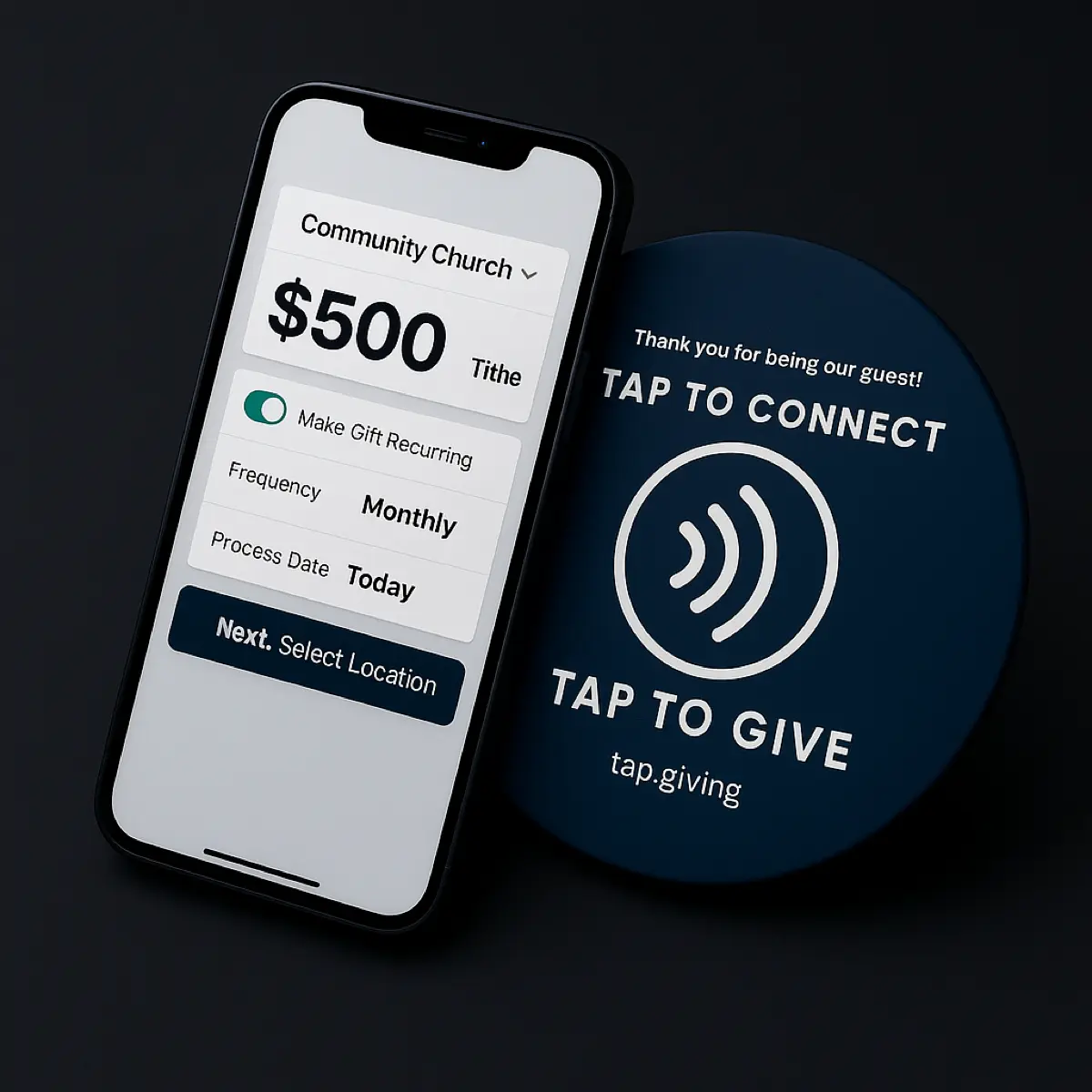
Whatever platform you use, close that gap. A visible giving page, a QR code in the bulletin, or a tap plate on the seat back all do the same job: they let a person give in the thirty seconds while the desire is fresh. Full disclosure on who is writing this. I am a pastor, and I built Tap.Giving because our own church wanted a simpler way for people to give in the moment. Tap.Giving plates are $3.50 to $5.00 each, one time, with free shipping and no monthly fees. We sell the plates. You keep the platform you already chose, and the plate just opens your existing giving page when someone taps a phone to it.
You do not need our hardware to retain givers well. You need a follow-up habit, a warm word, and a giving step that takes seconds. If a tap plate helps you make that second gift effortless, you can see what plates would cost for your church. If not, keep the platform you have and run the system below. For the broader strategy this sits inside, see how to increase online giving at your church.
A simple 90-day retention system
Here is the whole thing on one page. Give each step an owner and a place on the calendar, and keep the order.
- Every week: One person reads the first-time giver list and sends a personal thank-you within a few days, from a real human, not an autoresponder.
- Within two weeks of a first gift: A second touch that names what the gift did and invites the person into one next thing at the church.
- After a second or third gift: A plain invitation to set up recurring giving, with the setup made as frictionless as your platform allows.
- Each quarter: Reach out to givers who have gone quiet, leading with care, and fix the expired cards and changed emails you find.
- Each quarter: Write down your three numbers, new givers, second-gift rate, and active recurring givers, and compare them to last quarter.
None of this is complicated, and that is the point. Retention is not a campaign you run once. It is a handful of small, human habits that most churches never build, which is exactly why building them sets your giving on a rising floor.
See your church's plate and price in 30 seconds
Design it yourself on the next page. From $3.50 per plate, free shipping, no monthly fees.
Related Articles
New-Giver Thank-You Email Sequence
Three ready-to-copy messages for the first ten days after a first gift.
How to Build a Culture of Generosity
Retention and belonging are the same work. Here is the wider view.
How to Increase Online Giving
The full strategy that first-time giver retention fits inside.