GivingTools vs Tap.Giving: 5-Year Cost for Churches (2026)
GivingTools is one of the lowest-fee giving platforms in 2026: no monthly subscription, just a small 1.6 percent platform fee (their no-monthly-fee "Flex" tier) plus standard processor rates. Tap.Giving NFC tap plates are a one-time $500 hardware purchase for 100 plates. Together they form the cheapest tap-to-give stack we can find for a 100-seat church. Here is the honest math, with the use cases where each piece matters.
$4,500
Total 5-year platform plus hardware spend for a 100-seat church using GivingTools (1.6 percent platform fee (their no-monthly-fee "Flex" tier) on $50K annual giving) and 100 Tap.Giving NFC tap plates.
See your church's plate and price in 30 seconds
Design it yourself on the next page. From $3.50 per plate, free shipping, no monthly fees.
The Quick Answer: When GivingTools Churches Add Tap.Giving
GivingTools is a low-fee online giving platform built specifically for churches and nonprofits. It charges no monthly subscription. Instead it takes a roughly 1.6 percent platform fee (their no-monthly-fee "Flex" tier) on top of the processor rate. That model favors smaller churches, where a percent of donations stays well below what a $99 per month platform would cost. Tap.Giving is hardware. We sell NFC tap plates that open whatever giving URL you already use, including a GivingTools donation page. The two solve different problems, and the churches we work with pair them rather than choose between them.
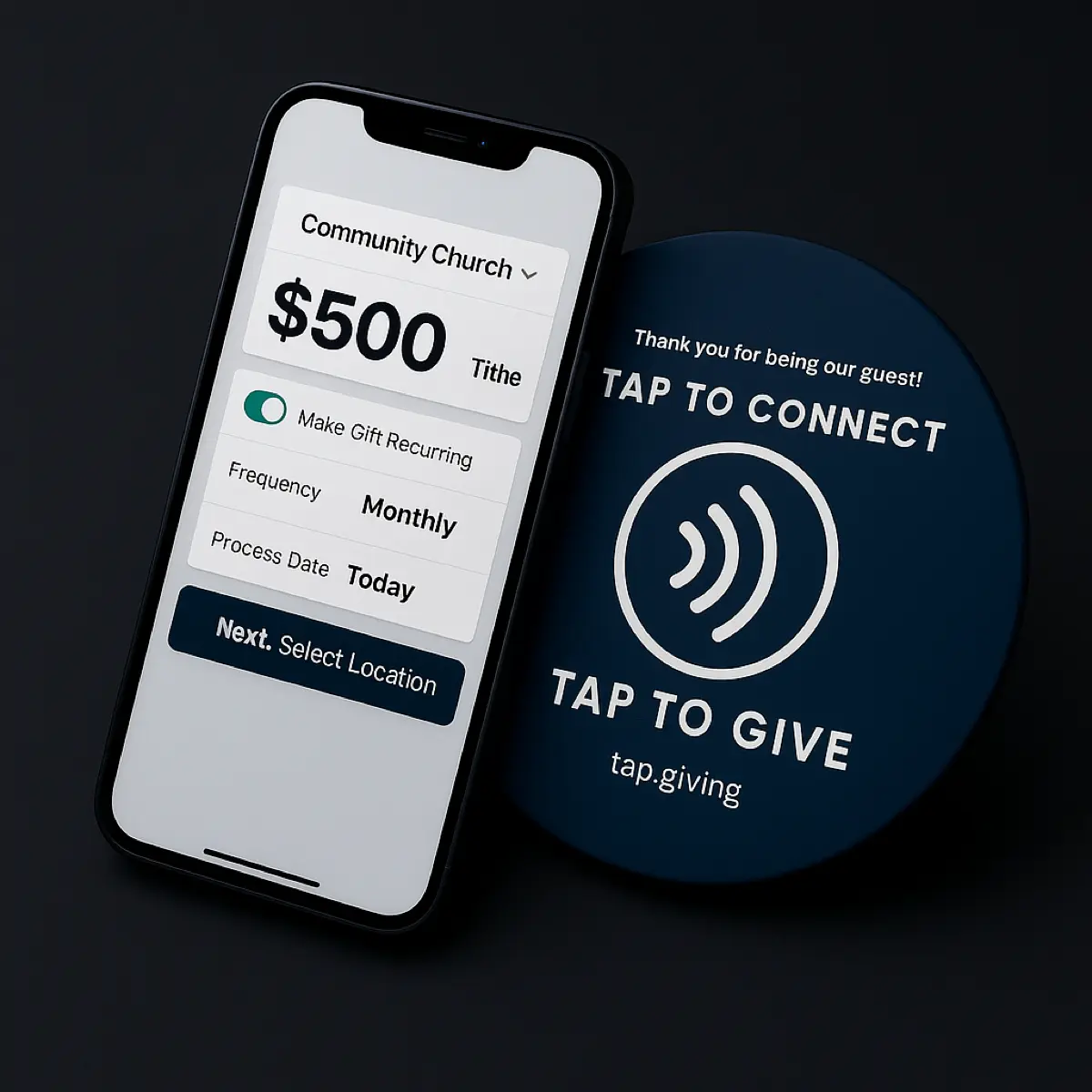
If your pastors keep saying "people would give if it were easier on a Sunday morning," that is the in-service participation gap. NFC tap plates close it by putting tap to give and tap to donate on every pew or chair, which is faster than a QR code and works with any GivingTools URL. Adding plates does not require touching GivingTools at all. You point each plate at the existing GivingTools donation link and the plate behaves like a member who typed the URL into a phone.
For more context on how tap technology for churches actually works, see our plain-English walkthrough of NFC tap to give. For the broader landscape of contactless giving options, our tap-to-give platform comparison stacks the major options side by side.
What GivingTools Actually Costs in 2026
GivingTools is unusual in the church-software market because it publishes pricing right on the home page. As of 2026 they offer three tiers: Flex (no monthly fee, ~1.6% on top of standard processing), Standard ($15/mo, no markup over standard processing), and Value ($30/mo, a reduced processing rate). This page uses Flex, the no-monthly-fee option, since it best matches a small church just getting started. Card processing on Flex runs about 2.2 percent plus $0.30 per transaction on top of the 1.6%; ACH and bank transfers run lower, in the low-cents-per-gift range. A church already doing enough volume for the Standard or Value tier to pay for itself may land on a different number. Confirm the current rates against the GivingTools public pricing page before you sign anything, because processor terms move once or twice a year.
The trade-off is straightforward. A 1.6 percent Flex-tier platform fee is great when giving is small. A church with $30,000 in annual digital giving pays GivingTools about $480 a year in platform fees, vs $1,188 a year for a $99 per month subscription elsewhere. The economics flip when annual giving climbs. At $250,000 of digital giving the 1.6 percent fee is $4,000 a year, which is more than most flat-rate plans charge. That is why GivingTools is so popular with church plants and small congregations and less commonly used at larger ministries.
The pattern in plain English. GivingTools is variable cost (1.6 percent of every gift, forever). Most competitors are fixed cost (a monthly subscription regardless of giving volume). Tap.Giving plates are one-time cost (you pay once and the hardware keeps working). The cheapest stack picks the right mix of those three.
For a wider look at the line items that hide inside church-platform contracts, our breakdown of hidden costs in church giving platforms walks through the gotchas (setup fees, premium tiers, exit fees). And if you want a sense of where digital giving for churches is headed in 2026, see our guide to church giving technology.
The 5-Year Total Cost Math for a 100-Seat Church
To keep the math apples to apples, assume the same 100-seat church running $50,000 of annual digital giving. Processor fees apply on both paths because the donation still moves through a processor either way. The variable is the platform fee and the hardware spend.
| Line Item | GivingTools (Standalone) | GivingTools + Tap.Giving Plates |
|---|---|---|
| Setup / hardware (one time) | $0 | $500 (100 plates at $5.00) |
| Year 1 platform fee (1.6% of $50K, Flex tier) | $800 | $800 (GivingTools stays) |
| Years 2 to 5 platform fee | $3,200 | $3,200 |
| Processor fees (industry standard, both paths) | ~2.2% + $0.30 per gift | ~2.2% + $0.30 per gift |
| 5-year platform + hardware spend | $4,000 | $4,500 |
| Avg cost per seat per year (plates only) | N/A | $0.90 per seat per year |
Read that last row. Adding NFC tap plates costs about $0.90 per seat per year over five years. It is not a recurring line item. Compare that to a $99 per month flat platform (about $5,940 over five years, before processing fees) or a Pushpay-tier ministry plan (closer to $88,500 over five years). For a complete five-year subscription comparison, see our breakdown of Tithely Tap three-year TCO vs Tap.Giving and our Pushpay vs Tap.Giving comparison.
Want to model your own numbers? Our pricing page shows the three quantity tiers ($5.00, $4.00, $3.50) and example totals from 100 plates up to 1,000+, and how many NFC plates your church needs walks through sizing for single-service vs multi-service campuses.
Need plates for your church?
$5.00 each (100-199), $4.00 each (200-399), $3.50 each (400+). Free shipping. the first-order discount is 10% for 7 days from the quote.
See pricing →Where Tap.Giving Plates Fit With Your GivingTools Setup
Plates work with GivingTools the same way they work with Tithely, Pushpay, Subsplash, Donorbox, or any platform that hands you a public giving URL. The NFC chip stores one thing: a web address. We program every plate with the GivingTools donation link you already use.
Find your GivingTools donation URL.
It is the public link your church already shares from the website and bulletin. GivingTools-hosted donation pages have a clean mobile-friendly URL with your church name in it.
Send us that URL and your logo.
We program every plate with the same URL and print your logo on the face. A proof goes back for approval before manufacturing, so you can confirm the artwork and the destination URL.
Mount them on pew backs or chairs.
Adhesive backing or screw mounts. A volunteer team can mount 100 plates in about 45 minutes. The detailed installation walk-through lives in our mounting guide for church chairs.
Demo from the stage on launch Sunday.
A 30-second walk-through during announcements is the single most valuable move. GivingTools handles the rest, the receipt email, the recurring schedule, the donor record, all happens exactly as it does today.
Because nothing inside GivingTools changes, the rollout is reversible. If a church decides plates are not for them in week three, the plates come off the pews and the only money out is the one-time hardware. There is no contract to exit, no data to migrate, no second platform to wind down. The same reversibility is one reason small churches pick the GivingTools + plates pairing over a bigger ChMS bundle.
Feature Comparison: Software Plus Hardware
A pure feature-by-feature table is the wrong frame, because GivingTools and Tap.Giving solve different problems. Here is the honest landscape, with what each layer owns.
| Capability | GivingTools | Tap.Giving Plates |
|---|---|---|
| Payment processing | Yes | No (uses your existing platform) |
| Donor records and statements | Yes | No (uses your existing platform) |
| Recurring giving | Yes | No (uses your existing platform) |
| In-service NFC tap to give at every seat | Not natively | Yes |
| First-time visitor friction | Hosted form, mobile-friendly | Single tap, no app, no scan |
| Monthly fee | $0 | $0 |
| Vendor platform fee | ~1% of each gift | $0 from us |
| Platform agnostic | No (closed system) | Yes, works with any URL |
The pattern is the same one you will see in our Donorbox vs Tap.Giving piece or the Anedot vs Tap.Giving comparison: software platforms own the donor record, the recurring schedule, and the payment rails. Hardware closes the in-service gap by putting tap to give and tap and give within arm's reach of every member. The two stack cleanly because they are not competing for the same dollar in your budget.
For a step-by-step look at how a non-software path works, see DIY NFC giving with no monthly fees, or browse the broader landscape of best online giving platforms for churches in 2026.
When GivingTools Alone Is Enough
A short and honest section, because we believe in carving this out. GivingTools on its own is a good fit when:
- Your church is small (under about $150,000 a year in digital giving) and a flat monthly subscription would cost more than the 1.6 percent platform fee (their no-monthly-fee "Flex" tier).
- You already see strong in-service participation through text-to-give, QR codes, or envelopes, and you do not have a Sunday-morning friction problem.
- You want a single hosted form that handles recurring gifts and donor statements with no platform-switch headaches.
If any of those describe you, the right move is to keep GivingTools and revisit hardware only when an in-service participation gap becomes obvious. We are not trying to be a software replacement. Most of our best customers were already on a giving platform when they added NFC tap plates. The plates lifted in-service giving without rocking the rest of their stack.
A real-world participation gap. Industry research and our own customer data point at a consistent pattern: about 60 percent of churchgoers are willing to give digitally, but only 24 percent actually do on a Sunday. NFC tap plates close that gap because the act of giving sits in front of every seat, with no app to download and no QR code to focus a camera on. Churches we work with often report less friction in the first month after launch and higher in-service participation by month three. The math is in our NFC giving ROI breakdown if you want to model your own.
Keep GivingTools. Add NFC tap plates.
One-time hardware. No monthly fees. Works with the GivingTools donation URL you already use. Most churches are tapping by week three.
Start a quote to get 10% off for 7 days
FAQ: GivingTools + Plates Questions
How much does GivingTools cost a church in 2026?
GivingTools advertises no monthly fee for churches and charges a small platform fee (around 1.6 percent) on top of standard processor rates of roughly 2.2 percent plus $0.30 per card gift, with ACH transactions lower. On $50,000 in annual giving the platform fee alone runs about $800 per year, or roughly $4,000 over five years. Confirm exact rates against the GivingTools public pricing page before signing, because processor rates shift once or twice a year.
Does Tap.Giving replace GivingTools?
No. Tap.Giving sells hardware, not software. We do not process payments and we do not store donor records. The NFC tap plates open the giving page your church already runs on GivingTools, so receipts, recurring schedules, and donor records all stay inside GivingTools exactly as they do today. Think of the plate as a physical shortcut to the donation URL you already publish.
Will NFC tap plates work with a GivingTools giving URL?
Yes. Every plate is programmed with a single URL of your choosing. Point it at your public GivingTools donation page (the link your church already shares from the bulletin or website) and the plate behaves exactly like a member typing that URL into a phone. The same approach works for digital giving for churches running on Tithely, Pushpay, Subsplash, Donorbox, Givelify, or Planning Center Giving.
What is the cheapest tap-to-give setup for a 100-seat church?
GivingTools (1.6 percent Flex-tier platform fee, no monthly subscription) paired with 100 Tap.Giving NFC tap plates at $5.00 each. The plates are a one-time $500 purchase, free shipping, typical delivery 2-3 weeks from artwork approval. During the 7-day offer, the first order drops to $450. Over five years on $50K of annual giving, the all-in platform plus hardware spend is roughly $4,500 before processor fees, which is the cheapest tap-to-give stack we can model for a small church.
Does GivingTools support recurring giving and Apple Pay?
Yes. GivingTools supports recurring schedules, one-time gifts, text-to-give, and modern mobile wallet payments where the processor enables them. NFC tap plates do not change any of that. The plate just opens the hosted giving page; whatever payment methods that page accepts, including Apple Pay and Google Pay when supported, still apply. Tap and give, tap to donate, and contactless giving all converge on the same hosted form.
When is GivingTools alone enough without adding tap plates?
If your church already sees strong in-service giving through QR codes or text-to-give, plates are an addition, not a fix. Churches with about 60 percent of attendees willing to give digitally but only 24 percent actually giving on a Sunday are the ones we see lift hardest after adding tap plates. Without that gap, GivingTools on its own may be the right stop.
Are these the same as church NFC tags or tap tags for churches?
They use the same NFC chip standard. Generic NFC tags for churches are the chip plus a sticker; our plates wrap the chip in a printed, brandable disc with a QR code fallback, screw or adhesive backing, and a pre-programmed URL of your choosing. Tap technology for churches is one family of products with different form factors, the plate is the form factor optimized for sanctuary seating and a contactless church collection plate experience.
Related Articles
DIY NFC Giving with No Monthly Fees
The full no-subscription path: low-fee processor + tap plates. How small churches build a giving stack that costs them almost nothing month over month.
ComparisonChurch Plants: The Cheapest Giving Setup in 2026
A field guide for new churches stretching every dollar: which low-fee platforms fit, when to add tap plates, what to skip.
GuideHidden Costs in Church Giving Platforms
What to ask before signing a giving platform contract: setup fees, add-on tiers, exit fees, and the line items that vanish from quotes.