HID NFC Tags vs Tap.Giving for Church Giving
HID Global builds enterprise-grade NFC tags for pharmaceutical authentication, asset tracking, and brand protection. None of those are church problems. For a 200-seat church evaluating tap to give, the loaded HID-based build runs about $1,100 once design, encoding, and mounting are counted. Tap.Giving plates for the same 200 seats are $800, branded and pre-encoded.
Should My Church Use HID NFC Tags or Tap.Giving Plates?
Ordering HID NFC tags instead of Tap.Giving plates makes sense in narrow cases: a church already standardized on HID across a denominational supply chain, a ministry selling branded merchandise that needs HID's brand-protection features, a procurement department that requires SOC 2 and ISO-certified manufacturing, or a church already running a separate badge or access-control program. Outside those cases, most churches just want a small, branded, in-pew surface that opens a giving page when a phone gets close, which is what Tap.Giving plates are built for, at a lower per-unit cost.
$300
Typical extra spend for a 200-seat church choosing HID enterprise NFC tags over Tap.Giving plates, once design, encoding, mounting, and shipping are honestly counted. The chip standard underneath is identical.
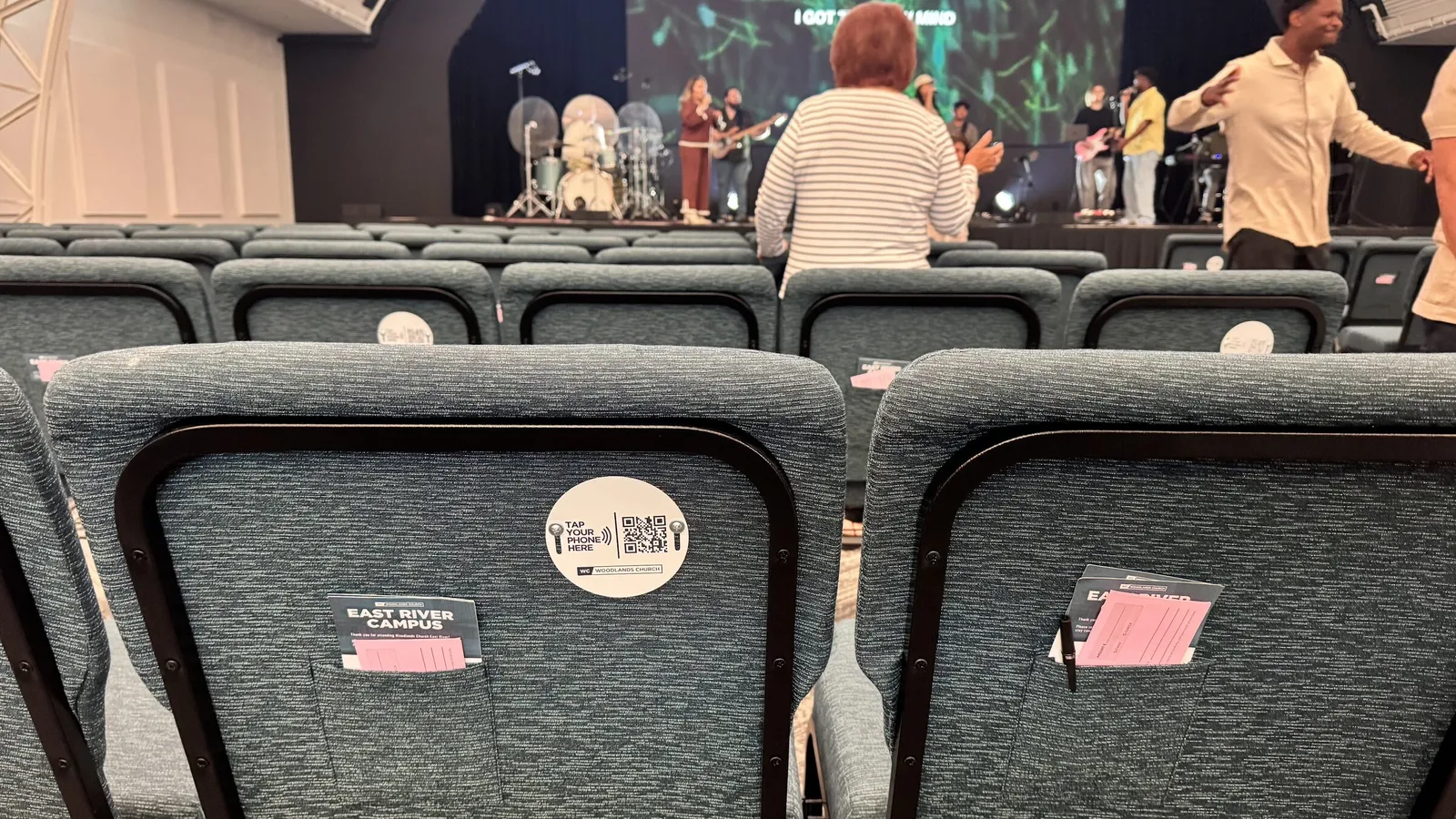
See your church's plate and price in 30 seconds
Design it yourself on the next page. From $3.50 per plate, free shipping, no monthly fees.
What HID Global Actually Sells (and Who Buys It)
HID Global is a Texas-based subsidiary of Assa Abloy and one of the larger enterprise credential vendors in the world. They sell secure access cards, government ID smart cards, biometric readers, and the NFC and RFID tag lines that show up when a church searches HID NFC tags for churches. Their NFC catalog includes HID Trusted Tag Services, HID NFC inlays for asset tracking, and a range of laundry, healthcare, and brand-protection tags. The customer base is enterprise: pharmaceutical companies authenticating product packaging, hospitals tracking surgical instruments, governments issuing credentials, retailers fighting counterfeit goods.
The relevant point for a pastor evaluating NFC giving: HID is a serious vendor with serious products, and none of their core use cases overlap with passing a giving plate down a pew. That does not mean their tags will not work for tap to give. It means a church buying HID is paying for features designed around problems the church does not have.
At the silicon level, every passive NFC tag on the market follows the same NFC Forum standards. An HID NFC inlay, an NXP NTAG sticker, a Seritag-printed disc, and a Tap.Giving plate all hand a URL to a phone the same way. The differences live in the product around the chip: how it is encoded, how it is locked, what brand sits behind the warranty, and whether the tag is sold standalone or as part of a cloud platform with a per-tap fee.
The plain answer: HID makes excellent NFC tags for authentication and supply chain. The HID name carries enterprise weight. For tap to donate at a Sunday service, the receiving giving page does the security work, and the silicon underneath does not need to do more than open a URL. Our complete buyer's guide to NFC tags for churches covers the chip variants and tradeoffs in more depth.
For background on the underlying standard, Wikipedia has a clear overview of near-field communication. None of it is proprietary to any one vendor.
How Churches End Up Looking at HID Tags
A few realistic paths lead a church board to put HID on the shortlist alongside Tap.Giving and the usual NFC tags for churches resellers. Recognizing the path is the fastest way to figure out whether the shortlist is the right shape.
- A board member with an enterprise IT background recognizes the HID name from their day job and assumes the brand premium is worth paying. Common in larger churches where one trustee runs procurement for a Fortune 500.
- A denominational technology committee evaluates vendors at the same tier they would buy door access systems or staff ID badges, and HID is already on the approved-supplier list.
- Search results for church NFC tags surface HID inlays alongside generic stickers and consumer brands, and the church does not realize the price gap reflects a different product category.
- A consultant or integrator quotes HID Trusted Tag Services because the per-tap cryptographic signature sounds reassuring in a board presentation, even when the giving page is already PCI-compliant and does not need it.
The honest read on each of those paths: enterprise brand recognition is real, but it does not change what the chip has to do during the offering. Our 2026 buyer guide for church donation technology walks through how to evaluate church giving technology on the actual job to be done rather than on brand.
For an apples-to-apples look at the parts-bin alternative, the NXP NTAG tags vs Tap.Giving breakdown covers the same math at the other end of the price spectrum, and the Seritag vs Tap.Giving comparison covers the specialty-reseller middle ground.
5-Year Cost Math for a 200-Seat Church
Here is the line-item math for a 200-seat church choosing between an HID-based build and a Tap.Giving plate run. Both are hardware purchases (no monthly fees on the standard HID inlay path), so 5-year cost equals year-one cost. HID Trusted Tag Services adds a cloud subscription on top; that variant is broken out below the main table. Pricing reflects conservative public 2026 quotes; talk to an HID distributor for the exact number.
| Line Item | HID Mid-Range Inlay Build | Tap.Giving (Done For You) |
|---|---|---|
| 200 NFC tags or plates | $500 (200 x $2.50 via distributor) | $800 (200 x $4.00 plate) |
| Branded artwork on the tag face | $300 to $400 (designer or local print shop) | Included |
| Pre-encoding the giving URL on every tag | $80 to $120 (2 to 3 volunteer hours) | Included |
| Locking the chip read-only | Manual per tag, app-driven | Default on every plate |
| QR code fallback printed on the face | Not standard, second print pass | Included |
| Mounting (adhesive or screw) | $50 to $100 hardware plus labor | Included (3 options shipped on request) |
| US shipping | $20 to $60 across vendors | Free |
| Year 1 loaded total (typical) | $1,100 (range $950 to $1,280) | $800 |
| Years 2 to 5 recurring | $0 (plus rework if URL changes) | $0 |
| 5-year total (standard inlay) | $1,100 | $800 |
| Trusted Tag Services cloud add-on | $300 to $1,200/year typical for 200 tags | Not applicable |
| 5-year total (Trusted Tag path) | $2,600 to $7,100 | $800 |
The honest read: at the standard inlay level, a 200-tag HID build runs about $300 more than Tap.Giving once every line is counted. That gap is not catastrophic; if the church already has a designer, a patient volunteer, and a distributor account, the standard HID path is workable. At the Trusted Tag Services level, the gap is several thousand dollars over five years, and the church is paying for cryptographic features the giving page itself already handles. Cost details for the Tap.Giving side live on the pricing page.
Putting the HID number against the SaaS-platform comparison is also instructive: the Tithely Tap 3-year TCO breakdown and the Pushpay VisitorTap hidden cost teardown show how subscription-based giving stacks compound over the same five years. Hardware-only is the cheapest route either way; HID is just hardware-only with an enterprise markup.
The Enterprise Features Churches Will Not Use
HID Trusted Tag Services and the higher-tier HID inlays solve real problems for enterprise buyers. The question for a pastor is whether those problems apply on a Sunday morning. Going through each major feature honestly:
- Cryptographic tap signatures. Trusted Tag Services signs every tap with a rotating code so the server can prove the tap came from a genuine HID tag. Valuable for pharmaceutical authentication. Not relevant when the tap just opens a public giving page.
- Per-tap analytics on a cloud platform. HID's platform can log each tap and aggregate dashboards. Useful for asset tracking. A church already has this data inside its giving platform, Tithely, Pushpay, Subsplash, Donorbox, Givelify, Anedot, Planning Center Giving, Nucleus Giving, all log every donation.
- Tamper-evident inlays. Tags that break when peeled off, designed to prove a product has not been opened. A church pew does not need to detect tag removal.
- FIPS-compliant or government-grade chip variants. Required for federal procurement. Not on the requirements list for a 200-seat suburban congregation.
- Custom firmware and per-tag UID provisioning. Justified for industrial workflows. The giving URL does not need a serialized UID; the tap just needs to open a browser.
None of this is a knock on HID. It is a category mismatch. Paying for an enterprise tag is the same shape of decision as buying a commercial walk-in cooler to refrigerate the coffee bar; the build quality is excellent, the price reflects use cases the church will never trigger, and a smaller, purpose-built unit does the job.
Where the church does benefit from a security feature, locked chips that cannot be rewritten in the field, Tap.Giving plates ship locked from the factory by default. The NFC FAQ covers the security tradeoffs, and the DIY NFC giving guide covers what most churches miss the first time through.
When an HID-Based Build Is the Right Call
There are honest scenarios where ordering HID NFC tags is better than ordering plates from us. Worth naming them out loud so a church reading this can self-select.
- The church is part of a larger denominational supply chain (printed liturgical resources, asset-tracked AV equipment across campuses) that already standardized on HID. Buying tap-to-give tags from the same vendor reduces procurement complexity even if the per-unit price is higher.
- The ministry sells physical merchandise where brand-protection matters: a publishing house, a music ministry running its own product line, a school distributing branded uniforms. HID Trusted Tag Services makes sense for the merch program; giving plates are a small additional SKU on the same purchase order.
- The procurement department requires a vendor with a SOC 2 Type II audit, a published security disclosure program, and an ISO-certified manufacturing line, and no alternative meets the bar.
- The church is also running a separate authentication or access-control project (staff badges, member cards, secure facility access), and consolidating credentials with one vendor cuts integration costs elsewhere.
Outside those cases, the bundled plate exists because most churches are not running a credential program. They are looking for a small, branded, in-pew surface that opens a giving page when a phone gets close. The break-even point against an enterprise tag is reached the moment the volunteer hours and design fees get counted honestly.
A few practical next steps depending on where you are: read how it works for the giver-side walkthrough; see how tap to give works for churches for the pastor-friendly explainer; skim the church guide to tap discs and plates for a wider view of digital giving for churches; or read the founder story if you want to know why a pastor ended up running a hardware company instead of a SaaS one.
Skip the enterprise markup and receive plates 2-3 weeks from artwork approval
NTAG215 chip, branded artwork, pre-encoded giving URL, locked from the factory, free shipping to every destination we agree to serve, no monthly or per-tap charges. Works with the giving platform your church already uses.
Start a quote to get 10% off for 7 days
FAQ: HID NFC Tags vs Tap.Giving
What is HID Global and what NFC tags do they make?
HID Global is a Texas-based subsidiary of Assa Abloy that sells secure access credentials, NFC and RFID tags, and authentication platforms. Their NFC product lines include HID Trusted Tag Services (cryptographically signed tags), HID NFC inlays for asset tracking, and HID smart-card credentials. The customer base is enterprise: pharmaceutical authentication, healthcare asset tracking, brand-protection programs, and government ID. Almost none of those use cases overlap with tap to give in a church. See our pricing page for the church-priced alternative.
Can a church buy HID NFC tags?
Yes, but not easily. HID sells primarily through distributors and integrators rather than direct retail. Expect a minimum order quantity, a sales conversation, and per-tag pricing in the $1.50 to $5 range depending on the product family and whether the tag is paired with a cloud subscription. None of HID's product catalog is built around a church use case. The NXP NTAG tags vs Tap.Giving guide covers the parts-bin alternative at the other end of the price spectrum.
Do HID tags work for tap to give?
Technically yes. An HID NFC tag is, at the silicon level, the same kind of passive NFC chip used in every other tap to give plate, an NXP NTAG or a similar standard chip. Any tag that responds to NFC Type 2 or Type 4 will hand a URL to a modern phone. The harder question is whether paying enterprise pricing for features designed around supply chain and authentication makes sense when the only thing the chip needs to do is open a giving page.
What does the loaded cost of an HID tag build look like for a 200-seat church?
Expect about $1,100 all-in for a 200-tag deployment using mid-range HID inlays: roughly $500 in raw tags at $2.50 each, $300 to $400 in branded artwork and printing, $80 to $120 in encoding labor, $50 to $100 in mounting hardware, and $20 to $60 in shipping. Tap.Giving's done-for-you equivalent for 200 plates is $800 (see pricing). Trusted Tag Services with the optional cloud subscription pushes the total to $1,400 or more in year one and compounds over 5 years.
Do HID tags work with iPhones and Android phones?
Yes. HID NFC tags follow the same NFC Forum standards every NFC tap plate uses, so every iPhone since the iPhone XS (2018) and every modern Android phone will read them without an app. The same chip standard powers Apple Pay and Google Pay. The phone does not know or care that the chip came from HID rather than NXP or another vendor; it just sees a URL. The NFC giving explained guide covers phone compatibility in detail.
When is an HID-based build the right call for a ministry?
Rarely for tap to give, occasionally for adjacent use cases. A denominational headquarters tracking distributed liturgical resources, a megachurch running an asset-tracking program across multiple campuses, or a ministry running brand-protection on physical merchandise might genuinely benefit from HID's authentication features. For 100 to 400 plates mounted in pews to open a Tithely or Pushpay giving page, the enterprise tier is paying for security features that the giving page itself already handles.
Are HID NFC tags more secure than Tap.Giving plates?
Only if you use the enterprise features. A raw HID inlay tag with a static URL has the same security profile as any other locked NFC tag, including a locked Tap.Giving plate. HID Trusted Tag Services adds cryptographic signing so the receiving server can verify the tap came from a genuine HID tag, which is valuable for authentication and brand protection but irrelevant when the chip's only job is to point a phone at a giving URL. Start a quote to get 10% off for 7 days if you decide to skip the enterprise markup; start at the order page.
Related Articles
NXP NTAG Tags vs Tap.Giving: True DIY NFC for Churches
The parts-bin alternative at the other end of the price spectrum, with side-by-side 5-year math for 200 tags.
ComparisonSeritag vs Tap.Giving: NFC Specialist Reseller vs Church Plates
A specialist-reseller take on the same parts-bin tradeoff, with the printing and encoding workflow churches usually miss.
GuideChurch NFC Tags: The Complete Buyer's Guide
Chip variants, locking, encoding, mounting, and the realistic options when sourcing NFC tags for a church giving program.