Text-to-Give vs Tap-to-Give: Which Method Fits Your Church in 2026
Text-to-give charges churches roughly $10 to $50 per month plus per-transaction processing fees. Tap-to-give NFC tap plates are a one-time $3.50 to $5.00 each, no monthly fee ever. Over five years, a 200-seat church spends $800 once on plates vs $600 to $3,000 on SMS service alone. This is the honest, pastor-to-pastor breakdown of where each method wins.
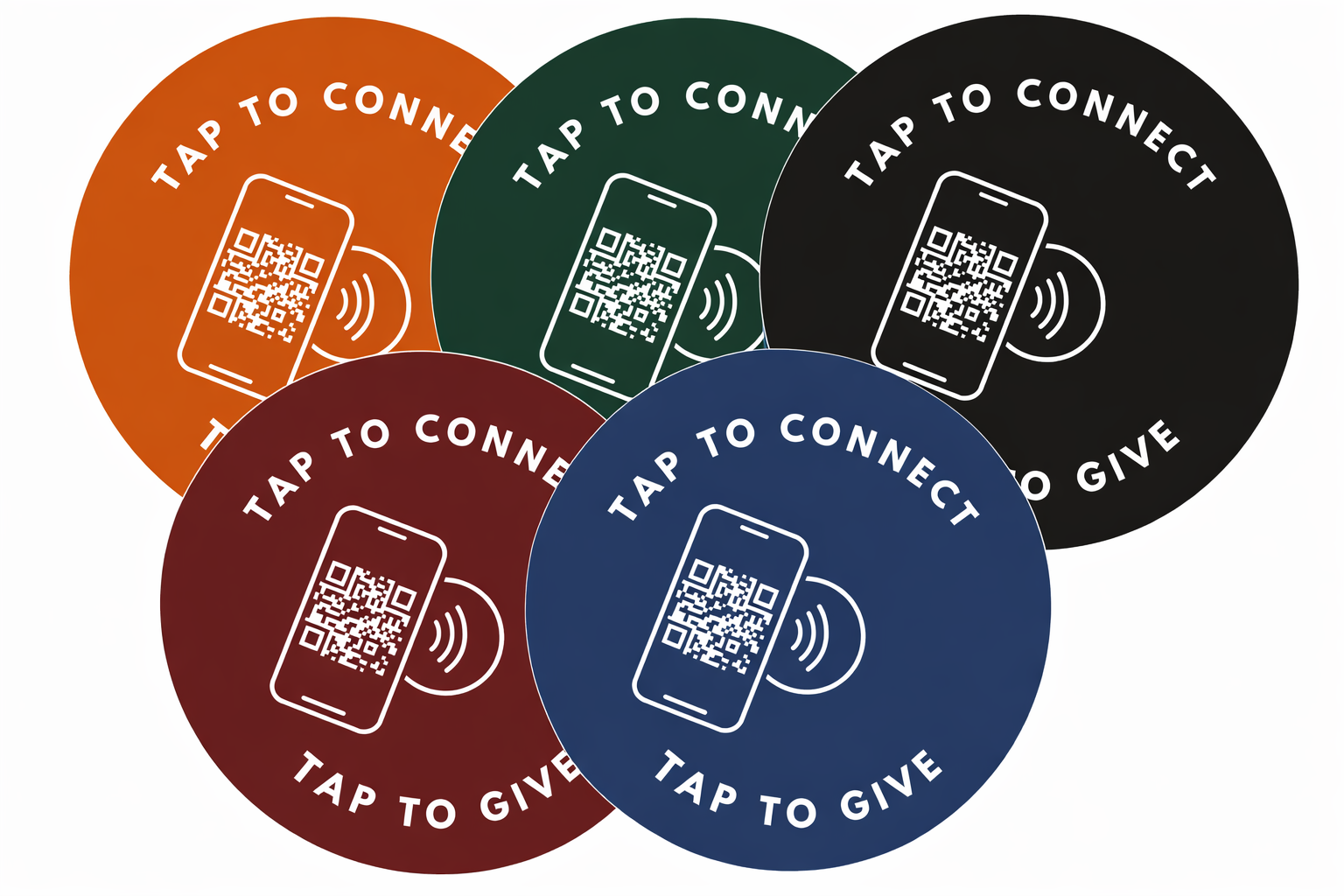
5-Year Cost, 200-Seat Church
$800 vs $1,800+
Tap-to-give plates are a one-time $800 purchase for a 200-seat church. A mid-range text-to-give plan runs about $30 per month, roughly $1,800 over five years, before any per-transaction fees.
See your church's plate and price in 30 seconds
Design it yourself on the next page. From $3.50 per plate, free shipping, no monthly fees.
What Text-to-Give and Tap-to-Give Actually Are
Both methods are built for the same problem: making it easy to give without cash. They just take opposite paths to get there. Text-to-give asks the giver to type a keyword or amount into their messages app, send it, wait for a reply link, then complete the donation on a mobile web page. Tap-to-give asks the giver to hold their phone near a plate on the pew back, then complete the donation on the same mobile web page.
Tap-to-give is what a lot of pastors mean when they say tap to donate, contactless giving, or NFC giving. The plate is a small printed disc with a passive NFC chip laminated inside, the same chip standard behind Apple Pay and Google Pay. Nobody downloads an app. Nobody types a URL. If you have ever tapped a card to pay at a coffee shop, you already know how a tap plate feels.
Text-to-give lives inside your giving platform (or a stand-alone SMS provider that connects to it). Tap-to-give lives on the pew. A single church can run both at the same time and often should, because they solve different moments. The question is not which to keep and which to kill. It is which one carries the offering.
What Text-to-Give Costs a Church in 2026
Text-to-give pricing sits inside your giving platform, so the number you pay depends on which platform you use and whether you buy the SMS layer as an add-on or as part of a bundle. Public pricing from the largest providers, as of 2026:
| Platform | Text-to-Give Cost | Per-Transaction Fee |
|---|---|---|
| Tithely | Included on paid plans (from around $99/mo) | 2.9% + $0.30 |
| Pushpay | Bundled into full suite (roughly $1,475/mo) | 2.9% + $0.30 |
| Subsplash | Bundled inside Subsplash Giving | Custom |
| Givelify | No native SMS shortcode | 2.9% + $0.30 |
| Donorbox | $10-$50 add-on tier | 1.5%-2.95% platform + processor |
| Stand-alone SMS providers | $25-$50/mo plus shortcode share | Processor rate |
Pull those into a single number for a mid-size church running a mid-range plan and you land at roughly $30 per month for text-to-give. That is $360 a year, $1,800 over five years, before you count the transaction fees the same platform charges every gift. Text-to-give is not a bad number in isolation. It is a recurring number, which is the point.
What Tap-to-Give Costs a Church in 2026
Tap-to-give is priced like a piece of church furniture, not a subscription. The NFC chip inside each plate costs a few cents, the printed plate costs a few dollars, and once it is on the pew back it works for years without a bill in the mail. Our plate pricing at Tap.Giving:
The plates, one-time
- 100-199 plates: $5.00 each
- 200-399 plates: $4.00 each
- 400+ plates: $3.50 each
- Free shipping, no setup fees, no monthly fees
- The first-order discount is 10% for 7 days from the quote
Per-transaction, unchanged
- Typically 2.9% + $0.30 per donation
- Charged by your giving platform, not us
- Same fee your online givers already pay
- Adding plates does not change it
- Tap.Giving takes $0 in transaction fees, ever
A 200-seat church ordering 200 plates pays $800 once. A 400-seat church ordering 400 pays $1,400 once. Beyond the plate purchase there is no annual renewal, no per-seat license, and no metering of donations. See the full quantity ladder on our pricing page.
5-Year Total Cost, Side by Side
Set the two side by side for a 200-seat church, assuming a mid-range text-to-give plan at $30 per month and 200 NFC tap plates at $4.00 each. Ignore the processing fees on both sides because they are identical (your existing giving platform charges 2.9% + $0.30 whether the gift came from an SMS link or a plate tap).
| Cost Line | Text-to-Give | Tap-to-Give (200 plates) |
|---|---|---|
| Setup fee | $0-$250 (varies by provider) | $0 |
| Hardware | $0 | $800 one-time |
| Year 1 recurring | $360 | $0 |
| Years 2-5 recurring | $1,440 ($360 x 4) | $0 |
| 5-year total | $1,800-$2,050 | $800 |
Tap-to-give runs about $1,000 to $1,250 cheaper over the same five years, and the tap plates keep working in year six and beyond with no additional cost. If your church already runs text-to-give and it converts well, that is fine. But if you are looking at church giving technology from scratch, or you already pay a monthly SMS bill you barely track, plates get you off the recurring meter.
Need plates for your church?
One-time $3.50 to $5.00 per plate. No monthly fees, ever.
See pricing →How Each Method Feels on a Sunday Morning
Cost matters, but the reason a church picks a giving method is what happens in the room. Watch a first-time visitor try each one and the difference gets loud fast.
Text-to-give, first-timer path
The announcement slide says "Text GIVE to 55555." The visitor unlocks their phone, opens messages, taps the compose icon, types the shortcode, types the keyword, sends. Waits. A reply link arrives. Tap the link. Wait for the giving page to load. Enter an amount, enter card, submit. Nine to thirty seconds if everything works. Longer if their carrier is slow, if the shortcode is regional, or if they mistype.
Tap-to-give, first-timer path
The plate is on the pew back in front of them. They pick up their phone, hold it near the plate, tap the banner that pops up, land on the giving page in under a second, pay with Apple Pay or Google Pay in one confirm. Roughly 8 seconds total. No typing. No shortcodes. No waiting.
The gap widens with age and unfamiliarity. A 22-year-old who lives in messages barely notices the text flow. A first-time guest in their fifties can stall three times before the SMS keyword clears. Tap plates flatten that curve because the interaction is physical, you show a phone to a plate, and the phone does the work. In field data from churches running both, tap plates typically capture higher in-service participation from guests than any text-based method.
The other quiet advantage: the plate sits in the room. Text-to-give works only if the giver sees the slide and remembers the keyword. Tap plates are their own reminder. Guest hands go on the pew back, phone comes out, plate is right there. This is why we hear the same story from pastors adopting tap technology for churches, giving lifts even in weeks with no push from the stage.
Recurring Giving, Reporting, and Guest Friction
Both methods land the giver on the same giving page, so recurring giving, receipting, and donor reporting come from your platform, not the delivery method. If your church runs Tithely, the report in Tithely looks the same whether the gift came from an SMS link, a QR code, or an NFC tap. That is a good thing, one less system of record to maintain.
| Feature | Text-to-Give | Tap-to-Give |
|---|---|---|
| App required | No (uses messages) | No (opens the browser) |
| Typical time to complete | 9-30 seconds | About 8 seconds |
| Recurring giving | Yes (via platform) | Yes (via platform) |
| Works platform-agnostic | Usually tied to one platform | Yes, any platform |
| In-service visibility | Slide only | Plate on pew back |
| Monthly cost | $10-$50 | $0 |
On the guest-friction line, tap-to-give wins in every study we have seen. Data across churches running both methods consistently shows about fewer steps with NFC tap plates than QR codes, and text-to-give sits in the middle. First-time givers, especially, convert best where the friction is smallest. A visitor deciding whether to give in the offering does not want to type a keyword.
When Text-to-Give Still Makes Sense
Not every church wins by dropping SMS giving. Text-to-give still earns its keep in three places, and we tell pastors to keep it in the mix if any of these fit.
- Special-appeal moments. A missions Sunday, a capital campaign, a benevolence emergency, all benefit from an announcement-slide keyword that anyone can act on immediately without leaving the sanctuary. Church NFC tags on the pew do the everyday offering; the SMS keyword handles the moment-in-time push.
- Off-campus giving. If your platform lets members text a keyword from home during a weekday appeal, that path stays valuable. Tap plates only work when the giver is physically in front of one.
- Older congregations without smartphones. The first step of text-to-give works on any phone that can send a text, though the second step (paying on the linked page) does still need a smartphone browser. If you have a segment of your church that does not tap or scan, keep the SMS path as a bridge while you introduce contactless giving on the pew.
The right answer for most churches is not either/or. It is: tap plates carry the weekly offering, text-to-give supports special appeals. Once you have that split, you can look at whether your text-to-give plan is worth the monthly fee or whether an ordinary link on your announcement slide would work just as well.
Ready to move your Sunday offering to NFC tap plates?
One-time hardware cost. No monthly fees. Works with the giving platform you already use, Tithely, Pushpay, Subsplash, Donorbox, Givelify, Anedot, Planning Center, and more. Most churches are tapping by week three.
Start a quote to get 10% off for 7 days
FAQ
What is text-to-give and how much does it cost churches?
Text-to-give lets members text a keyword or amount to a shortcode, then complete the donation on a linked web page. Providers typically charge $10 to $50 per month for the SMS service, plus the same 2.9% + $0.30 per-transaction processing fee your giving platform already charges. Some run higher when you add a dedicated shortcode or shared shortcode fees. Over five years a 200-seat church spends $600 to $3,000 on the SMS layer alone.
What is tap-to-give and how much does it cost churches?
Tap-to-give uses NFC tap plates mounted on pew backs or chairs. A member holds their phone within an inch of the plate, the church's existing giving page opens, and they pay with Apple Pay, Google Pay, or a card. Tap.Giving plates are a one-time purchase: $5.00 each for 100-199, $4.00 for 200-399, $3.50 for 400+. A 200-seat church spends $800 once, nothing after. Processing fees stay with your giving platform (typically 2.9% + $0.30).
Which converts better on Sunday morning, text-to-give or tap-to-give?
Tap-to-give converts better in-service because it removes typing. A giver taps, the page opens in about a second, and they finish in roughly 8 seconds with Apple Pay or Google Pay. Text-to-give requires opening messages, typing a keyword or amount, sending, waiting for the reply link, then tapping through. Guests especially stall on the text flow. NFC engagement has been observed at fewer steps than a QR code engagement in comparable church settings, and text-to-give sits between the two.
Do I need to switch giving platforms to use tap-to-give?
No. Tap.Giving sells the hardware only. The plates open whatever giving page you already use, Tithely, Pushpay, Subsplash, Donorbox, Givelify, Anedot, Planning Center Giving, Nucleus Giving, or any other platform with a mobile-friendly URL. Text-to-give is usually tied to your giving platform, so switching often means changing platforms. Tap-to-give lets you keep the platform you have. See our how it works page for the full setup.
Does text-to-give require a smartphone?
The first step (sending the text) works on any phone, but completing the gift needs a smartphone browser to open the reply link. Tap-to-give needs an NFC phone, which is every iPhone from the XS (2018) onward and virtually every modern Android. Practically both methods land on the same donor cohort, adults with modern phones. The Tap.Giving plate also carries a printed QR code fallback for anyone who cannot get NFC to register.
Can we run both text-to-give and tap-to-give in the same service?
Yes, and many churches do. Text-to-give makes sense for the announcement slide and for members giving from home. Tap-to-give handles the physical offering moment where a plate on the pew back removes every friction between the ask and the gift. Because both flows land on the same giving page on your existing platform, reporting stays clean. Our full NFC FAQ covers the mixed rollout.
What about privacy, is a tap-to-give plate tracking donors?
No. The plate stores one URL and nothing else. It has no battery, no radio, no memory of the last person who tapped, and no way to identify the phone. The donation happens on your giving platform's normal secure page, the same page your online givers already use. Text-to-give links a phone number to the giver in the SMS provider's records, which is a slightly larger data footprint. Both are compliant with normal donor-privacy expectations.
Related Articles
QR Codes vs NFC for Church Giving
The other in-service delivery mechanism, scored on speed, guest friction, and per-gift conversion.
ComparisonBest Tap-to-Give Platform for Churches in 2026
Five NFC giving providers compared side by side on real prices and honest picks.
GuideChurch Giving Without an App
Every app-free giving method ranked by friction, cost, and Sunday-morning results.