Electronic Giving for Churches: How It Works and What It Costs
Electronic giving means your church accepts tithes and offerings without cash or a paper check, by card, bank transfer, app, text, or a tap of a phone. Every method opens the same door: a giving page your platform already runs. This guide walks through the methods, what each one costs, and how to start, written for pastors and treasurers rather than engineers.
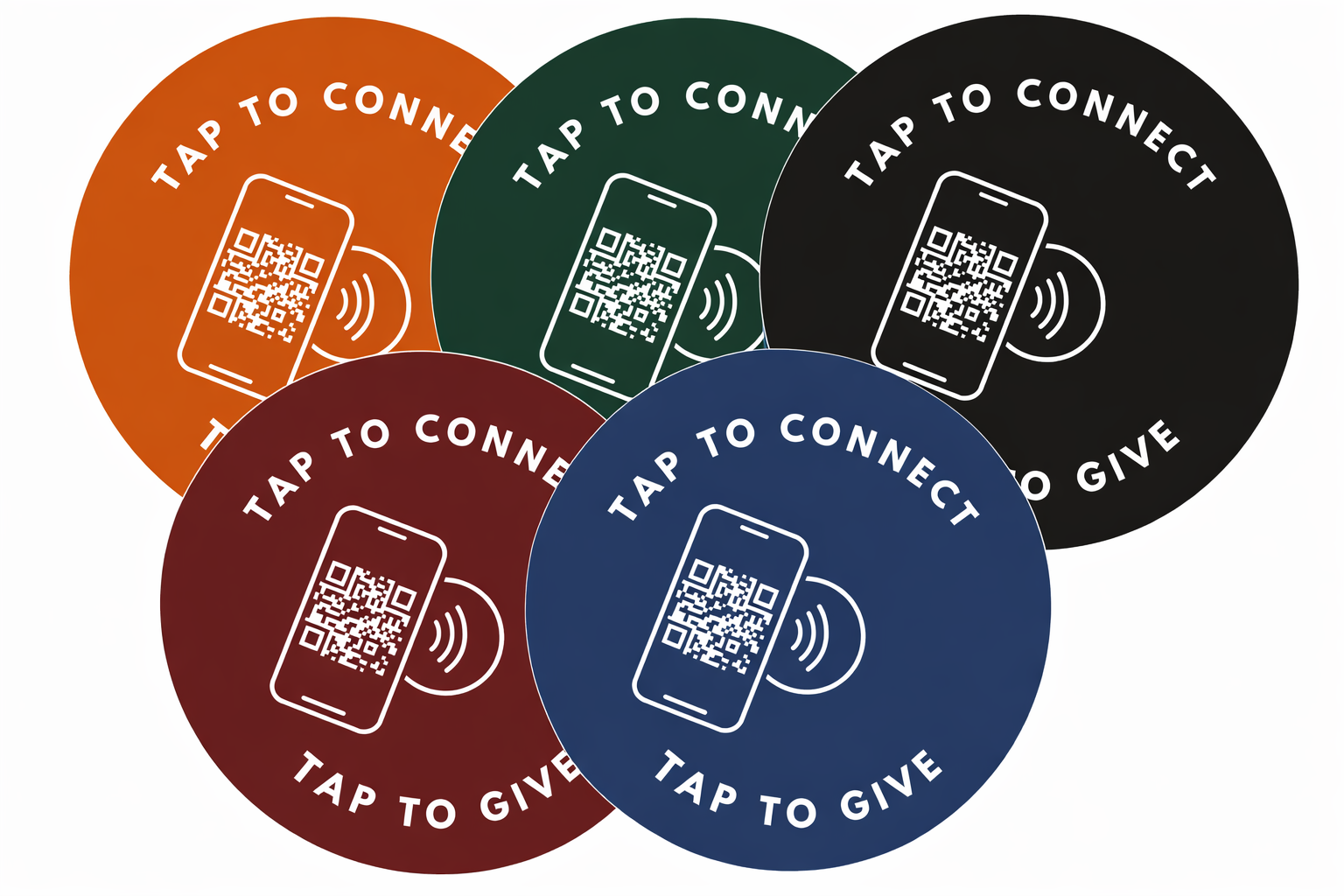
See your church's plate and price in 30 seconds
Design it yourself on the next page. From $3.50 per plate, free shipping, no monthly fees.
What Is Electronic Giving for a Church?
Electronic giving is any tithe or offering that moves without cash or a paper check. The gift travels over a card network or a bank transfer instead of an envelope. That is the whole idea.
You will also hear it called electronic tithing, digital giving, or online giving. Older church budget documents and denominational handbooks tend to say "electronic giving," which is why plenty of treasurers still type those exact words. They all point at the same thing: a way for a member to give from a phone, a computer, or a card reader rather than a wallet.
The reason it matters is simple math. Fewer people carry cash every year, and a giver who forgot their checkbook is not going to walk back out to the car. When the offering plate passes and the only options are cash or check, some gifts never happen. Electronic giving meets people where their money already lives.
The Main Ways Churches Accept Electronic Giving
There are six methods most churches use. They are not competitors so much as doors into the same room. Most churches end up running two or three at once, one for people at home and one for people in the pew.
| Method | How the giver uses it | Best for |
|---|---|---|
| Web giving page | Opens your giving URL in a browser and enters an amount | Giving from home, the website, and email links |
| Recurring bank draft (ACH) | Sets up an automatic transfer from a checking account | Committed members and the lowest processing cost |
| Giving app | Downloads the platform's app and gives inside it | Regular members who already use the app |
| Text-to-give | Texts a keyword to a number, then taps a reply link | Quick gifts during a service announcement |
| QR code | Scans a printed code with the phone camera | Bulletins, screens, and signage |
| Tap-to-give (NFC) plate | Holds a phone near a plate on the pew or chair | In-service giving with the least friction |
Every one of these ends at the same place: your existing giving platform, which processes the card or bank transfer, sends the receipt, and deposits the money. The method is just the on-ramp.
How Much Does Electronic Giving Cost a Church?
There are two cost layers, and churches often confuse them. Keeping them separate is how you compare options honestly.
Layer 1: Processing fees
- Card gifts: about 2.9% + $0.30 each
- Bank draft (ACH): usually well under 1%
- Charged by your platform, not by the method
- Steering large gifts to ACH saves real money
Layer 2: Platform or hardware
- Some apps and kiosks bill a monthly plan
- A giving page itself is usually free to run
- Tap-to-give plates are a one-time hardware cost
- Ask whether a cost is one-time or forever
The processing fee is unavoidable and mostly the same everywhere, because it belongs to the card networks and your processor. Where churches overpay is layer two. A monthly platform fee looks small on the invoice and large over three years. A treasurer comparing options should always add the recurring cost across the years the church actually plans to give, not just month one.
A worked example: a 200-seat church adding tap-to-give plates orders 200 plates at $4.00 each, which is $800 one time, with free shipping and no renewal. Compare that against a kiosk or app method billing $20 to $50 a month, and the difference over a few years is the price of a mission trip.
Is Electronic Giving Safe for a Church?
Yes, because the money and the card details never touch the church. The payment happens on your giving platform's secure, PCI-compliant page, the same page members already use online.
When a giver pays with Apple Pay or Google Pay, their real card number is never shared. A one-time encrypted token stands in for it, so even the platform does not store the actual number. That is the same protection that guards a tap at the grocery store.
A tap-to-give plate deserves one clarifying note, because the object is physical. The chip in the plate holds one thing: a web address. There is no payment information on it, nothing to skim, and nothing that changes if a plate is moved or handled. It is a sign-post pointing at a page, not a card reader.
How to Set Up Electronic Giving in Your Church
If you already have a giving page, most of this is done. The steps below take a church from nothing to giving in a normal month.
1. Pick one giving platform
Tithely, Pushpay, Subsplash, Donorbox, Givelify, and Planning Center all handle the processing, receipts, and deposits. Our church giving technology guide walks through how to choose one.
2. Make the giving page work on a phone
Open your giving URL on your own phone. Make sure it loads fast and lets a guest give without creating an account. A page that demands a login before the first gift loses first-time givers.
3. Add an in-person on-ramp
Most people who give during a service will not stop to scan a QR code or download an app. A mobile giving option at the seat, like a tap-to-give plate, is what turns intent into a completed gift.
4. Announce it from the stage
A 30-second demo on a Sunday is the single highest-return thing you will do. People will not use a method they have never seen. Here is how to announce digital giving from the stage without it feeling like a sales pitch.
5. Watch the reports and thank people
Your platform already tracks new givers. Thank a first-time giver within a week and invite them to set up recurring giving. That first month is when a one-time gift becomes a habit.
Which Method Has the Least Friction on a Sunday?
For giving in the room, a tap-to-give plate wins, because it removes every step between the impulse and the gift. No app to download, no code to scan, no URL to type. A member holds a phone near a plate on the pew back, the giving page opens, they choose an amount, and they pay with the fingerprint or face they already use.
QR codes and text-to-give both work, but each adds a step: aim the camera, or type a keyword and wait for a reply. A step is where a giver hesitates and puts the phone away. Tapping is the one motion people already trust from paying at a store.
This is where Tap.Giving fits. We sell the plates, and your church keeps the giving platform it already chose. The plate opens whatever page you already run on Tithely, Pushpay, Subsplash, Donorbox, Givelify, or Planning Center, so nothing about your processing, receipts, or reporting changes. Tap.Giving plates are $3.50 to $5.00 each, one time, with free shipping and no monthly fees.
I am a pastor, and I built Tap.Giving because our own church wanted electronic giving in the pew without adding another monthly bill. If you want to see what a plate would look like for your church, you can design one and see the price in about a minute.
Add electronic giving in the pew
One-time hardware cost. No monthly fees. Works with the giving platform you already use. Most churches are tapping by week three.
Start a quote to get 10% off for 7 days
FAQ: Electronic Giving Questions
What is the difference between electronic giving and online giving?
Electronic giving is the umbrella term for any donation that moves without cash or a paper check: card, bank draft, app, text, or a tap of a phone. Online giving is one method inside it, a gift made through a web page. Older church documents often say electronic giving or electronic tithing to mean the whole category, which is why treasurers still type those words into a search bar.
Do we have to switch giving platforms to accept electronic giving?
No. If your church already has a giving page on Tithely, Pushpay, Subsplash, Donorbox, Givelify, or Planning Center, you already accept electronic giving. Adding a method like a tap-to-give plate does not require changing platforms. The plate simply opens the giving page you already use.
What does electronic giving cost a church?
There are two cost layers. Your giving platform charges a per-gift processing fee, typically about 2.9% plus $0.30 for a card and less for a bank draft (ACH). On top of that, some methods carry a subscription or hardware cost. A tap-to-give plate is a one-time hardware purchase of $3.50 to $5.00 each with no monthly fee, while an app or kiosk platform usually bills every month.
Related Articles
Church Giving Technology: The Complete Guide
How to choose a giving platform and the tools that sit on top of it, without overpaying for features you will not use.
GuideMobile Giving for Churches: Methods, Cost and Setup
The five ways churches enable giving from a phone, ranked by friction, with the cost of each.
GuideHow Tap to Give Works for Churches
A plain-English walkthrough of the in-person method with the least friction, from the tap to where the money goes.