NFC Giving for Non-Denominational Churches (2026)
Non-denominational congregations make the giving-tech decision themselves. No district office, no national headquarters. Here is how NFC tap plates fit a modern auditorium, what they cost for a 300, 600, or 1,000 seat room, and how to roll out tap to give without leaving Pushpay, Subsplash, Tithely, or Planning Center.
See your church's plate and price in 30 seconds
Design it yourself on the next page. From $3.50 per plate, free shipping, no monthly fees.
Why Non-Denominational Churches Adopt Giving Tech First
A Baptist church usually clears tech decisions through a deacon board. A Catholic parish often defers to the diocese. A United Methodist congregation has annual conference guidance. Non-denominational churches do not have any of that. The lead pastor and the executive pastor make the call on what goes on the chairs, and that autonomy is why this segment moves faster than almost any other on giving technology.
The other reason is demographic. Non-denominational rooms tend to skew younger than mainline congregations, and younger attenders rarely carry cash or a checkbook. The Federal Reserve's 2024 report on U.S. household finances found that most adults now pay routinely by phone or card, so the basket that comes around during the offering meets an empty pocket. The intent to give is there; the cash is not. NFC tap plates close that gap by letting people give from their seat with the phone already in their hand.
A pastor on staff at a 900-seat campus told us last year that the moment they tried tap to give on a Sunday, the question shifted from should we do this to why did we wait two years. That is the typical non-denom adoption curve in 2026.
What the Giving Stack Usually Looks Like
Non-denominational churches concentrate on a small set of platforms. In any given week we hear from churches running one of these stacks, sometimes two together:
| Platform | Typical Non-Denom Use | Works with NFC Tap Plates |
|---|---|---|
| Pushpay | Larger campuses, multisite, premium app | Yes |
| Subsplash | Bundled app, media, and giving | Yes |
| Tithely | Smaller and mid-size, low monthly cost | Yes |
| Planning Center Giving | Churches already on PCO for check-in and groups | Yes |
| Donorbox | Church plants, simple setup, no contract | Yes |
| Nucleus Giving | Churches that want a hosted launcher overlay | Yes |
The plate carries your existing giving URL. If you are on Pushpay, the plate opens your Pushpay branded giving link. If you are on Subsplash, the plate opens your Subsplash web giving link. There is no integration to maintain and no webhook to wire up. This is also why churches use tap to donate as a low-risk addition rather than a platform migration.
How Tap Plates Fit Stadium Chairs (Not Pews)
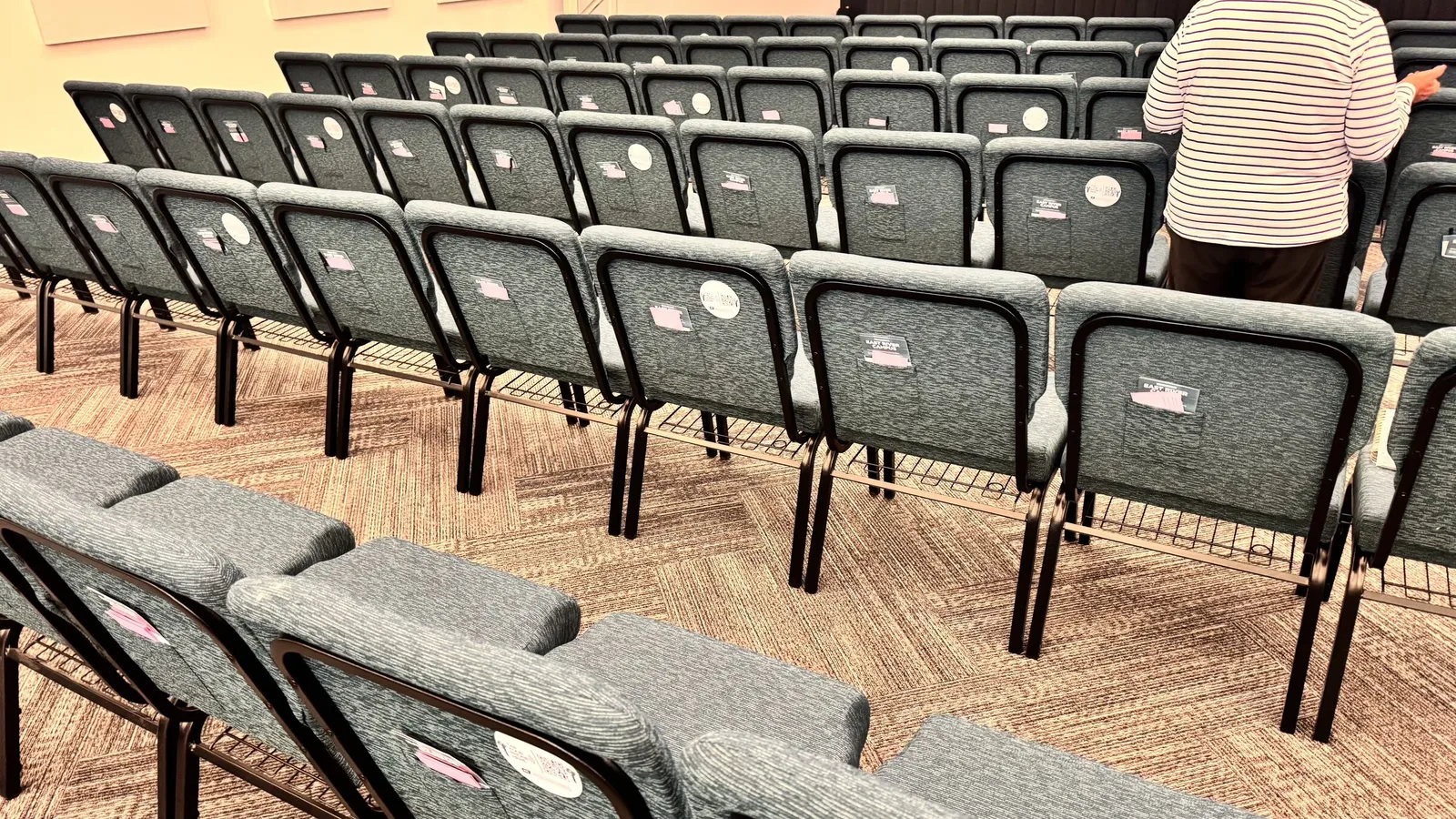
Most non-denominational rooms run stadium seating. The plate ships with three mounting options and you choose based on chair style, not denomination.
- Hard-shell stadium chairs (most common). Adhesive back on the rear of the seat in front, at chest height for a seated guest. About 60 seconds per chair with a volunteer team.
- Folding chairs or chairs without backs. Plates suit a welcome desk or entry table better than the chair itself. Slightly slower to mount, easier to relocate.
- Wooden or metal-framed chairs. Pre-drilled holes for two short screws. Permanent, theft-resistant, common in larger campuses.
For details on each style, see our step-by-step mounting guide. A team of four volunteers can mount 600 plates in about 90 minutes on a Saturday morning, which is the typical install pattern we see for non-denom rollouts.
A 4-Week Rollout for a Non-Denom Service
Non-denominational churches usually want to align a rollout with a sermon series or a vision Sunday. Four weeks is the rhythm we recommend.
- Week 1: Confirm the giving URL. Open your existing giving page on a phone and time how long it takes to give as a guest. If it is more than 15 seconds, fix that before ordering plates. The most common giving page leaks are slow load, forced account creation, and a hidden Apple Pay button.
- Week 2: Order plates and approve the proof. Send a vector logo and your giving URL. Approve the design proof. Production runs about a week. Start a quote to get 10% off for 7 days.
- Week 3: Mount and stage a soft launch. Run a volunteer install on Saturday. Demo to your stage team and a small group on Wednesday so they can answer questions on Sunday.
- Week 4: Announce from the stage. A 30-second pastor demo at the offering, plus a one-line script in the bulletin. The churches that see the most adoption are the ones where the lead pastor taps a plate on camera the first Sunday, so guests and regulars both see it modeled once. The full announcement script is in our launch kit.
Cost Math for 300, 600, and 1,000 Seat Rooms
Plates are priced on quantity, not on church size or denomination. The numbers below assume one plate per seat, which is the rule of thumb. Larger volunteer-staffed rooms sometimes go with one plate per pair of seats and the cost drops by half.
| Room Size | Plates Ordered | Per-Plate | One-Time Cost |
|---|---|---|---|
| 150 seats (small) | 150 | $5.00 | $750 |
| 300 seats | 300 | $4.00 | $1,200 |
| 600 seats | 600 | $3.50 | $2,100 |
| 1,000 seats | 1,000 | $3.50 | $3,500 |
No monthly fee. No transaction fee from us. Your existing giving platform charges its normal processing fee (typically 2.9% plus $0.30) and that does not change when you add plates. For the full quantity-break table, see our pricing page. For sizing logic on rooms with mixed pews and chairs, see how many NFC plates a church needs.
The number that matters to an executive pastor is the one that repeats, and for the plates that number is zero. You buy the hardware once. There is no per-plate subscription, no annual license, and no transaction fee from Tap.Giving in year one or year five. Run the 600-seat room forward: $2,100 in year one, and $0 for the plates every year after, while a giving kiosk or a hardware-plus-software terminal keeps billing. That flat second-year-and-beyond cost is the whole reason hardware-only beats a recurring device.
Here is the ROI as arithmetic you can check. Say that 600-seat room gives $1,000,000 a year. A 5% lift is $50,000. Against a one-time $2,100 hardware spend, the plates only need to move the needle a fraction of that to pay for themselves the first month, and the lift keeps compounding in the years when the hardware costs nothing. Plug your own weekly giving number into the same math before you order.
When NFC Plates Are Not the Right Move
Honesty matters more than a sale. Skip the plates if any of these describe your church right now.
- Your giving page is slow, requires account creation, or hides Apple Pay. Fix that first. The plate cannot rescue a broken giving page.
- Your room has fewer than 80 regular attenders. The math still works at $5.00 per plate, but you may get more lift from a single dedicated giving moment than from 80 plates.
- You are mid-platform migration. Wait until your URL is stable. Re-encoding plates later is doable, but easier to skip.
Most non-denom churches do not hit any of these. If yours does, fix the upstream issue and revisit in a quarter.
Ready to put tap-to-give on every chair?
One-time hardware. No monthly fees. Works with Pushpay, Subsplash, Tithely, Planning Center, Donorbox, and any other platform you already use.
Start a quote to get 10% off for 7 days
FAQ
Do NFC tap plates work with Pushpay, Subsplash, and Planning Center Giving?
Yes. NFC tap plates from Tap.Giving open a URL, so they work with any modern giving platform that gives you a mobile-friendly giving page. That includes Pushpay, Subsplash, Planning Center Giving, Tithely, Donorbox, Anedot, Givelify, and Nucleus Giving. You keep your existing platform; the plates just shorten the path to the giving page.
Our chairs do not have pew backs. Will plates still work?
Yes, and most non-denominational rooms are stadium chairs, not pews. Plates mount with adhesive on the seat-back hard shell, with pre-drilled holes for screws on metal or wooden frames. Our mounting guide covers the three common chair styles you will see in modern auditoriums.
How does tap-to-donate help with first-time visitors?
Guests give more readily with NFC giving because there is no app to download, no account to create, and no QR code to focus. A first-time visitor at a non-denominational service can give in roughly eight seconds without ever talking to staff or filling out a connection card, which removes the social friction that keeps many guests from giving at all.
What does it cost to roll out NFC tap plates across our auditorium?
Plates are $5.00 each for 100-199, $4.00 each for 200-399, and $3.50 each for 400 or more, one-time. A 300-seat room is $1,200, a 600-seat room is $2,100, and a 1,000-seat room is $3,500. Free shipping. The first-order discount is 10% for 7 days from the quote.
Do we need to switch giving platforms to use tap-to-give?
No. Tap.Giving sells hardware. The plate carries your existing giving URL, so reporting, recurring schedules, donor records, and bank deposits all stay where they are. If you are on Pushpay or Subsplash and happy with it, plates complement that stack rather than replace it.
What is the lead time on a 500-plate order?
Production is roughly one week, shipping is one to two weeks, so plan on about 2-3 weeks from artwork approval to plates on chairs. Larger orders ship on the same timeline because production is parallel. We recommend ordering at least three weeks before a sermon series launch or vision Sunday.
How is this different from a giving kiosk in the lobby?
A kiosk requires a giver to leave their seat during a non-giving moment in the service. Tap plates put the giving opportunity at every chair during the offering, which is when generosity is already on the mind of the room. Lobby kiosks also cost $1,500 to $3,000 each plus payment processor fees; a full room of plates is usually less than one kiosk. See our breakdown on the kiosk alternative.
Related Articles
NFC Giving for Baptist Churches: A Practical Guide
The denomination-specific companion: deacon-board language, Tithely and Realm pointers, and dollar math for a 200-seat sanctuary.
GuideHow Many NFC Plates Does Our Church Need in 2026?
Sizing logic for one-per-seat, one-per-pair, and mixed-rooms with both fixed pews and stadium chairs.
GuideMultisite Church Tap-to-Give: Cost Per Campus (2026)
Per-campus cost math, routing across Pushpay, Subsplash, and Tithely, and a rollout sequence for central finance teams.