QGiv vs Tap.Giving: 5-Year Cost for Churches (2026)
QGiv is now Bloomerang: an online fundraising platform that runs your church campaigns, peer-to-peer events, and recurring giving from a single dashboard, with monthly tiers from about $40 up to $242 in 2026. Tap.Giving sells one-time NFC tap plates that work with whatever giving page your church already uses, including QGiv. Here is what each one actually costs a 200-seat church over five years, and which option fits which church.
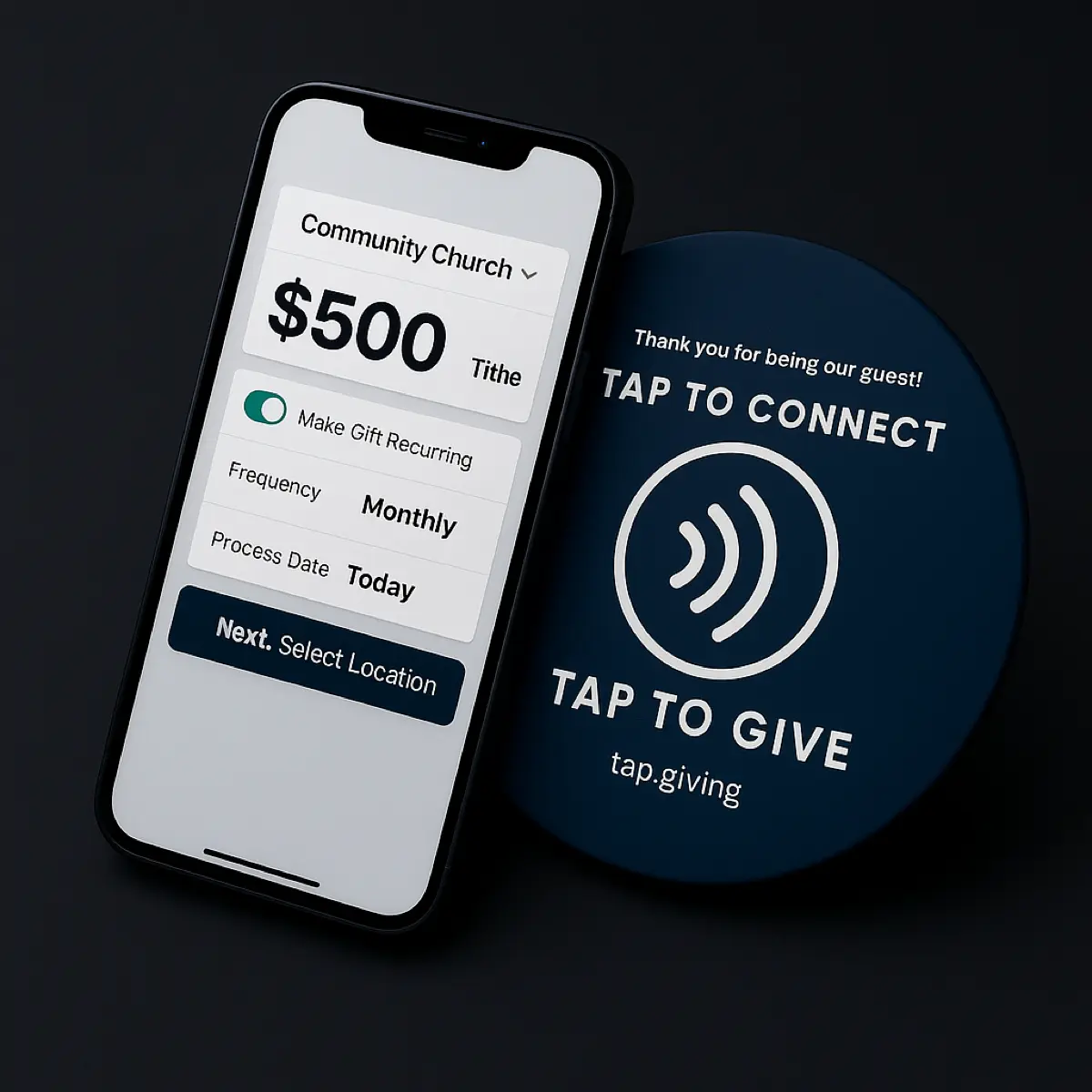
See your church's plate and price in 30 seconds
Design it yourself on the next page. From $3.50 per plate, free shipping, no monthly fees.
$5,940
What a 200-seat church pays Bloomerang (formerly QGiv) over 5 years on its all-in-one Giving Platform at $242 per month, before processing fees, compared to $800 once for 200 Tap.Giving NFC tap plates that never bill again.
The Short Answer (Read This First)
QGiv and Tap.Giving sit at different layers of the church giving technology stack. QGiv is a recurring SaaS subscription that powers online donation pages, peer-to-peer fundraisers, event registration, and online auctions. Tap.Giving is passive hardware: a printed disc with an NFC chip the size of a grain of rice, one per seat, no battery, no monthly fee, no platform of its own.
For a 200-seat church in 2026, Bloomerang's all-in-one Giving Platform totals about $14,520 over five years in subscription alone, before the roughly 2.95 percent plus $0.30 processor charge on every gift. Tap.Giving plates for the same room total $800 once at $4.00 per plate, with free shipping and no recurring cost. Both can power tap to give, tap to donate, and NFC giving in your service, but the price profile is the opposite shape. Most churches do not have to choose; they keep their fundraising platform and add NFC tap plates at every seat. For a wider look at the field, see our tap to give platform comparison.
What QGiv Is (and Who Uses It)
QGiv has been around since 2007 and is based in Lakeland, Florida. The platform grew up serving nonprofits broadly, then layered in features that churches sometimes need: hosted donation pages, recurring giving, text giving, peer-to-peer fundraisers, online auctions, and event registration. A modern church running a 5K, an annual gala, or a mission-trip funding campaign can hand the whole project to QGiv and run it from one dashboard.
The churches that pick QGiv typically share one trait: they run a lot of campaigns and events, not just a Sunday offering. A church that mostly needs a clean recurring-giving page and a way to take donations in the room often pays for features it never uses. A church that runs three peer-to-peer events a year and a fall auction tends to get its money's worth.
That is the reason NFC tap plates and QGiv are complementary, not competitive. The plate hands a giver's phone a URL and then steps out of the way. That URL can be your QGiv donation page, your QGiv peer-to-peer campaign, your Tithely, Pushpay, Subsplash, Donorbox, Givelify, Anedot, Planning Center Giving, or Nucleus Giving page. The chip does not care. For a plain-English walkthrough of the underlying technology, read how tap to give works for churches and our church NFC tags guide.
QGiv Pricing in 2026
QGiv publishes monthly pricing on a public page, which is a useful signal. The numbers below are approximate list pricing as of 2026, and QGiv runs promotional discounts and annual-billing options that trim the headline a little. Confirm current numbers on qgiv.com before signing.
| Plan | Approx. 2026 Monthly Price (USD) | What You Get |
|---|---|---|
| Bloomerang Fundraising | From $40 / month | Donation forms, one-time and recurring giving — requires a CRM plan bundle |
| Bloomerang CRM | From $125 / month | Donor database and reporting, the required bundle partner for Fundraising |
| Bloomerang Volunteer | From $119 / month | Volunteer scheduling and management add-on |
| The Giving Platform (all-in-one, common church landing spot) | From $242 / month | Campaigns, peer-to-peer, recurring giving and CRM in one dashboard — the closest match to what QGiv offered as a standalone product |
| Payment processing | ~2.95% + $0.30 per gift | Standard processor charge on top of the subscription |
QGiv has been consolidated into Bloomerang — qgiv.com now redirects straight to bloomerang.com/pricing, and the old Start/Essentials/Impact/Engage tier names are gone. Pricing above is Bloomerang's published tiers as of 2026; standard processor rates are current as of 2026. Confirm the exact bundle a given church needs directly with Bloomerang before quoting a total, since Fundraising requires a CRM plan alongside it.
The pattern is the same as every SaaS giving platform: the monthly fee is for the software, and you keep paying it whether one person gives this month or 200 people give. There is no hardware in the box, so the in-pew giving experience is whatever the giver chooses to do with the link on their phone. That is where NFC tap plates fit, and where the math changes shape. For more context on recurring-fee giving stacks, see our look at the Tithely fees breakdown and the hidden costs of church giving platforms.
Need plates for your church?
100 plates from $500, free shipping, works with QGiv and every major giving platform. No monthly bill.
Tap.Giving Plate Pricing for Churches
Our pricing has one shape: per plate, one time, free shipping. No monthly fee, no setup fee, no transaction fee from us. The plate ships with adhesive backing, pre-drilled screw holes for permanent mounts, and a QR code printed on the front as a fallback for any phone that cannot read NFC.
| Quantity | Per Plate | Example Total |
|---|---|---|
| 100 to 199 | $5.00 | $500 (100 plates) |
| 200 to 399 | $4.00 | $800 (200 plates) |
| 400+ | $3.50 | $1,400 (400 plates) |
The first-order discount is 10% for 7 days from the quote. Free shipping, typical delivery 2-3 weeks from artwork approval, no contract. Full tier detail and quantity breaks up to 1,000+ plates are on our pricing page, or you can start an order directly. For a sanity check on quantity, our how many plates does a church need guide walks through the seats-per-plate math.
5-Year Total Cost: A 200-Seat Church
Here is the math for a 200-seat church running roughly $150,000 a year through its giving platform. Column one assumes the church pays for Bloomerang's all-in-one Giving Platform at about $242 per month, the most common landing spot for a church that wants peer-to-peer campaigns on top of basic online giving. Column two assumes the church keeps whatever giving platform it already uses (Tithely, Pushpay, Subsplash, Donorbox, Givelify, Anedot, or another) and adds 200 Tap.Giving NFC tap plates at every seat. Processing fees apply on both sides because they live with the processor, not the hardware.
| Line Item | Bloomerang Giving Platform ($242/mo) | Existing platform + 200 Tap.Giving plates |
|---|---|---|
| Hardware (one-time) | $0 (software only) | $800 (200 plates @ $4.00) |
| Platform subscription (5 yr) | ~$14,520 ($242 × 60 months) | $0 from us; you keep your current platform |
| Processing fees on $150K/yr (5 yr) | ~$22,500 (2.95% + $0.30) | ~$22,500 (same processor on your platform) |
| In-pew tap to give included? | No (hosted pages only) | Yes (every seat) |
| 5-year total | ~$37,020 (no in-pew hardware) | $800 + your existing platform cost |
Bloomerang (formerly QGiv) is not overpriced for what it does. A peer-to-peer campaign engine, an event registration tool, and CRM under one login is reasonable value if you actually run those things. The point is that the $242 a month is buying campaigns, donor management and events, not the in-pew Sunday giving moment. Adding NFC tap plates does not require leaving your giving platform and does not add a second monthly bill. Plates and a fundraising platform solve different problems on different timelines.
The lift side of the math is the part churches under-budget for. Congregations using NFC tap plates have reported in-service donation lifts of 300 percent or more, with 81 percent of attendees willing to give in service when a tap option is available compared to only 24 percent who actually do without one. Tap to give is fewer steps than a QR code, and 53 percent of NFC givers in church studies are first-time givers. The full numbers are in our NFC giving ROI post. For independent context on donor trends, the ECFA publishes useful annual data worth reading before any platform decision.
Feature Comparison
QGiv and Tap.Giving live at different layers of the church giving technology stack, so this is less a head-to-head chart and more a "what does each one actually do" reference. Treat the chart below as a way to decide which line items you are paying for, and which ones you still need.
| Capability | QGiv | Tap.Giving NFC tap plates |
|---|---|---|
| What it is | Cloud fundraising platform (donation pages, P2P, events, auctions) | Passive NFC hardware at every seat |
| Peer-to-peer fundraising, auctions, event registration | Yes (this is the core product) | No (not our job) |
| In-pew tap to give and tap to donate | No (no hardware shipped) | Yes (every seat, every Sunday) |
| Works with non-QGiv platforms | QGiv is the platform | Yes (any platform with a mobile URL) |
| Monthly fee | ~$25 to $399+ per month | None, ever |
| Power and connectivity required | Yes (it is software) | None (powered by the giver's phone) |
| Replaces your current giving page | Yes (QGiv hosts it) | No (we point to whatever you already have) |
For a wider side-by-side that includes contactless giving options across the category, see our contactless church collection plate guide, and for SaaS-bundled alternatives in the same lane as QGiv, our roundup of the best church donation technology of 2026 is the right starting point. The Givebutter comparison covers the closest spiritual cousin to QGiv in our existing posts.
When to Pick QGiv Anyway
Honest carve-out: situations where QGiv earns its monthly fee and is the right call even if you also want tap-and-give hardware in the room.
- Your church runs two or more peer-to-peer fundraisers a year (mission trips, capital campaigns, ministry sponsorships) and you want personalized donor pages for participants.
- You host an annual gala or banquet with an online auction and want bidding, registration, and giving to share one donor record.
- You run event registration for a conference, a women's retreat, or a youth camp and want ticket sales and donations under one roof.
- You have an in-house finance staffer who will actually use the reporting, the cover-fees toggle, and the campaign analytics QGiv builds for.
Even when QGiv is the right campaign engine, the in-room experience still benefits from physical tap tags for churches at every seat. The plate hands the phone the QGiv donation URL, the giver pays in about eight seconds, and QGiv books the gift like any other web donation. Many of our customers run exactly that stack: QGiv (or another campaign platform) for the events, NFC tap plates for the Sunday offering. To think through whether the combination fits, walk through how it works, then grab a plate quantity that matches your seats. If you want a 4-week rollout plan, our deployment playbook walks the timeline.
Add tap to give to your QGiv donation page
One-time hardware. No monthly fee. Works with QGiv, Tithely, Pushpay, Subsplash, Donorbox, Givelify, Anedot, Planning Center Giving, and Nucleus Giving. Free shipping, typical delivery 2-3 weeks from artwork approval on every order.
Start a quote to get 10% off for 7 days
FAQ: QGiv and Tap.Giving Questions
What is QGiv and do churches use it?
QGiv is an online fundraising platform founded in 2007 and headquartered in Lakeland, Florida. It serves nonprofits broadly and a slice of churches that run peer-to-peer fundraisers, auctions, event registrations, and recurring giving from a single dashboard. Churches that lean heavily on campaigns and events choose QGiv more often than churches that just need a Sunday giving page.
How much does QGiv cost in 2026?
QGiv has been consolidated into Bloomerang, which publishes tiered monthly pricing. As of 2026, Bloomerang Fundraising starts around $40 per month (requires a CRM plan bundle, from $125/month), and the all-in-one Giving Platform most churches land on runs about $242 per month. Online donations are processed at roughly 2.95 percent plus $0.30 per transaction on top of the subscription. Confirm current numbers on qgiv.com before signing.
How does Tap.Giving compare on price?
Tap.Giving plates are a one-time purchase: $5.00 each for 100 to 199, $4.00 for 200 to 399, and $3.50 for 400 or more. No monthly fees, no setup fees, and no transaction fees from us. A 200-seat church spends $800 once. The first-order discount is 10% for 7 days from the quote. See our pricing page for full quantity breaks.
Do NFC tap plates work if my church already uses QGiv?
Yes. NFC tap plates work with any giving platform that gives you a mobile-friendly URL, and QGiv qualifies. We encode the plate with your QGiv donation page or campaign URL so a tap opens the same page QGiv already hosts. Your recurring donors, peer-to-peer fundraisers, and event registrations stay in QGiv untouched. See the Anedot comparison for another example of pairing plates with a hosted donation form.
Can I keep QGiv for campaigns and add NFC tap plates for the Sunday offering?
That is the cleanest setup for churches that already pay for QGiv. Keep QGiv as your campaign, peer-to-peer, and event registration engine, then add NFC tap plates at every seat so the in-service tap to give and tap to donate moment is one second. The donation still flows through your QGiv giving page; the plate is just a faster way to reach it.
Are NFC tap plates secure if QGiv handles the actual payment?
The plate stores only a web address, not any payment information. The actual donation happens on QGiv's secure, PCI-compliant page, the same place your members already give online. When the giver uses Apple Pay or Google Pay, only a one-time encrypted token is exchanged, so the church and QGiv never see the raw card number. Adding a plate does not change the security profile.
When should a church pick QGiv anyway?
Pick QGiv when your church runs serious peer-to-peer fundraisers, annual galas with online auctions, or registration-heavy events and needs a single dashboard for all of it. QGiv earns its monthly fee on campaign and event tooling, not on the in-pew giving experience. For most churches whose main need is Sunday and recurring giving, NFC tap plates plus your existing giving page is the cheaper way to add tap to give.
Related Articles
Givebutter vs Tap.Giving
The closest spiritual cousin to QGiv in our comparison library: another modern fundraising platform, side by side with one-time NFC tap plates.
GuideThe Hidden Costs of Church Giving Platforms
Where subscription giving stacks accumulate cost, and what to actually compare line by line.
GuideNFC Tap Plates for Capital Campaigns
How plates and a campaign platform pair up during a 12 to 24 month giving push.