Reaching Longtime Members Who Have Never Started Giving
Every church has them: faithful people who show up every week, serve, pray, and belong, but who have never put a dollar in. Most of them are not withholding on purpose. They are unequipped, unasked, or unsure how, and the fastest way to reach them is to name giving plainly, make the first gift effortless, and invite them personally.
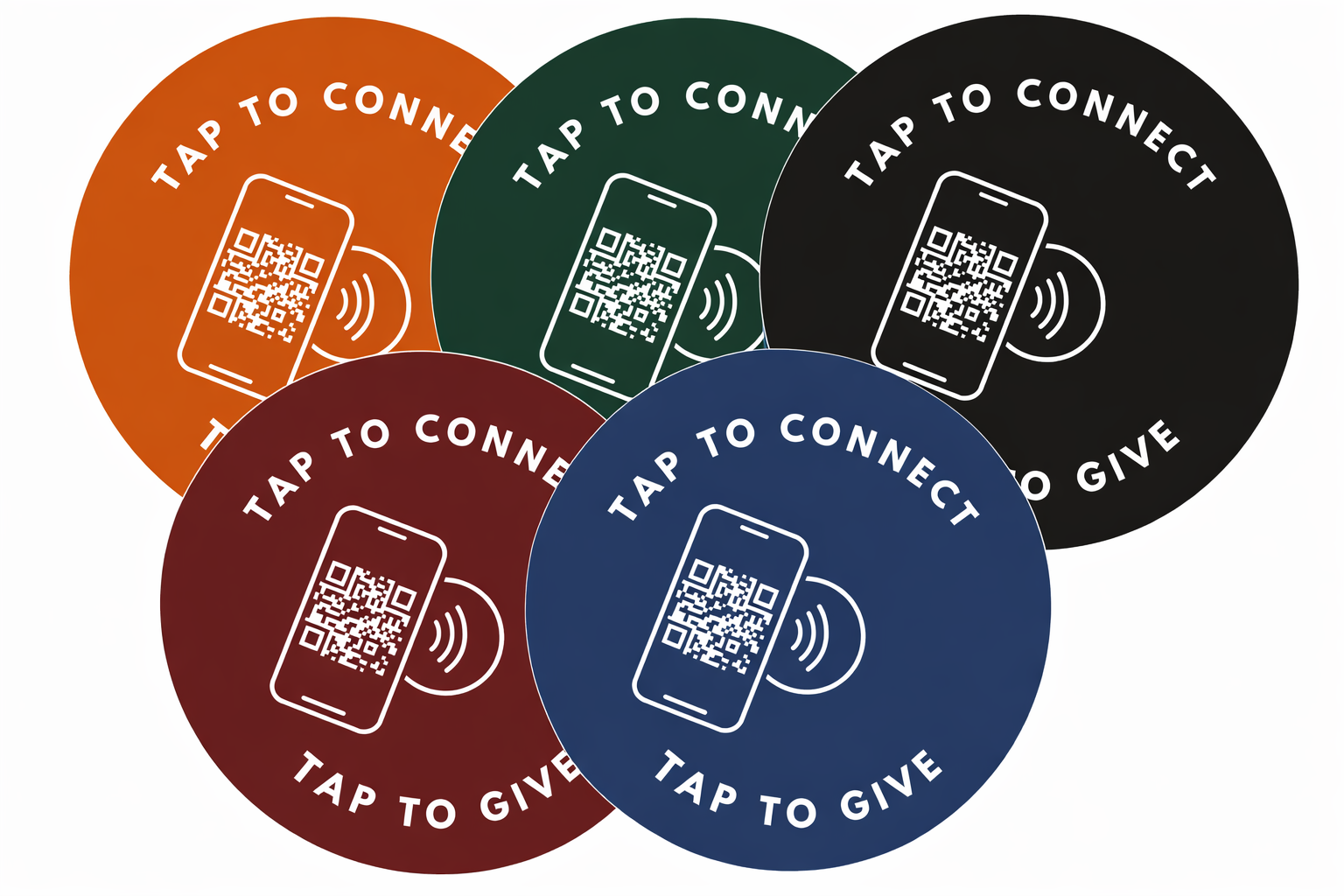
See your church's plate and price in 30 seconds
Design it yourself on the next page. From $3.50 per plate, free shipping, no monthly fees.
Why Longtime Members Stop Short of Giving
Most non-givers in your church are not stingy; they are stuck at a barrier you can name. Before you assume a heart problem, rule out the practical ones, because they are more common and far easier to fix.
Some simply stopped carrying the tools. The offering plate was built for a world of cash and checkbooks, and that world is gone for most people under fifty. They would give if giving met them where their money already lives, on their phone.
Some have never been asked, only informed. A slide that says "Give online at our website" is an announcement, not an invitation, and a faithful introvert can attend for years without ever feeling personally addressed by it.
Some assume giving is for members with a formal title, a pledge card, or a certain income. They love the church and quietly believe the budget is somebody else's responsibility.
And some are wrestling with something real: debt, fear, a season of scarcity, or a theology of money they have never heard taught. That group needs pastoring, not a better payment method. The point of clearing the practical barriers first is that it lets you see who is actually left.
Look at the One Number Most Churches Never Check
Pull the count of households that gave anything in the last twelve months and set it next to your attendance. You do not need names to do this, and you do not need a consultant. Your existing giving platform or accounting software can hand you a giving-by-household report in a few clicks.
In most congregations the pattern is the same: a minority of households carries the large majority of the budget, and a surprising number of regular attenders show up in the report exactly zero times. That gap is not a failure. It is your opportunity, measured.
A quick way to see the gap
Say you average 180 households on a Sunday and your report shows 95 gave at least once this year. That is 85 households who belong, attend, and have never given. If even a quarter of them started with a modest recurring gift, the change to your budget would be immediate, and the reason most of them have not started is almost never rebellion.
Run the number before you build a plan. It turns a vague worry into a specific, reachable list, and it keeps you from preaching a guilt series to the wrong people.
Clear the Practical Barrier Before You Preach
The cheapest generosity win available to any church is removing friction, and it usually costs a Sunday, not a sermon series. A member who has decided to give and then cannot find the giving page will not try twice.
Start by giving your own giving page the guest test. Open it on your phone as if you had never seen it. Count the taps from "I want to give" to "it is done." If it takes more than a few, or asks a first-time giver to create an account, that is where your non-givers are dropping. We wrote a full fix list in our guide on how to increase church giving without talking about money.
Then bring the giving page into the room. The reason offering plates worked for centuries is that they arrived in the moment, in the pew, when the decision was warm. A giving link buried on a website loses that moment entirely. Putting a tap-to-give plate or a clear QR code on the seat back restores it, so the member who felt a prompt during worship can act on it before it fades. Our walkthrough on how tap-to-give works for churches explains the eight-second version.
None of this reaches the member with a deeper struggle. All of it reaches the member whose only barrier was that giving was inconvenient, and that is a larger group than most pastors expect.
Name Giving Plainly, From the Front, Without Cringing
Silence about giving does not feel gracious to a non-giver; it feels like the subject is off-limits. Longtime members take their cues from you, and if you never teach on generosity, many conclude it is either unimportant or slightly shameful.
Talk about giving the way you talk about prayer or service: as a normal, joyful part of following Jesus, tied to what the church is actually doing. "Your giving is why we could feed forty families last month" lands very differently than "we are behind on budget." One invites people into a mission; the other asks them to bail out an institution.
Demonstrate the mechanics from the stage, once, without apology. Hold up a phone, tap a plate, and show how fast it is. You are not begging; you are removing confusion, and a first-time giver in the third row is watching to learn what to do. Our post on how to announce digital giving from stage has scripts you can adapt.
If the whole topic feels awkward in your context, that is worth its own work. We wrote about how to make tithing feel less awkward in your church, because the awkwardness usually lives in the pastor before it lives in the pew.
Why a Personal Invitation Beats a Pulpit Push
A general appeal reaches everyone and moves almost no one; a personal word reaches one person and often moves them. The longtime member who has never given has heard every announcement already. What they have not heard is you, or a leader they trust, speaking to them directly and warmly.
Keep it relational, not transactional. "I have loved watching you serve in the kids' ministry these years. I would love for you to be part of the giving side of what God is doing here too, and it is genuinely simple to start." That is an invitation into belonging, not a dunning notice.
Equip a few trusted leaders to have the same conversation, and give them the easy on-ramp to point to in the same breath. The ask and the answer should be inches apart, so nobody has to go home, find a website, and remember to follow through.
What to Do After the First Gift
The first gift is a beginning, not a finish line, and the days right after it decide whether it becomes a habit. A new giver who hears nothing back often assumes the moment did not matter and drifts back to zero.
Thank them like a person, not a receipt. A short, warm note that names the ministry their gift supports does more than any automated statement, and it is the single highest-return follow-up a church can send. We built a ready-to-use thank-you sequence for new givers you can adapt in an afternoon.
Then make the second gift easier than the first. Invite them, gently, to set up a recurring gift on your platform so generosity becomes a rhythm instead of a decision they have to make again every week. Retention is the cheapest growth a church has, and it starts with treating a first-time giver as the beginning of a relationship.
Where the plates fit
If the barrier you keep hitting is "our people would give but the giving page is a website nobody visits," a tap plate in the pew closes that gap without changing anything else. We sell the plates. You keep the giving platform you already chose.
Tap.Giving plates are $3.50 to $5.00 each, one-time, with free shipping and no monthly fees, so a small church can put giving in every seat for a one-time cost and never pay us again. I am a pastor, and I built this because our own church needed a way to make giving effortless in the moment.
FAQ
Is it wrong to talk to longtime members about giving?
No. Teaching a congregation to give is part of discipleship, not a fundraising tactic. The line to watch is pressure, not the topic. When you talk about giving as a spiritual practice tied to the church's mission, and you make the first step genuinely easy, most faithful members are relieved to finally have a clear on-ramp rather than a vague sense they should be doing something.
How do I know how many of my members actually give?
Pull a giving-by-household report from your existing giving platform or accounting software for the last twelve months, then compare the count of giving households to your average weekly attendance in households. Most pastors are surprised by the gap. You do not need names to see the pattern; the ratio alone tells you how much room there is.
Will making giving easier really change anything for a member who has never given?
For some, yes. A share of non-givers are not unwilling, they are unequipped: they stopped carrying cash and checks years ago and never found the giving page. Removing the friction, a tap or a scan in the pew instead of a website they have to hunt for, converts the members whose only barrier was practical. It will not reach a member with a deeper heart issue, but it clears the easy blockers first so you can see who is left.
Related Articles
Building a Culture of Generosity in Your Church
The long game behind reaching non-givers: how generosity becomes normal rather than nagged.
GuideThe Real Reasons Church Visitors Don't Give
The first-time-guest companion to this post: the barriers that stop new people before they ever start.
StrategyHelping First-Time Visitors Give Without Friction
How tap-to-give lowers the bar for the newest people in the room, not just the longtime ones.