How to Talk About Money in Church Without Making It Weird
You make money talk less awkward by doing two things most churches get backwards: talk about it more often, not less, and stop apologizing when you do. Short, honest, vision-tied words about giving every few weeks keep the subject normal, so no single Sunday has to carry the weight of a fundraiser. The awkwardness is almost never the topic. It is the silence and the flinch around it.
See your church's plate and price in 30 seconds
Design it yourself on the next page. From $3.50 per plate, free shipping, no monthly fees.
Why Talking About Money Feels So Awkward
Most of the awkwardness around church money comes from two habits, and neither one is the money itself. The first is talking about it too rarely. The second is apologizing every time you do.
When you only raise giving once a year, the rarity becomes the message. A congregation that hears about money one Sunday out of fifty learns, correctly, that this is the uncomfortable Sunday. The dread you feel walking up to say it is the dread you taught them to feel by saving it all for one push.
The apology makes it worse. "I hate to bring this up, but the budget is tight" tells people three things at once: money is embarrassing, the church is struggling, and you would rather not be doing this. None of that invites generosity. It just spreads your discomfort to everyone in the room.
Here is the reframe that changed it for me. Giving is not a fee your church collects. It is a spiritual practice you get to pastor people into, the same way you would pastor them toward prayer or forgiveness. You would never apologize for teaching on prayer. Money deserves the same steady, unembarrassed voice.
What to Actually Say From the Platform
The fastest way to make money talk normal is to have a few honest lines ready so you are never improvising an apology. Here are four you can use this month, none of which require you to sound sorry.
The invitation, not the demand
"In a moment we are going to give. If this is your church home, giving is one of the ways we say so, and it is a joy, not a bill. Let's give together."
The reason, in one line
"Everything this church does on a Tuesday, the counseling, the food pantry, the youth room lights, is paid for by people who gave on a Sunday. Thank you for making the rest of the week possible."
The story, not the shortfall
"A single mom in our neighborhood had groceries this week because of this church. That is what your giving does. It has a face and a name, even when you never see it."
The how, for the newcomer
"There is a plate on the seat back in front of you. You can tap your phone to it, give from the app, or drop something in the basket. All of it lands in the same place."
Notice what these have in common. None of them guilt anyone, all of them assume giving is a good and normal thing, and each one is short enough to say without breaking the flow of the service. That posture, more than any single sentence, is what makes the subject stop feeling weird.
How to Invite Giving Without Pressuring Guests
A lot of pastors stay quiet about money because they are afraid of what a first-time guest will think. The fix is not silence. The fix is to name the guest out loud and hand them an exit.
Let the guest off the hook, on purpose
"If you are visiting with us today, please let this one pass. You are our guest, not our donor. We are just glad you are here." Say it every single time you take an offering, and you free your members to give without a visitor ever feeling cornered.
Something counterintuitive happens when you do this. Guests trust the church more, not less. A church confident enough to tell a newcomer "you owe us nothing" is a church that clearly is not desperate, and that confidence is attractive. The pressure you were afraid of was never coming from the offering. It was coming from the awkward way we usually handle it.
If you want the fuller picture on why some visitors never give even once, we dug into the real and fixable reasons in how to increase giving without leaning on money talk at all.
How Often Should You Bring It Up?
Little and often beats one big push, every time. A thirty-second, honest word about generosity every few weeks keeps giving in the room without turning any single Sunday into a telethon.
Think of it as seasoning rather than a main course. You are not preaching a stewardship sermon every week. You are dropping one true, warm sentence into the ordinary rhythm often enough that money stops being a special, scary topic and becomes a normal part of following Jesus at your church.
The bonus is that your fall series and your year-end appeal stop having to carry the whole weight. When generosity has been in the room all year, the big moments become the peak of a steady rhythm instead of the one time you ask. We laid out a full year of this in our guide to building a culture of generosity, and the seasonal patterns behind it in our piece on the summer church giving slump. When the big appeal does land, a plan helps: here is how we think about the year-end giving season, and how to keep a first-time giver past their first gift.
What to Say for the Bigger Asks
Year-end appeals and capital campaigns are where the flinch comes back hardest, because the number is bigger and the stakes feel higher. The principle does not change. Lead with the vision, be specific about the outcome, and be honest about the number.
People give to vision, not to budgets. Nobody was ever moved by "we need to close a gap in the general fund." People will sacrifice for "forty kids are going to camp and forty families cannot afford it, and here is how we send them." Same dollars, completely different response.
Report back before you ask again
The most trust-building habit for a big ask is to close the loop on the last one first. Show the photos, name the fruit, and say plainly what the previous gift accomplished before you launch the next campaign. People give again to a church that proves the last gift mattered.
For a big ask, add one more sentence the ordinary weeks do not need: honesty about the goal. "Our goal is 50,000 dollars by the end of the year, we are at 31,000, and here is exactly what the rest unlocks." Treasurers and skeptics relax when the number is on the table instead of hinted at.
How to Talk About Giving When People Give on a Phone
Fewer people carry cash every year, which means the words you say now have to include the how, not just the why. A moving appeal that ends with no clear way to act loses the very generosity it just stirred up.
Keep the mechanics to one clean sentence and rehearse it so it does not sound like a tech tutorial. "Give from the app, scan the code on the screen, tap the plate on your seat, or drop it in the basket." Four options, one breath, no fumbling. For a deeper script on this exact moment, we wrote a whole piece on how to announce digital giving from stage.
The reason the mechanics matter is friction. Picture the giver you just spent a whole service moving. The music lands, the vision is clear, they reach for their wallet, and there is no cash. If the giving page will not load or the app wants a new account, that gift quietly evaporates. The awkwardness you were worried about is not nearly as costly as the generosity lost to a fumbled last step.
Where a tap plate fits, honestly
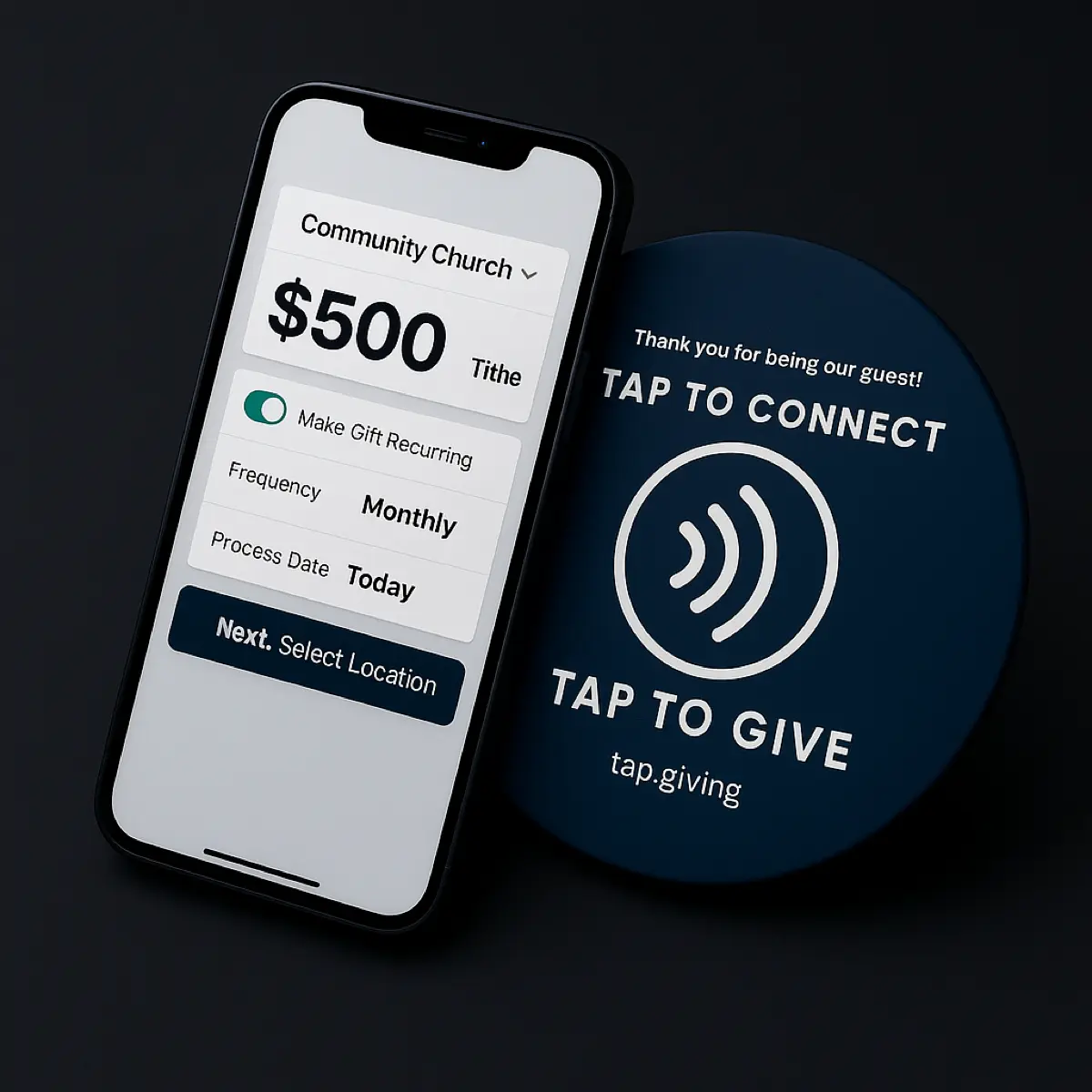
I am a pastor, and I built Tap.Giving because our own church needed a way to make in-service giving effortless without adding another monthly bill. A tap plate on the seat back lets someone give in about the time it takes to tap a card at a coffee shop, with no app to download.
To be plain about it: we sell the plates, and you keep the giving platform you already chose. It is a tool for the friction problem, not a substitute for the words. Get the words right first, then make it easy to act on them. If you want the mechanics, our walkthrough of how tap-to-give works covers it in plain English.
A Short Script Bank You Can Reuse
Print these, keep them in your notes app, and rotate through them. The goal is that you never again stand up to take an offering without a warm, honest line already in hand.
- Ordinary Sunday: "Giving is one of the ways we say this is our church. If that is you, let's give together. If you are visiting, this one is on us."
- The impact line: "Your giving last month kept the lights on in the youth room and put food on a real family's table. Thank you."
- The new-giver nudge: "If you have never set up giving here, take ten seconds today. Recurring giving is how most of our folks quietly carry this church all year."
- The honest big ask: "Here is the goal, here is where we are, and here is exactly what the rest makes possible. No pressure, just clarity."
- The report-back: "You gave, and here is what happened. Before we ask for anything new, I want you to see the fruit of the last thing."
None of these are scripts to read word for word. They are postures to borrow. Say them in your own voice, tie them to your own church's story, and the awkwardness you started with will be gone within a few months. For the practical moves that lift giving alongside the words, our guide to increasing online giving at your church goes deeper than we can here.
FAQ
Why does talking about money in church feel so awkward?
Most of the awkwardness comes from two habits: talking about money too rarely, and apologizing when you do. Both quietly teach the congregation that money is an uncomfortable subject the church would rather avoid. When you raise it once a year with a flinch, the silence around it becomes the message. Talk about generosity briefly and confidently on ordinary weeks and the awkwardness fades, because the topic stops being a rare event.
How do you invite giving without pressuring guests?
Name the guest out loud and let them off the hook. A line like "If you are visiting today, please let this one pass, you are our guest, not our donor" removes the pressure a guest feels and signals to your members that giving here is honest and unforced. Guests almost always respect a church more for saying it, not less.
How often should a pastor talk about money from the platform?
Little and often beats one big annual push. A short, honest, vision-tied word about generosity every few weeks keeps giving normal without turning any single Sunday into a fundraiser. Silence for eleven months followed by a heavy stewardship series teaches people that money talk means the church is in trouble.
Related Articles
How to Build a Culture of Generosity in Your Church
The full-year playbook this piece is one part of: teach it, model it, make it easy, and keep at it.
GuideHow to Increase Church Giving Without Talking About Money
The companion move: the ways generosity grows when the emphasis comes off the ask.
GuideThe Summer Church Giving Slump, and What to Do About It
Why giving dips when attendance does, and how to keep generosity steady through the summer.