NFC Tap-to-Give for Lutheran Churches: 2026 Guide
A 200-seat Lutheran church can add tap to give at every pew for $800, one-time, with no monthly fees and no platform switch. NFC tap plates carry your existing Vanco, Tithely, Realm, or Planning Center Giving URL, so the Church Council approves hardware, not another subscription. This guide covers the polity, the platforms, the cost, and the rollout for ELCA, LCMS, WELS, LCMC, and NALC congregations.
See your church's plate and price in 30 seconds
Design it yourself on the next page. From $3.50 per plate, free shipping, no monthly fees.
1. Why Lutheran Churches Are Adding NFC Giving
Lutheran congregations do stewardship the old-fashioned way: pledge cards in the fall, a personal letter from the pastor, and a treasurer who reads the general ledger to Council every month. That posture is exactly why NFC giving fits so well. NFC tap plates are a one-time hardware line item, not another recurring subscription for the treasurer to defend. Every dollar the plates lift stays in your existing giving platform, where the Financial Secretary already tracks it.
The other reason is generational. Lutheran pews still hold a healthy share of check-writers, but that group is aging out, and the confirmands taking their seats do not carry cash. According to research summarized by Lifeway Research That 36-point gap is what tap to give closes.
A pastor at a mid-size LCMS parish told us plainly: the plate still passes, but the checks in it have thinned out for a decade. Adding contactless giving to the pew back doesn't replace the offering, it just gives every willing giver a way to actually participate. Digital giving for churches is no longer a novelty; a growing majority of first-time gifts in most congregations now come from a phone.
2. How Tap-to-Give Fits the Divine Service
Lutheran worship is ordered. Whether your congregation uses Divine Service from the Lutheran Service Book (LCMS, WELS), Holy Communion settings from Evangelical Lutheran Worship (ELCA), or a hybrid liturgy in an LCMC or NALC parish, the offering sits inside a defined moment: after the sermon and Creed, followed by the Prayer of the Church and the Offertory. Nothing about that changes when you add tap plates.
The offering begins
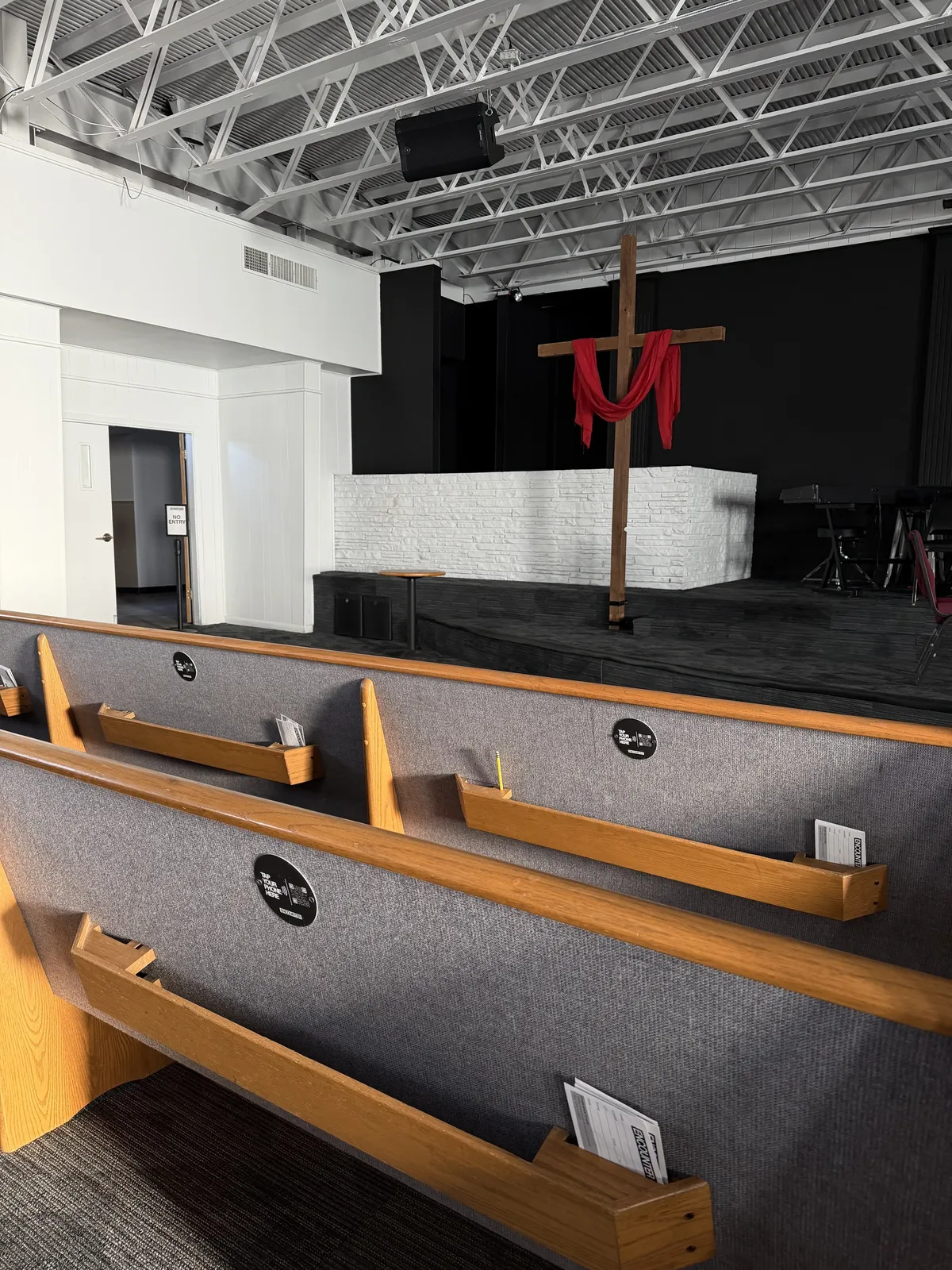
Ushers pass the plate as they always have. The pastor briefly invites the congregation to give and mentions the plate on the pew back for those who prefer to give from their phone.
Tap the plate
The giver holds their phone within an inch of the plate. The phone opens your existing giving page instantly. No app, no download, no QR code to focus.
Complete the gift
They give in about eight seconds through your Vanco, Tithely, or Realm giving page, then rejoin the Offertory. Reporting and receipts stay in your existing platform.
The plates are additive. The passing of the plate, the Prayer of the Church, the Offertory setting, and the Words of Institution all remain intact. What changes is the participation rate: churches offering a tap to donate option at the pew report an higher in-service participation and roughly 3x higher average gifts compared to cash-only weeks, and tap is fewer steps than a QR code because it removes the focus-and-scan step. Under the hood, NFC tags for churches use the same standard as Apple Pay and Google Pay, so every modern phone already knows how to read them.
3. Giving Platforms Common in ELCA, LCMS, and WELS Churches
Lutheran congregations tend to run a narrower set of platforms than the broader Protestant world. Our church giving technology guide covers the whole field, but here is what actually shows up in Lutheran sanctuaries:
| Platform | Typical Lutheran Use | Works with NFC Plates |
|---|---|---|
| Vanco | Very common across ELCA, LCMS, and WELS; often via synod-level agreements | Yes |
| Realm (ACS Technologies) | ELCA and mainline parishes already on ACS for member records | Yes |
| Tithely | Smaller LCMC, NALC, and church-plant Lutherans on a lean budget | Yes |
| Planning Center Giving | Evangelical Lutheran congregations already on the PCO suite | Yes |
| Pushpay | Larger LCMS congregations and multisite Lutheran churches | Yes |
| Donorbox | Church plants and small congregations running lean | Yes |
The plate carries your existing giving URL. If your parish runs Vanco, the plate opens your Vanco giving page. If you're on Planning Center Giving, the plate opens your PCO giving link. There is no integration to maintain and no webhook to wire up. Tap.Giving is hardware; your giving platform stays your giving platform, which is exactly how most Councils and Voters' Assemblies want it.
4. Church Council and Voters' Assembly Approval
Lutheran polity varies. ELCA congregations vote through a Church Council. LCMS parishes typically require a Voters' Assembly vote for capital purchases over a threshold set in the constitution. WELS is similar to LCMS. LCMC and NALC congregations run leaner councils. In every case the pitch is short and the numbers hold up.
The 5-Minute Council Pitch
- Ask: approve $800 (one-time) to add tap-to-give at every pew in the sanctuary.
- Why: NFC plates close that gap.
- Fit: works with our existing Vanco (or Tithely, Realm, Planning Center) giving page. No platform switch. No monthly fee.
- Timeline: 2-3 weeks from order to install. Elders or Trustees handle mounting on a Saturday morning.
- ROI: a 5% lift in annual offerings usually pays back the hardware inside the first month.
Most Councils approve on the first hearing. Where a Voters' Assembly vote is required, the small dollar figure and the absence of a subscription typically clears the floor without debate. See our nine questions a church board will ask for the objections you should be ready for.
5. Cost Math for 150, 300, and 600 Seat Sanctuaries
Plates are priced by quantity, not by denomination. Place them so one is within arm's reach, usually one plate per seat. Fixed pews may allow a different layout when every worshiper can still reach a plate comfortably.
| Sanctuary Size | Plates Ordered | Per-Plate | One-Time Cost |
|---|---|---|---|
| 150 seats (small) | 150 | $5.00 | $750 |
| 200 seats | 200 | $4.00 | $800 |
| 400 seats | 400 | $3.50 | $1,400 |
| 600 seats | 600 | $3.50 | $2,100 |
No monthly fee, no transaction fee from us. Your existing giving platform charges its normal processing (typically 2.9% plus $0.30) and that does not change when you add plates. See the full quantity breaks on our pricing page, and if you're not sure how many plates to order, see how many NFC plates your church needs.
The ROI math is straightforward. A 200-seat Lutheran church that lifts annual offerings by even 3% through NFC giving usually recovers the $800 hardware spend inside the first month.
6. A 4-Week Rollout for a Lutheran Congregation
- Week 1: Council approval and giving-page check. Bring the 5-minute pitch to Council (or Voters' Assembly). Time your existing giving page as a guest on a phone; if it's slower than 15 seconds or asks for account creation, fix that first. The most common giving page leaks are slow load, forced signup, and a hidden Apple Pay button.
- Week 2: Place the order. Send us a vector logo (a synod seal, a rose window, or your parish crest all work) and your giving URL, approve the design proof, and lock the quantity. Start a quote to get 10% off for 7 days. Production runs about a week.
- Week 3: Elder or Trustee install. Plates ship with adhesive backing (and pre-drilled holes for screw mounting if your Trustees prefer permanent installs on solid oak pews). Two people can mount a 200-seat sanctuary in about an hour on a Saturday morning. Our mounting guide covers pews, chairs, and mixed rooms.
- Week 4: Announce from the pulpit. A 30-second pastor mention at the offering ("if you'd prefer to give from your phone, just tap the plate on the pew"), plus a one-line note in the Sunday bulletin. Most congregations reach full adoption by the third Sunday. The announcement script from our launch kit is a good template.
Stewardship Season Timing
Many Lutheran congregations run the annual stewardship emphasis in October and November, with Reformation Sunday (October 31 or the nearest Sunday) as a natural launch anchor. Rolling out NFC plates one Sunday into the stewardship series lets the pastor connect Luther's teaching on vocation and the freedom of a Christian to a concrete, everyday form of generosity. It positions the plates as an implementation of the theology, not a tech upgrade for its own sake.
Ready to add tap-to-give to your sanctuary?
200 plates for $800. One-time. Works with Vanco, Tithely, Realm, Planning Center, and any other giving platform you already use.
Start a quote to get 10% off for 7 days
7. FAQ: NFC Giving for Lutheran Churches
Do NFC tap plates work with Vanco, Realm, and other Lutheran giving platforms?
Yes. NFC tap plates from Tap.Giving open a web URL, so they work with any giving platform that gives you a browser-based giving page. That covers Vanco (very common in ELCA, LCMS, and WELS congregations), Realm from ACS Technologies, Tithely, Planning Center Giving, Donorbox, Pushpay, and Givelify. You keep your existing platform; the plates just carry your giving URL. See our full integrations list.
How does NFC giving fit Lutheran polity and Church Council approval?
Because plates are a one-time hardware purchase (not a subscription), most Church Councils and LCMS Voters' Assemblies approve them the same night they hear the pitch. The typical framing is a capital line item: 200 plates for $800 out of the general fund or a dedicated stewardship gift. The Board of Elders or Board of Trustees often owns the rollout because the offering falls under their care.
Will NFC plates disrupt the Divine Service or the Lutheran liturgy?
No. Plates mount on pew backs and sit quietly through the service. During the offering, congregants who don't carry cash tap their phone on the plate; the Prayer of the Church, the Offertory, and the passing of the plate all continue exactly as before. The plate is an option, not a replacement.
How much do NFC giving plates cost for a Lutheran church?
Plates are $5.00 each for 100-199, $4.00 each for 200-399, and $3.50 each for 400 or more. A 150-seat sanctuary is $750, a 200-seat sanctuary is $800, and a 400-seat sanctuary is $1,400. Free shipping. The first-order discount is 10% for 7 days from the quote. There are no monthly fees and no transaction fees from us. See full pricing.
Are Lutheran churches actually using tap-to-give already?
Yes. We've shipped plates to ELCA, LCMS, WELS, LCMC, and NALC congregations of every size, from 50-member country parishes to 1,200-seat urban churches. The common thread is a Church Council that wanted to lift in-service participation without adding another recurring line item to the budget.
What's the lead time on a Lutheran church order?
Production is about one week after artwork approval, shipping is one to two weeks, so plan on 2-3 weeks from order to plates in the sanctuary. Councils often align the launch with the stewardship season, Reformation Sunday, or the beginning of a new church year in Advent. We recommend ordering at least three weeks before your target Sunday.
Related Articles
NFC Tap-to-Give for Presbyterian Churches: 2026 Guide
The Reformed companion: Session and Deacon pitch, Vanco and Realm platform pointers, and dollar math for PCA and PCUSA sanctuaries.
GuideNFC Giving for Methodist Churches: Modernizing the Collection
How UMC and independent Methodist congregations use tap-to-give to fit an ordered liturgy while lifting participation.
ComparisonVanco vs Tap.Giving: The Mainline Cost Comparison
Five-year total cost math for the platform many ELCA and LCMS congregations inherit through synod-level agreements.